
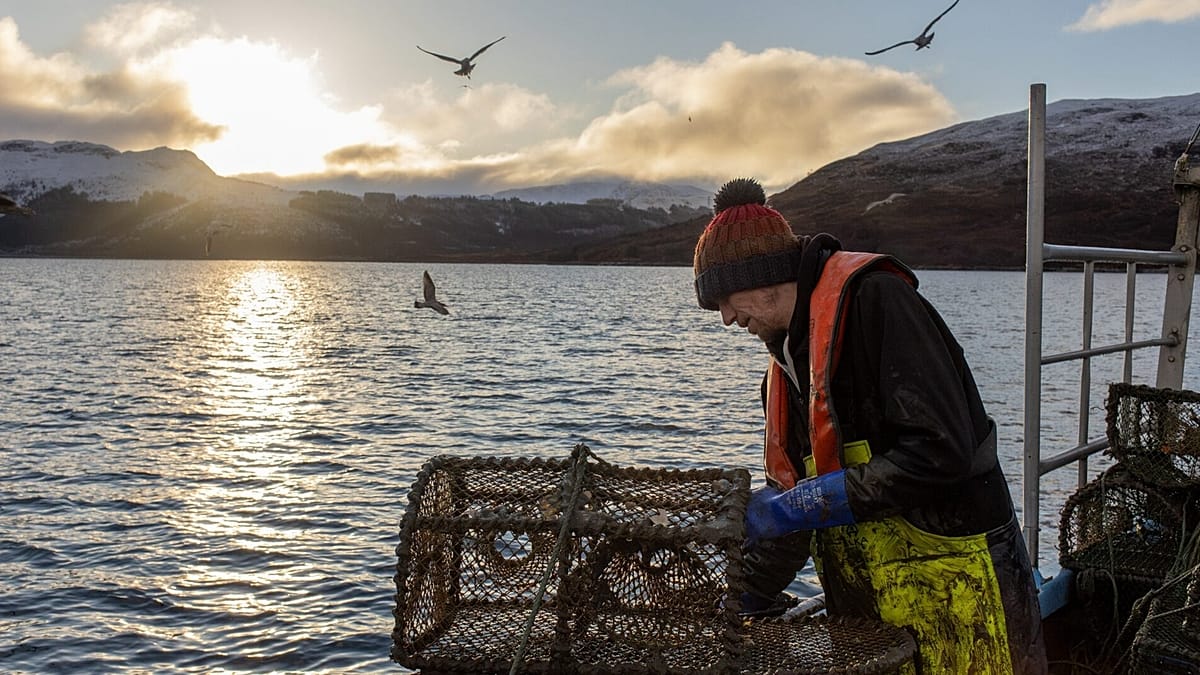
Bally Philp hauls up his baited traps from the waters off Scotland’s Isle of Skye, checking each one methodically.
Unlike most of Scotland’s coastline, these waters are protected from industrial fishing methods that have devastated seabeds elsewhere. But Philp, who’s fished for more than three decades, has watched conditions deteriorate nearly everywhere else along the coast.
“The inshore archipelagos on the West Coast of Scotland used to be full of fish,” Philp said. “We have no commercial quantities of fish left inshore at all.”
While 37 per cent of Scotland’s waters have been designated as marine protected areas, only a small fraction have management measures in place to enforce that protection, according to environmental groups.
Trawling inside protected areas is a Europe-wide problem
Bottom trawlingand scallop dredging – methods that rake the seabed – are permitted in about 95 per cent of Scotland’s coastal waters, including within designated protected areas, according to marine conservation groups.
Bottom trawls drag heavy nets across the seafloor, crushing marine habitats. The method causes extensive carbon pollution: it burns nearly three times more fuel than other fishing methods, and the nets disturb seabed sediments, releasing stored carbon into the ocean. Bottom trawlers often discard a substantial portion of their catch back into the sea, and survival rates for discarded marine life are typically very low.
The problem isn’t just in Scotland. Across Europe and globally, bottom trawling within protected areas remains common and often unregulated, with industrial vessels operating in waters officially set aside for conservation.
A 2024 report from the Marine Conservation Society and Oceana found 90 per cent of protected marine sites across seven European countries, including the Netherlands, Germany, Denmark and Spain, experienced bottom trawling between 2015 and 2023, with vessels logging 4.4 million bottom trawling hours in protected waters.
Marine protected areas without protection
In 1984, a longstanding 4.8-kilometre ban on bottom trawling around much of Scotland’s coast was repealed. Fish landings in areas such as the Clyde plummeted, with catches of many species now only a tiny fraction of their historical levels.
Philp began his fishing career working on trawlers in the late 1980s. By then, fish had become bycatch – unwanted species caught accidentally that were often illegal to land under newly introduced quota systems. His job was to shovel them overboard, dead.
“You would see a stream of dead fish flowing off the back of the boat,” he said. “It’s a heartbreaking thing to see.”
He resolved instead to fish with baited traps – a method that causes minimal habitat damage and allows most of the unwanted catch to survive when returned to the sea.
But that choice has meant limiting himself to the shrinking number of areas where such fishing remains viable.
Across much of the UK, reefs have been heavily damaged or destroyed by scallop dredging. Loch Alsh, where Philp works, holds some of the most intact reefs remaining.
A shrinking space for low-impact fishing
Philp, who comes from three generations of fishers, says he’ll be the last in his family to make a living in this industry. He taught his two sons, now 20 and 30, how to fish, but he’s discouraged them from making it a career.
“We’re at the arse end of something that was once really good,” Philp said. “Unless we can turn that around, why would anyone want their kids to do this?”
Philp isn’t alone in struggling to sustain traditional fishing practices.
Scallop diver Alasdair Hughson spends four days a week at sea, traveling far from home in Dingwall and his two children, because nearby coastal areas have been too degraded to support his work, he said.
“If there was no need to increase the size of vessels and move about and become more nomadic, we would have just stayed the way we were, because why wouldn’t you?” he said.
By the time he started diving, stocks had declined. “It wasn’t regenerating because scallop dredging had altered the habitat to such an extent.”
The costs extend far beyond fishing
A 2023 Marine Conservation Society analysis found that banning bottom trawling in UK offshore protected areas could deliver a net benefit of up to €4 billion over 20 years, accounting for increased carbon storage, pollution removal, nutrient cycling and recreation opportunities.
Marine biologist Caitlin Turner said the habitat destruction creates cascading effects throughout the ecosystem.
“If you degrade the habitat, then there’s less places for juvenile fish to live and spawn in,” she said. “This affects the abundance of the animals in the area. It trickles upward – you’ll have less of the bigger animals that feed on the prey animals.”
The damage could affect Scotland’s tourism industry, Turner said. Visitors to destinations like the Isle of Skye typically find fish and chips on menus that are imported. More than 80 per cent of seafood eaten in the UK in 2019 was fished or farmed outside UK waters, according to the World Wildlife Fund.
“There is a huge demand from tourists, and it is difficult to meet these demands,” said Miles Craven, executive chef at Wickman Hotels on the Isle of Skye. “I have noticed it get incrementally harder in the last eight years.”
Why protections are still not in place
The Scottish government had indicated it would launch a consultation on fisheries management measures for coastal protected areas in late 2025, but in December officials announced the consultation would be delayed at least six months.
Scientists and community groups are already in the field designing restoration approaches, including efforts to restore sea grass and oyster populations. But conservationists say this won’t be sufficient without reinstating a coastal limit that protects at least 30 per cent of Scotland’s inshore seas – part of the international target to protect 30 per cent of land and sea by 2030.
A Scottish government spokesperson said 13 per cent of inshore protected areas are currently closed to certain types of bottom trawling and scallop dredging, and additional measures are expected in the coming years that will allow Scotland to exceed the 30 per cent protection by the 2030 target.
Officials cited upcoming parliamentary elections and late delivery by external contractors for the consultation delay.
“The more aware I become about the nuances of fisheries management and the marine ecosystems that we’re working in, the more despair I feel because I know we can get it right,” Philp said.
For Philp and other small-scale fishermen, the timeline means more years of waiting for marine protected areas that were designated a decade ago and still lack enforcement.
“I know we can fix this,” he said. “I despair at the fact that we’re being so slow to fix this.”