
In early 1943 the SS locked several hundred Jewish women and girls in Auschwitz inside a sealed building without daylight: Block 10. For a long time hardly anyone knew what was done to the women in this block. Now these crimes are coming to cinemas as a feature film.
In Block 10 the gynaecologist Carl Clauberg, played by Axel Prahl, tested on behalf of SS chief Heinrich Himmler how women could be rendered infertile on a mass scale. Many victims did not survive the agonising procedures.
Alice Brauner wrote the screenplay and produced the film. As a historian she previously interviewed survivors for Steven Spielberg’s Shoah Foundation. She only learned about Block 10 late on, however, when she read Bogdan Musiał’s book “Mengeles Koffer”.
A Jewish doctor in an extreme moral situation
The film tells the story of the women in Block 10, but also of a Jewish doctor whom the SS forced to collaborate. They blackmailed him with his daughter’s life. Maximilian Samuel, a gynaecologist from Cologne played in the film by Christian Berkel, was actually supposed to bring new life into the world. Then he had to help mutilate women so that they would never be able to have children again.
The real Maximilian Samuel was a German patriot and for a long time did not want to believe that anything could happen to a respected doctor like him. In Auschwitz he then found himself in a moral conflict with no way out.
In an interview with Euronews, Brauner speaks of a “grey zone that Primo Levi identified”. She refuses to pass judgment on Samuel: “You cannot morally condemn anyone, no matter what he did, if he was a prisoner in Auschwitz.”
The film counters the doctor’s inner conflict with the strength of the women. Even in their darkest hour they draw support from one another, recite poems and sing together. The film does not invent such moments, Brauner stresses. The poem comes from the diaries of a doctor at Auschwitz, the song spread through many camps.
One character who embodies resistance is the doctor Adélaïde Hautval, played by Bibiana Beglau. The Frenchwoman was deported to Auschwitz in January 1943 as a so-called “friend of the Jews”. As a prisoner doctor she refused to help with the forced sterilisations of women. The Yad Vashem memorial later honoured her as a “Righteous Among the Nations”.
Alice Brauner’s screenplay is based on witness statements and trial records. “Every prisoner number is accurate, every person really existed,” says Brauner. Only in one abortion scene did she choose a different affected woman so as not to complicate the plot.
Block 10 reconstructed in the studio
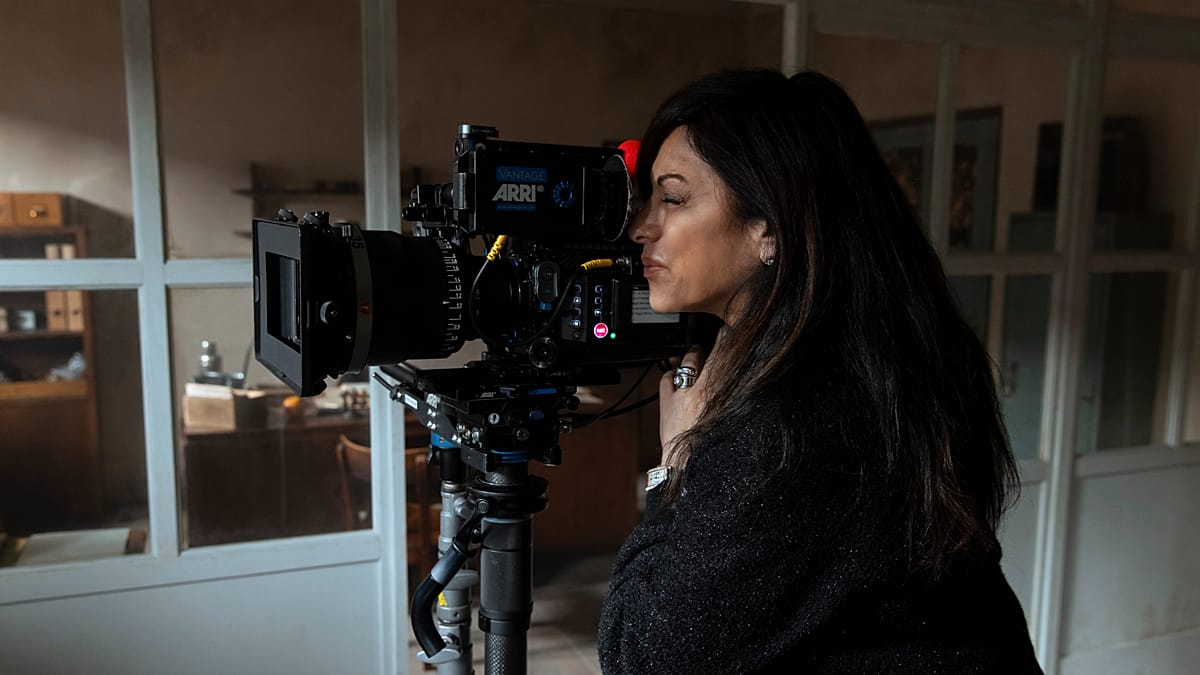
Filming began in September 2025 at the CCC film studios in Berlin. There a detailed reconstruction of Block 10 was created, with dormitory and operating rooms. The production designer based his work on 3D graphics of the original building.
The Auschwitz memorial made the new virtual reality 360-degree footage of the camp available to the team for the first time for a feature film, and the exterior shots come from this material. The arrival of the prisoners was shot at the Bochum Railway Museum with hundreds of extras.
The decision to dispense with music is no coincidence. “I do not need any additional aesthetic means of emotionalising,” says Brauner. It is only in the end credits that a Jewish prayer for the victims of the Shoah is heard.
As close to an uncomfortable reality as possible
“We did not want to work with masks,” says Brauner. Instead the actresses shaved their heads, some of them in front of a running camera. In the months beforehand director Marcus O. Rosenmüller spoke to them repeatedly about whether they would be able to bear the emotional burden.
Wherever possible the roles were cast with actresses from the victims’ countries of origin. One of them learned Ladino for the role, the language of many Sephardic Jews.
On the first day of shooting the team sat down together. “We all held hands and talked about it again. Everyone cried,” Brauner recalls. “Everyone thought they really were in Auschwitz.”
An intimacy coordinator took care of the scenes involving nudity and supported the women, “in effect also a psychologist on set”. The hardest work appears to have been for the actors playing the perpetrators.
Actor Johannes Zirner, for example, plays the SS doctor Horst Schumann, who also carried out experiments on prisoners in Auschwitz. In one scene he was supposed to beat a Jewish girl in the camp with a truncheon. At first he could not bring himself to do it. “We had to shoot the scene so many times,” says Brauner.
The dignity of the victims in focus rather than big effects
The film shows violence in a sober, unvarnished way. Naked bodies appear only in fragments from the doctors’ perspective, never in full view. “Perhaps we really did go beyond some people’s limits of what they can bear, but we always tried to preserve the dignity of the victims.” At the premiere in Munich only a few members of the audience left the auditorium, a pastoral counsellor was present. Afterwards there was prolonged applause and later the audience award at the Festival of German Film in Ludwigshafen.
Brauner also sees the film as an examination of war-time violence against women and girls. The victims were in some cases 15 to 17 years old and were, as she puts it, “dehumanised, stripped of their rights, deprived of their dignity”.
Anger after 7 October
The fact that the film became so drastic is linked for Brauner with 7 October 2023. She says the day was a profound rupture for her. As a Jew she experienced being held responsible for Israel’s policies. “All restraints have really fallen away now and everyone is letting out what they have long been thinking,” she says. “I experienced it like a tsunami crashing down on us.”
How serious the situation is can be seen from the reporting centres of the Federal Association of Research and Information Centres on Antisemitism (RIAS): they recorded around 8,700 antisemitic incidents in Germany in 2025, almost 24 per day. Between 2020 and 2022 the average was around 2,500 per year. RIAS also points out that many incidents are never reported.
Brauner’s parents, Artur and Maria, survived the Shoah and came to Germany after the war. Here, she says, they wanted to hold up a mirror to Germans, not with a wagging finger but with films.
To that end Artur Brauner founded the Berlin production company CCC 80 years ago. He died in 2019, his wife in 2017. Brauner says her parents would not have survived what has happened since 7 October 2023. She considers the culture of remembrance for which they stood to have failed. That is precisely why she wants to continue.
In cinemas from 5 November
“Block 10” opens on 5 November in selected German cinemas, with English subtitles. Together with the author Heike Gronemeier, Brauner has published a book to accompany the film in which they explore the historical background.
Brauner recommends not seeing the film alone, but with others in a cinema and then talking about it afterwards. She particularly hopes for young people as an audience. They should engage with the subject and work to ensure that something like this does not happen again. That is why she is taking the film into schools and cinemas and seeking dialogue.