
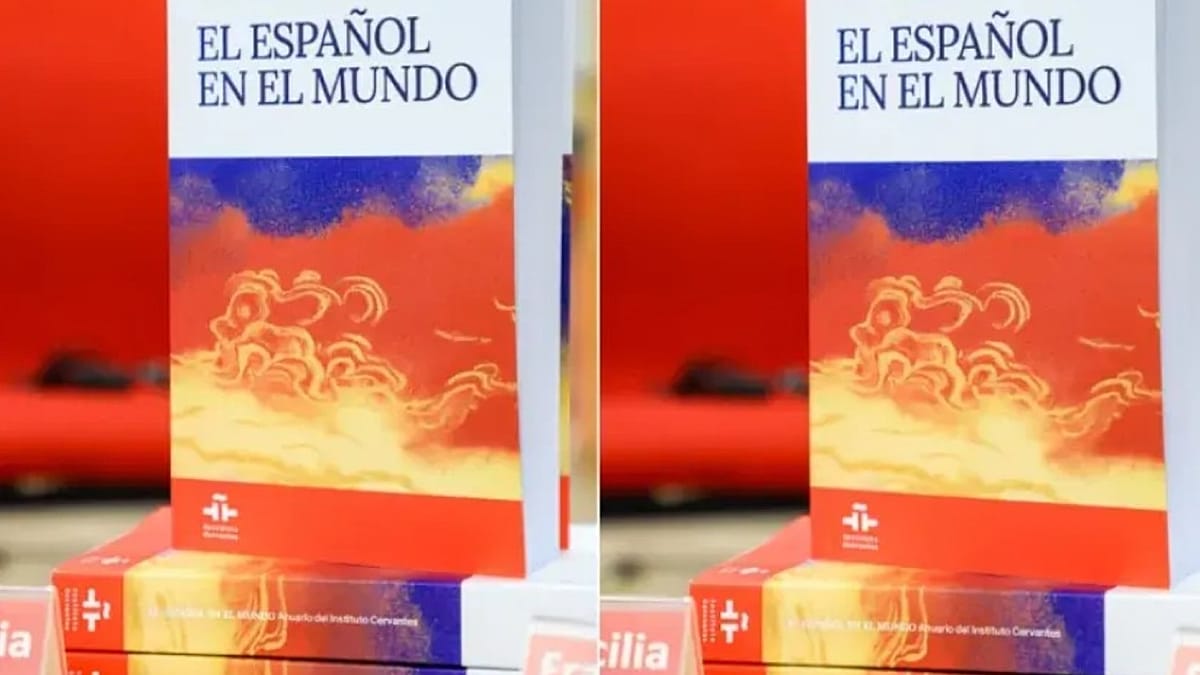
The number of children choosing to learn Spanish in China is growing at an incredible rate, according to new figures from the Cervantes Institute.
Enrolments in Philology degrees, optional subjects and Spanish as a foreign language courses have soared by 12.6% between 2023 and 2025. However, this post-pandemic surge has coincided with a shortage of staff.
In a speech in Beijing to launch the “Spanish in the World 2026” yearbook, Luis García Montero, director of the Cervantes Institute said: “Teachers tell us that demand for Spanish keeps rising in the wake of the pandemic, which is why we are prioritising teacher training: quite simply, more teachers are needed.”
The document was presented at the symposium ‘Spanish in China: Evolution and new dynamics’, organised to mark the 20th anniversary of the institution in Beijing. The second part of the yearbook pays tribute to this milestone with several analyses of the impact, evolution and reach of the language in the education system of the Asian giant.
Between the market and the humanities
China is approaching 98,000 potential Spanish speakers, a group made up of more than 18,000 native residents and some 66,000 students of the language. This boom in Spanish is reflected in data from the Global Spanish Observatory: the language is now offered in 31 Chinese cities and up to 98% of universities in the country already teach a degree in Hispanic Philology.
García Montero spoke of the “essential dialogue between China and the Spanish-speaking world”, driven decisively by Latin America, but he did not hide his misgivings about teaching that is increasingly geared towards the market. Although the language is gaining ground in business, engineering and science, he warned that philology is losing weight: “In the current dynamic of commercialisation, the humanities are in decline, and that is something that worries us.”
The map of Spanish in China counts 55,000 university graduates after “an expansion at extraordinary speed”, as explained at the event by SISU vice-dean Yang Ming. However, the professor highlighted the new demands of the business sector: the market no longer looks only for translators, but for multidisciplinary professionals able to master the language alongside law, accounting or business management.
The world’s third native language
Globally, Spanish now has 640 million users with some degree of proficiency, after growing by 1.5% in the last year, which means 10 million more Spanish speakers. The “Spanish in the World” yearbook also underlines the weight of the language in migration flows: one in ten native speakers already lives in non-Spanish-speaking countries.
In its 27th edition, the report explores the role of the language in strategic areas such as machine translation, digital media and the presence of Spanish in Europe. With more than 520 million native speakers (second only to Mandarin Chinese and Hindi) and 95 million speakers with limited skills (+3.3%), Spanish is consolidating its position among the most widely spoken languages in the world. Within the Spanish-speaking sphere, the report counts around 460 million native speakers and more than 20 million people with partial knowledge.
Without including students, Spanish has more than 137 million potential users in countries where it is not an official language. The United States leads this group with the largest pool of speakers outside the Spanish-speaking world, driven largely by its native community.
From AI to challenges in the classroom
With almost 50 million potential speakers in the EU, the yearbook also points to the fragile state of creole and contact varieties, which together do not reach one million people (0.2% of the global total).
Among the more than 24 million students of Spanish worldwide (+7% in two years), the contrast between continents is striking: while Brazil has suffered a 46% decline due to changes in legislation affecting public schools, Africa is seeing vigorous growth, driven by formal teaching in countries such as Cameroon, Ivory Coast, Benin, Morocco and Tunisia.
In the digital environment, Spanish stands out as the second language with the strongest presence on websites and has 72 million learners on Duolingo (two thirds of them English speakers). Digital reading leads in Spain (31.7%), Mexico (21%) and Argentina (20%), while audiobooks are gaining ground.
In artificial intelligence, Ibero-America accounts for 14% of global traffic for AI solutions, above its share of total internet users (11%). This growing demand, according to the yearbook, is reshaping the consumption of information and securing the language’s weight in the new era of virtual assistants.
Two decades of the Cervantes Institute in Beijing
The programme opened with a debate around the exhibition ‘Truths and Lies. The power of fiction’, with the participation of journalists, curators and renowned local artists such as Xu Bing and Zhang Peili. Several round tables focused on methods for teaching Spanish, updating textbooks and the pedagogical application of artificial intelligence.
Following the presentation of the yearbook, Inmaculada González Puy, director of the Cervantes Institute in Beijing, and Hispanist Lu Jingsheng held a discussion titled ‘Spanish in China’. The sessions were rounded off with contributions from ambassador Marta Betanzos Roig, Chinese education official Chang Fuliang and prestigious academics such as Carme Riera and Darío Villanueva.