
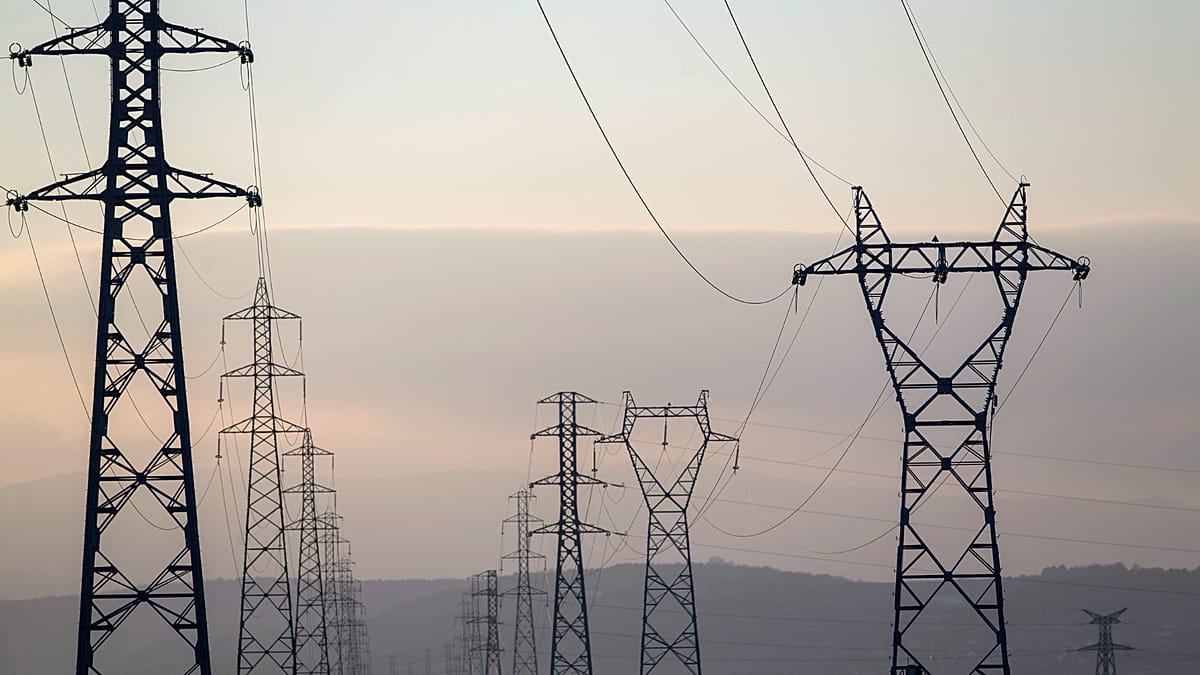
European Union governments want to weaken a proposal that would hand Brussels greater control over the bloc’s power grid, preferring to retain control of how electricity networks are paid for and managed, according to a Council document seen by Euronews.
Political talks over who will pay for the modernisation of the bloc’s power grid, a crucial step in meeting the EU’s 2050 climate neutrality goal, are underway in Brussels just as electricity moves to the centre of the bloc’s economic strategy.
The EU wants homes and businesses to switch from fossil fuels to electricity, while manufacturers, data centres, heat pumps and electric vehicles are all expected to drive up demand. But the cost of expanding and operating energy grids is increasingly showing up in electricity bills.
Grid charges and taxes combined often outweigh the price of the electricity consumed. Network charges accounted for 27% of household electricity bills and 21% for businesses, while national taxes and levies added another 24% for households and 16% for firms, according to EU data.
Europe’s rising electricity bills prompted the European Commission to propose new rules in July designed to slash energy bills amid a growing crisis triggered by the closure of the Strait of Hormuz. The Commission also introduced an electrification plan setting a 46% goal by 2040 for the Union.
The Irish Presidency — the rotating chairmanship of the Council of the European Union — is seeking to keep the Commission’s broad ambition of making electricity cheaper and easier to adopt, while also giving national governments and regulators more room to decide how the rules work in practice, the document reveals.
The Irish Presidency, which is tasked with mediating negotiations between the Commission, the Council and the European Parliament, is proposing a sweeping overhaul of network charges, requiring tariffs to encourage consumers to reduce peak demand, use electricity at different times and take account of where new connections are located.
But the latest preparatory talks held on 23 September by EU ambassadors suggest governments are reluctant to let those tools become one-size-fits-all requirements.
“The rules on the application of a reference tariff methodology for electricity shall allow regulatory authorities to deviate from the reference tariff methodology in duly justified cases,” reads a Council document dated 16 September and seen by Euronews.
Poland, Italy, Czechia, Luxembourg, Lithuania and Latvia want regulators to use tools such as cheaper off-peak electricity or incentives to locate new projects where the grid has spare capacity and only when suitable for an individual country’s power system, rather than imposing these rules across the EU.
Spain, the Netherlands, Sweden and Cyprus have raised stronger concerns about the effectiveness and possible social consequences of these tools and measures.
Francesco Sassi, Assistant Professor at the University of Oslo, told Euronews that a centralised control by the Commission could “work towards easing the isolation of the Iberian Peninsula or drive more investments in low-carbon energy interconnections in Eastern and Southeastern Europe”.
“These [countries] are showing increasing unease about ceding power to Brussels amid the second energy crisis under the presidency of Ursula Von der Leyen and repeated market shocks the European Commission appears unable to control,” said Sassi.
National flexibility versus EU coordination
For the Commission, common rules are a way of making the bloc’s fragmented power market more transparent and efficient. But EU countries are resisting anything that could force them to redesign national tariff systems that reflect very different grids, industries and consumer bases.
The clearest battleground is a provision that would allow the Commission to establish a common structure and reference methodology for electricity tariffs.
The Irish Presidency stresses that this would “harmonise the methodology” not the actual tariffs and that national regulators could depart from the reference approach where justified.
But several major EU members are still unhappy.
France, Germany, Italy, Poland, Finland, Spain and the Netherlands want the Commission’s powers significantly reduced or removed. They argue that the emerging preference is for guidelines rather than a binding approach. Ultimately, the decision will come down to how the costs of the EU’s energy transition are distributed.
“The elephant in the room that nobody wants to discuss directly, preferring to debate techno-economics applied to grid systems, grid control, interconnections, and tariffs, is that the nature of these issues is intrinsically political and geopolitical,” Sassi added.
The fight over who gets the grid first
The political stakes become even clearer when it comes to new grid connections.
The EU is facing growing queues for grid access as factories, renewable projects, data centres and other electricity-intensive investments compete for limited capacity. The proposed rules would allow EU countries to establish priorities when there is not enough room on the network.
The latest compromise would strengthen the role of member states in setting the general policy direction, leaving regulators the freedom to implement the rules.
A large group of countries — including Germany, France, Spain, Portugal, Poland, Sweden, Denmark, Finland, Belgium, Lithuania and Latvia — broadly support giving governments a stronger role.
They argue that deciding which projects get scarce grid capacity is not merely a technical exercise, it involves political choices about industrial competitiveness, energy security and social priorities. The Commission argues that setting technical criteria and network charges is fundamentally a regulatory task.
Denmark has recently announced an emergency grid law that gives data centres the lowest priority for grid connections, after Copenhagen was forced to stop new connections early in the year because of a surge in data centre applications.
Several EU countries fear that the rapid expansion of data centres, which Brussels aims to triple capacity for across the bloc by 2035 as part of a push to reduce reliance on Big Tech and develop Europe’s own AI capabilities, could strain electricity grids and drive up domestic energy prices.