
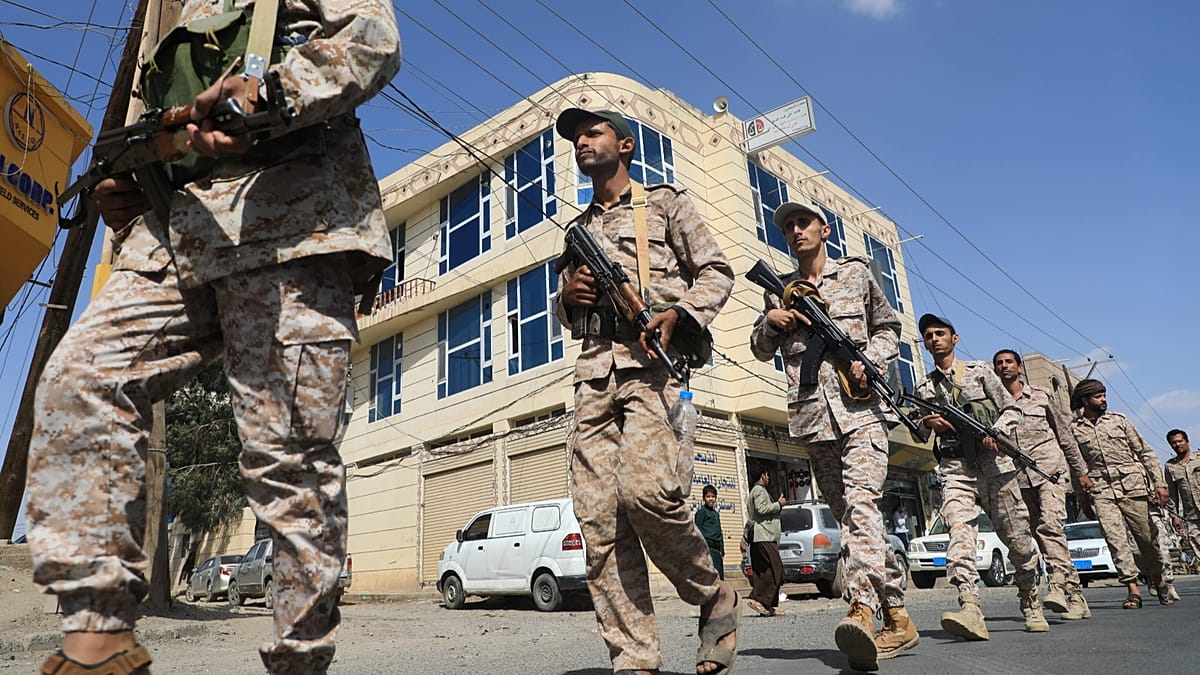
Yemen’s Houthis have assured Washington that they would not attack US vessels in the Red Sea, following reports that the US cancelled its planned strikes on the group at the last minute, a senior Houthi official said on Monday.
Mohamed al-Bukhaiti, a member of the Houthis’ political bureau, said Washington reached out to the group after their rapid advance down Yemen’s western coast to the Bab el-Mandeb strait earlier this month.
“We confirmed that we are not targeting the United States, or any other nation, in the strait, with the sole exception of the Saudi enemy,” he said. “That remains the case.”
Al-Bukhaiti said the group have the capacity to fight a war on multiple fronts “should any nation become implicated in the aggression against Yemen alongside Saudi Arabia.”
“Today, Yemen is capable of waging battle — not merely an internal conflict, but an international one as well,” he said.
He said the Houthi attacks against neighbouring Saudi Arabia will persist until Riyadh ends its decade-long blockade on Houthi-held areas in Yemen and allows vessels to reach Red Sea ports controlled by the group. Then they will be ready to negotiate, he said.
Mixed signals from Washington
Al-Bukhaiti’s comments came after US media reported that US President Donald Trump on Sunday pulled back from striking the Houthis at the last minute, just hours after deciding to target the Iran-backed group’s positions following a call with Saudi Arabia’s de facto leader Crown Prince Mohammed bin Salman.
In an earlier indication that the US was mulling joining the fighting on Riyadh’s side, Trump cut short a weekend at Camp David, a secluded presidential complex in rural Maryland, to return unexpectedly to the White House.
The White House gave no explanation for the early return or comment on the reports. Instead, the US warned on Sunday that fighting between Saudi Arabia and the Houthis could surge after a missile attack targeted Riyadh for the first time since the war in Yemen resumed.
Loud explosions rang out on Saturday in the Saudi capital and a fuel tank bearing the logo of oil giant Aramco caught on fire in an apparent strike on Riyadh airport.
“This military conflict has the potential to escalate rapidly,” the US State Department warned, adding US citizens outside the Middle East should “seriously reconsider travel to and through the region”.
Separately, the State Department restricted travel for US government employees to the Saudi cities of Taif and Yanbu, home to a major Red Sea oil export terminal that has previously been targeted by Houthi strikes.
In recent weeks, the Houthis’ lightning offensive seizing swathes of Yemeni territory has left hundreds dead and, according to the UN refugee agency, displaced more than 110,000 people.
The Houthis captured Yemen’s Red Sea coast and key islands in an apparent plot to take control of the Bab el-Mandeb, a waterway that is crucial to energy flows and global shipping which has become even more strategic since Iran imposed a blockade on the Strait of Hormuz.
The Houthis have insisted that there is no threat to navigation in the Bab el-Mandeb except for Saudi vessels.
The fighting has already disrupted exports from Saudi Arabia, the world’s leading supplier of crude oil, as well as maritime traffic.
The US has sent mixed signals to its ally Saudi Arabia since the Houthi offensive began in July. According to US media reports, Washington last week refused repeat Saudi requests to strike the Houthis.
Trump said last weekend his administration “had discussions” with the Houthis, but did not say when. “The Houthis called us, and they don’t want to fight with us,” he said. “They would much prefer not having us involved, and they’re letting most ships go through.”
‘Intercepted and destroyed’
On Sunday, US Central Intelligence Agency Director John Ratcliffe met Egyptian President Abdel Fattah al-Sisi in a rare visit to Cairo.
The visit came days after bin Salman was also in the Egyptian capital, where he and al-Sisi urged safe and secure navigation through Bab el-Mandeb.
Condemning the Houthis’ latest attacks, Turkey’s Foreign Minister Hakan Fidan told the broadcaster NTV that his country had discussions with Saudi Arabia and Pakistan, partners in a mutual defence pact, about possible assistance.
“In this regard, military needs, especially in state technical matters, may happen. There would be no problem in meeting this demand either,” he said.
The Riyadh-led coalition said on Sunday that a ballistic missile launched by the Houthis was “successfully intercepted and destroyed”.
The coalition added that the Houthis had tried to target “civilians and civilian infrastructure” in several cities in the west of the kingdom, including the port of Yanbu on the Red Sea, an important export hub for Saudi oil.
Saudi Arabia has responded with scores of airstrikes on Houthi-held areas but has failed to stop the fighters’ advance in Yemen.
Claiming responsibility for the attack, Houthi military spokesman Yahya Saree said the group’s fighters had carried out “two successful military operations using a large number of ballistic and cruise missiles and drones”.
“The first targeted sensitive sites in the Saudi capital Riyadh, and the second targeted Aramco facilities in Yanbu.”
Saudi strategy ‘under strain’
According to the International Crisis Group, for Saudi Arabia “the Houthi advance sharpens an increasingly dangerous two-strait problem, in which its ships face peril in both the Strait of Hormuz and Bab el-Mandeb.”
“Riyadh had tried to prepare for this contingency by strengthening Yemeni government forces, building multilateral deterrence arrangementsand keeping channels open with the Houthis and Iran,” the International Crisis Group said in a statement.
“All three elements of this strategy are now under strain.”
Meanwhile, tthe attack on Riyadh — the first to threaten the Saudi capital since Yemen’s war resumed — crossed “an important psychological threshold,” Senior Lecturer in Defence Studies at King’s College London Andreas Krieg said.
“Saudi Arabia can absorb intermittent attacks on remote military or energy installations more easily than repeated threats to Riyadh itself,” he said.
“Strikes around airports, fuel storage and populated areas make restraint politically and strategically much harder to sustain.”
The attack has piled further pressure on a global economy already rocked by seven months of Iran war, which began in late February with US-Israeli strikes on Tehran, triggering the Islamic Republic’s own attacks across the region.
Setting off on Sunday for New York to attend the UN General Assembly, Iran’s Foreign Minister Abbas Araghchi said Tehran had conveyed to the US through mediators its conditions for reopening the Strait of Hormuz, which it has blockaded throughout the ongoing seven-month war.
Formally known as Ansar Allah, the Houthis are tied to Tehran’s so-called Axis of Resistance — a loose network of militant groups in several countries in the region including Hezbollah in Lebanon, Hamas in Gaza and militias in Iraq, all backed, trained and equipped by the IRGC to varying degrees.