



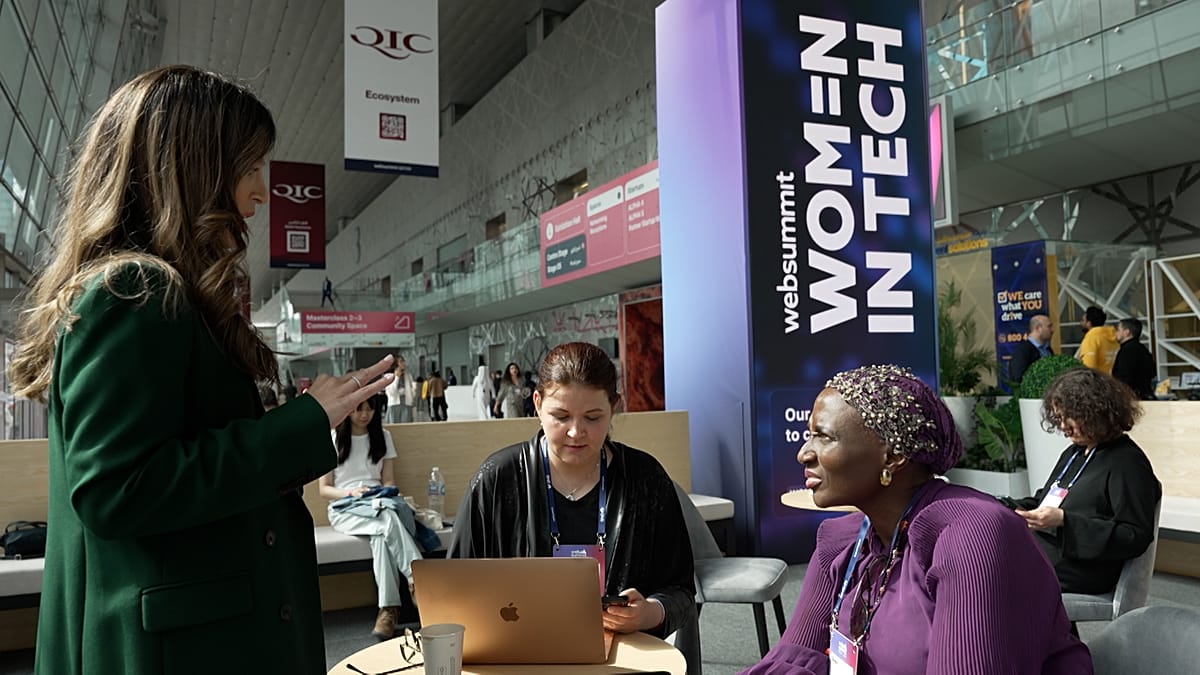
First launched in 2015 to bridge the gender gap in tech and entrepreneurship, Web Summit’s Women in Tech programme saw a 7 per cent increase in women-founded startups this year, signalling progress is underway.
Speaking to Euronews at the Women in Tech networking space, Dima Wahbeh, Deputy Country Manager of Web Summit Qatar, highlighted the biggest milestones of the programme over the 10 years.
“Globally, we’ve seen an increase in women’s participation at our events. Looking at Qatar specifically, we saw an increase in terms of female founders from 31 percent in 2024 to 38 percent this year,” Wahbeh said.
Another milestone was recorded in Lisbon in 2021, when the number of female attendees at Web Summit exceeded that of their male counterparts for the first time.
Where Conversations Turn Into Action
Discounts, mentorship and networking opportunities are the main anchors of the Women in Tech initiative, which drives women’s participation. But providing access to successful female global leaders is also another key tool.
Over the course of the week, women at the forefront of artificial intelligence, Justina Nixon-Saintil from IBM and Anie Akpe from Lumo Hubs, took to the stage, delivering speeches and insightful panel discussions.
As artificial intelligence continues to disrupt industries and transform jobs, a big topic at Web Summit Qatar was the future of work in the age of AI, a shift Nixon-Saintil believes will belong to those with access, skills and confidence to keep learning.
“Real workforce readiness is not just about access to tools,” she said. “It means having AI fluency and understanding how AI impacts your role.”
IBM’s response to this changing landscape has been to scale access to learning. Through its free IBM SkillsBuild platform, the company partners with universities, schools, and nonprofit organisations to offer AI training that leads to recognised credentials and real job pathways.
The goal, Nixon-Saintil said, is practical impact: helping people move into better-paying roles and new industries, not just teaching theory.
“Seeing students develop new AI solutions, seeing people move into new jobs because we’ve upskilled them, and knowing we’re actually changing lives,” she adds.
At the Web Summit Qatar, IBM announced a partnership with the country’s Ministry of Communications and Information Technology to launch a global request for proposals for its Impact Accelerator programme, solidifying its commitment to AI education and workforce development.
Boosting Accessibility and Lifelong Learning through AI
The Women in Tech programme is built around the idea that inclusion promotes innovation, a sentiment that resonates with Anie Apke. Since founding the African Women in Technology, Apke has been on a 10-year-long mission to ensure young African women are not left behind.
Through partnerships with companies like Cisco, the organisation offers free classes for women to upskill in fields like cybersecurity and AI.
“The key here is not to have fear of AI. The key is to jump all in. AI is not going to be a complete solution for a lot of organisations, but AI will be a tool. It will give you the opportunities that you need,” Akpe said.
Akpe hopes that her efforts will help businesswomen, even at the wet markets around Nigeria, build their own websites and expand their enterprises, even if they don’t fully understand how the technology works.
“Innovation doesn’t have to sit at a table they don’t understand. The goal would be that they’re able to utilise it the way they see fit, that they can advertise to customers anywhere in the community, and that is where the real impact starts to matter. It doesn’t solve all the problems in the world, but there’s nothing like creating opportunities to,” Akpe explained.
From Dismissed Pain to Disrupting Femtech
This year, a Qatari firm was listed among the top 10 women-founded startups at Web Summit Qatar.
Rather than a flashy idea, ScreenMe was born out of Dr Golnoush Golsharazi’s years of health struggles and being dismissed at the doctor’s office.
“That really pushed me to ask: what’s wrong in the system? Where is the gap?” she said. “We don’t have sufficient screening. We don’t have sufficient research in women’s health. We deserve better.”
ScreenMe provides at-home testing of the reproductive microbiome. Achieving the balance of bacteria plays a vital role in preventing infections, cervical cancer and fertility complications.
A molecular biologist with a PhD in gene therapy from the University of Cambridge, Dr Golsharazi explained, “The good bacteria act like a gate to your house. When that gate is broken, other bacteria can grow, increasing risks like HPV infection, miscarriages and unexplained fertility.”
While the Web Summit acknowledges a lot more needs to be done to narrow the gender gap, Dr Golsharazi is optimistic the event will continue amplifying the voices of women founders like her, “They allow women like me to stand up and say: I have something important to say and I want you to listen,” she said, adding that the rise in female founders, investors and femtech startups is only the beginning.
“This is just the start,” Dr Golsharazi said. “The region will see growth in women-led innovation and especially in women’s health.”