
A question many of us have posed in our minds is: where would you go if you had a time machine?
Would you crank the dial backwards like Marty McFly and risk sabotaging your own future? Before you start packing, a physicist has some news that may ruin a few Marvel movies: you may only be able to go one way, and it isn’t backwards.
Hongsheng Zhang, a researcher at the University of Jinan in China, has shown that in a broad class of theoretical universes, travelling into your own past is impossible.
The whole argument rests on one fact. In relativity, the direction of light can never sit at right angles to an object’s direction through time.
Imagine spacetime sliced into layers that light itself can travel along. Anything moving slower or faster than light must cross these surfaces in the same direction, like climbing a staircase that never lets you step down.
If you can only ever go up, you can never arrive back on the step where you started.
The argument needs no exotic matter, no quantum effects and no assumptions about what fills the universe. “The whole content is bookkeeping about directions,” Zhang told ScienceAlert.
The two loopholes
Physicists call journeys to the past “closed timelike curves”: routes through spacetime that loop back to the very place and moment they began. Einstein’s equations allow them in a handful of scenarios, such as near the core of a spinning black hole.
Crucially, Zhang’s research – which is awaiting peer review – also reveals exactly how a time machine could achieve travelling back in time, and it claims there are only two ways.
The first is twist. Imagine light rays that, instead of travelling side by side, spiral around one another like the strands of a rope. When that happens, the neat surfaces of light can’t form, so there is no one-dimensional staircase to keep you climbing.
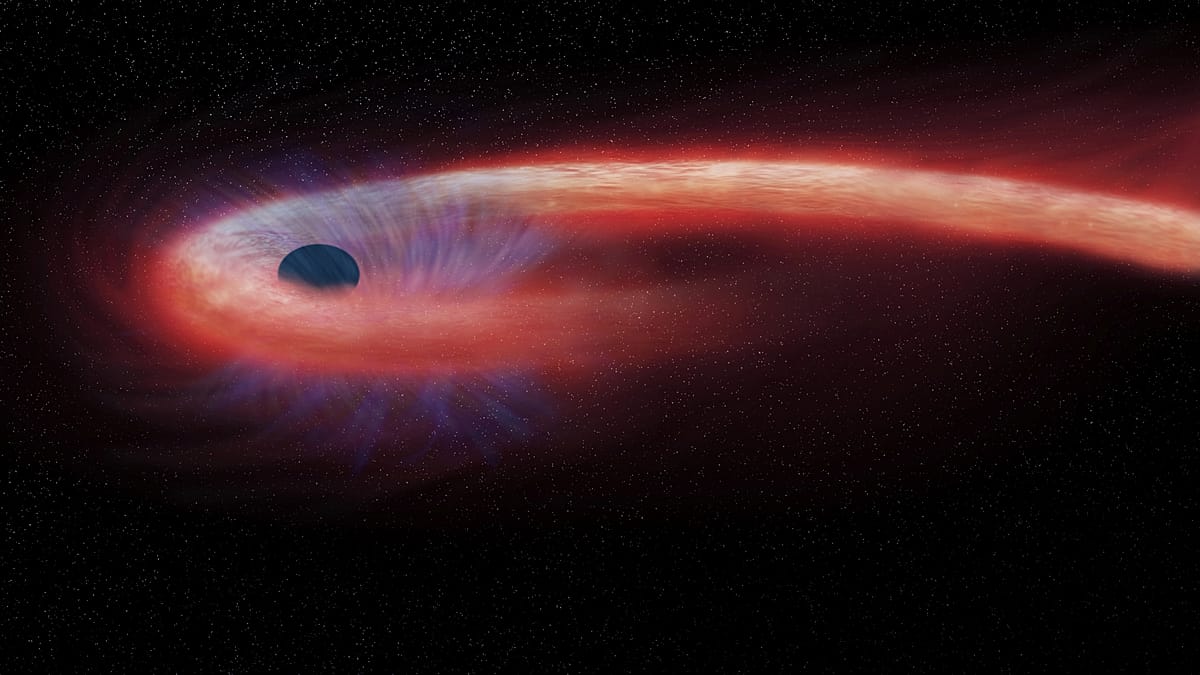
This is what happens near the centre of a spinning black hole. Einstein’s theory says a spinning mass drags space and time around with it, an effect NASA’s Gravity Probe B satellite measured around Earth in 2011. Close to the black hole’s core the drag is so strong that moving “forward in time” is bent into a circle.
A traveller following that circle would see their clock ticking forward in time as normal, yet their journey would arrive back at the moment they set off. Physicist Brandon Carter showed in 1968 that such loops exist inside spinning black holes.
The second is the shape of the universe itself. The staircase might be perfectly built, but it could lead around the sides of a building, so the top step leads straight back to the bottom, like the impossible staircases in an Escher drawing. You would keep climbing and still end up where you began. Most of the time machines physicists have designed on paper, including those built from wormholes, rely on this trick.
The theorem has its limits, as Zhang acknowledges.
“What it does not do is tell us whether nature permits any of this. That remains open, and it is the question I would most like to see answered,” Zhang explained to ScienceAlert.
Destination: tomorrow
Trips to the future, by contrast, are already well established. Einstein showed that moving very fast, or sitting in strong gravity, slows your clock relative to everyone else’s. Astronauts aboard the International Space Station return to Earth a few thousandths of a second younger than they would otherwise have been, according to the European Space Agency.
The work does not settle whether our own universe allows a journey to the past.
For now, though, anyone planning a trip may want to pack for tomorrow rather than yesterday… unless you have the Time Stone of course.