
The most closely watched speech in central banking arrives at an awkward moment for the man giving it.
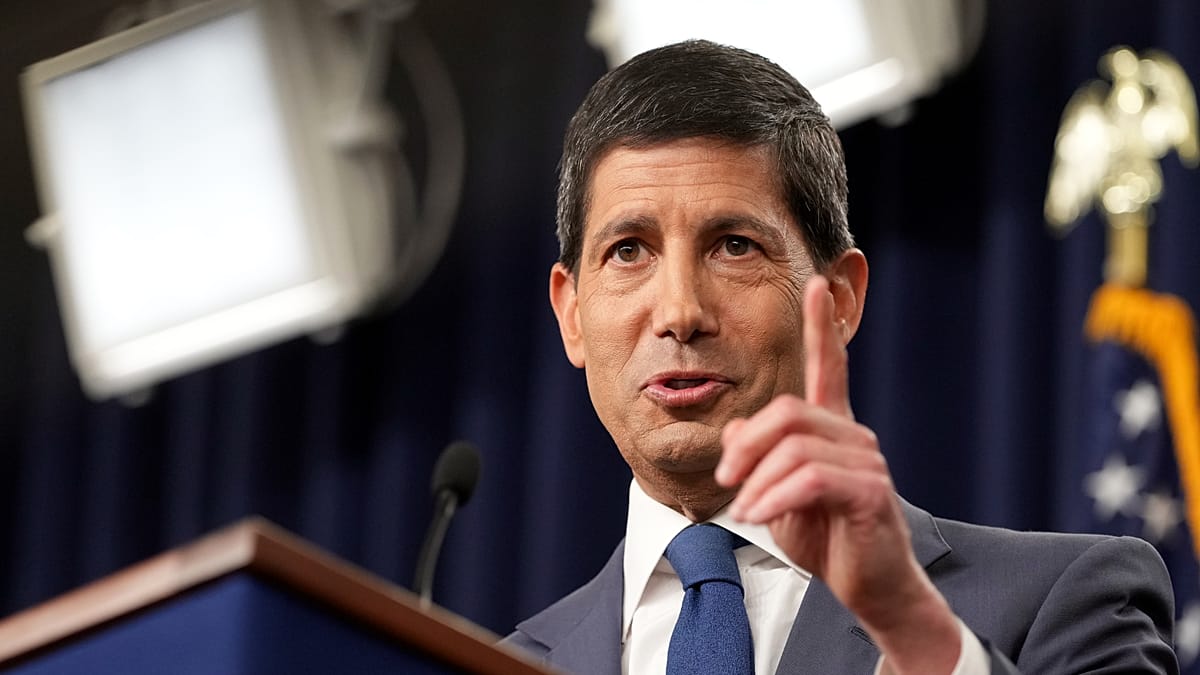
Federal Reserve Chair Kevin Warsh takes the podium in Wyoming on Friday morning with government borrowing costs high, inflation stalled well above target and US Treasury Secretary Scott Bessent already stepping into the bond market to hold yields down.
The symposium itself explains why this matters. Hosted by the Federal Reserve Bank of Kansas City since 1978 and held at Jackson Lake Lodge in Grand Teton National Park since 1982, it gathers roughly 120 central bankers, academics and policymakers from more than 70 countries for three days of papers and panels.
This year’s theme is “Financial Innovation: Implications for Payments and Policy”. Its significance is one of timing, as the event always falls between scheduled Fed meetings, making Warsh’s Friday keynote one of the few moments when policy direction can be signalled outside a formal decision.
The Fed Chair has been unambiguous about the destination.
“There is no soft inflation target,” he has said. “There’s only a target, and it’s 2%.”
What he has not offered is a route as five internal task forces are currently reviewing how the Fed operates, including one on communications, and Warsh has so far avoided the forward guidance his predecessors used freely.
Wednesday’s data gave him little cover.
The personal consumption expenditures index, the Fed’s preferred gauge, rose 0.2% in July against expectations of 0.1%, leaving the annual rate at 3.7% rather than easing to the 3.6% forecast.
Core prices rose 0.2% on the month and 3.3% over the year, both in line, but that keeps core inflation above the 2% target for a 65th consecutive month. Consumer prices rose 3.4% in the year to July.
The Federal Open Market Committee held rates at 3.50% to 3.75% in July, but three regional Fed presidents dissented in favour of a quarter-point increase, the most dissents in one direction since September 2016.
Markets have since moved the other way.
CME’s FedWatch tool puts the probability of a September hike at around 40%, down from roughly 55% a month ago. Investors are pricing less restriction than the committee’s hawks are demanding, and that gap is what Friday’s speech has to address.
The bond market is the real test
The pressure point is at the long end of the curve.
US national debt has passed $40 trillion, and yields on 10 and 30-year Treasuries have climbed sharply, pushing up borrowing costs across the economy.
That forced the US Treasury to act.
Treasury Secretary Scott Bessent announced plans to at least double buybacks of 10 to 30-year bonds, from $2 billion to $4 billion per operation, reducing the supply of long-dated paper to support prices and pull yields lower.
The market was unconvinced as yields subsequently rose back above where they stood before the announcement which prompted Bessent to immediately state publicly that the US Treasury is ready to intervene with much higher amounts, which he purposely left undefined.
That creates an unusual tension as the US Treasury is intervening to suppress long-term yields at precisely the moment the Fed chair appears content to let market forces do the tightening work.
The debasement trade
When investors suspect a government cannot manage its debts without allowing inflation to erode them, they buy assets that cannot be created at will. Markets call it the debasement trade, and it is having an exceptional run this month.
Gold has gained roughly 15% so far in August and, with only days of trading left, is on track for its strongest month since 1999. It traded near $4,713 an ounce on Tuesday, a three-month high.
Bitcoin is up over 25% this month, its best in around two years, pushing above $80,000.
The dollar has moved the other way, with the index measuring it against six major peers heading for a third consecutive monthly loss.
Hard assets rising, the currency falling and long-term borrowing costs stubbornly high point in the same direction. If Warsh reads market prices as information, as he has suggested he does, the message is that policy is too loose.
Europe’s stake in Wyoming
The ECB will also be represented on the ground at Jackson Hole.
Executive board member Isabel Schnabel takes part in a panel discussion at the symposium on Friday at 17:55 CET, addressing the payments and financial innovation theme rather than the immediate policy outlook.
The transatlantic timing matters more than the panel.
The ECB publishes the account of its 22 to 23 July meeting on Thursday, and its next rate decision falls on 10 September, days before the Fed’s own September meeting.
A hawkish signal from Warsh would strengthen the dollar and tighten global financial conditions, complicating the calculation in Frankfurt, where policymakers are already managing energy-driven inflation and now face food price pressure building into 2027.
Either way, Friday is no longer a routine central banking speech. It is a test of whether the Fed can persuade markets that 2% remains a genuine destination, and that it has a credible way of getting there.