
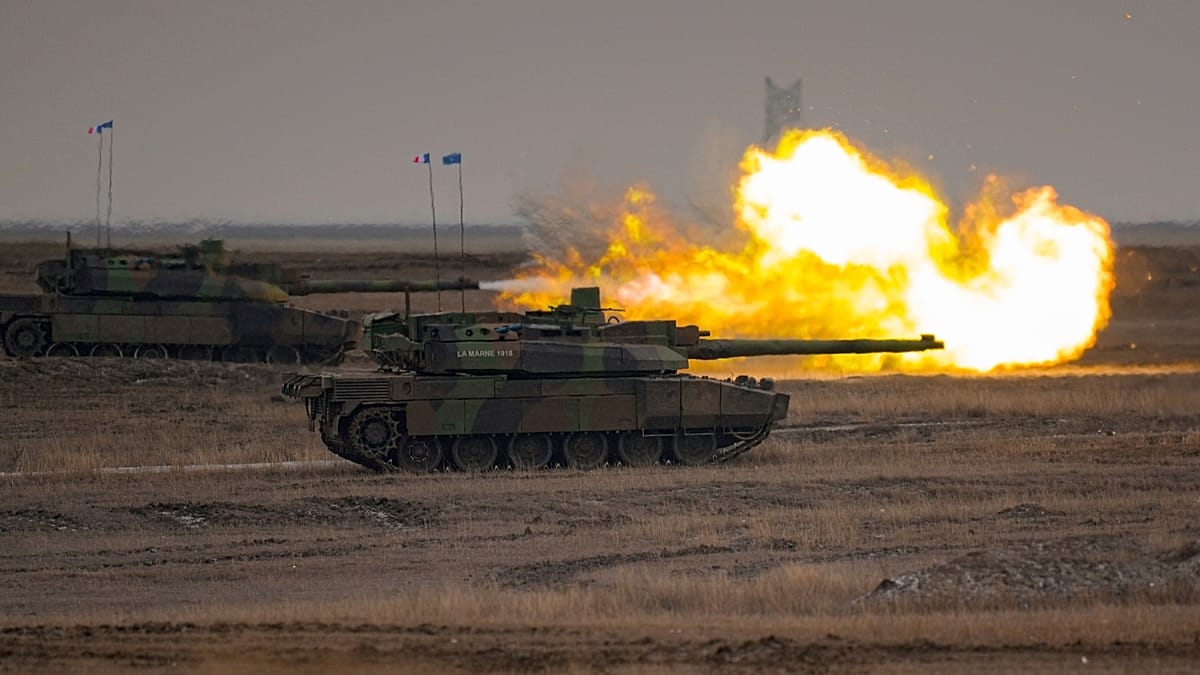
The EU risks breaching climate targets unless it shows “credible leadership” and fully discloses its militaries’ emissions.
Experts have warned that the environmental cost of conflict can no longer remain “hidden in plain sight”, as COP30 sees fossil fuel phase-out negotiations intensify.
A 2022 study by Scientists for Global Responsibility and the Conflict and Environment Observatory estimates that militaries are responsible for around 5.5 per cent of global greenhouse gas emissions, with armed conflicts emitting more CO₂ than most countries.
However, they are widely excluded from mandatory reporting under global climate agreements.
Is war driving the climate crisis?
Last year, 92 nations – almost half of the world – fought in wars. Not only does widespread warfare have a devastating impact on the livelihoods of those in conflict zones but also wreaks havoc on the environment.
Emissions are generated by fuel-guzzling jets and tanks, but also by efforts to clear and reconstruct damage following conflict.
According to The War On Climate, the Israel-Gaza war produced 32.2 million tonnes of CO₂ equivalents in just 15 months.
In three years, Russia’s invasion of Ukraine has also produced a staggering 230 million CO₂ equivalents.
“Militaries churn out massive greenhouse gas emissions, devastate ecosystems, and leave behind toxic waste that poisons communities for generations,” the organisation says. “Yet they face zero accountability.”
Europe’s military emissions
The EU leaves around 82 per cent of its military emissions unreported, and is projected to increase its defence spending by €100 billion by 2027.
Germany, for example, has recently announced it is dramatically increasing its military spending – a move which experts predict will emit 10 million tonnes of carbon.
At the same time, the country has slashed its annual budget for helping developing nations cut their greenhouse gas emissions by around €1.5 billion.
“Europe can’t claim climate leadership while its military emissions remain opaque,” says Dr Soroush Abolfathi, an associate professor at Warwick University and part of The War on Climate.
“Armed forces worldwide are thought to generate around 5.5 per cent of global emissions – yet the EU leaves about 82 per cent of its own military emissions off the books.”
Dr Abolfathi argues that the EU must close this gap as COP 30 fossil-fuel phase-out talks reach a “critical stage” to keep the Paris Agreement within reach.
Is a zero-emissions military possible?
While many EU states argue that disclosing their military emissions poses a security threat, two countries have committed to net-zero military emissions: Austria and Slovenia.
However, Dr Abolfathi tells Euronews Green that achieving this target is “very ambitious” and depends on the country’s definition and the scope.
“Does ‘zero-emission military’ mean all of the armed forces or just a subset?” he asks.
“Even in states that commit to net zero, the biggest challenges will likely be high fuel use, especially in aircraft and ships, energy-intensive equipment manufacturing, overseas operations and emissions from procurement and supply chains. Many of those are currently not well tracked or reported.”
As military emissions are voluntary to report and often not disaggregated, Dr Abolfathi argues that achieving net zero would require a very strong political, financial and technical commitment, as well as a “transformation in how defence logistics and operations are structured”.
“That said, such targets can be symbolically powerful and may drive more detailed monitoring and transparency, which is a positive step,” he adds.
Which EU states have the biggest military emissions?
Based on estimates from the Conflict and Environment Observatory, France has one of the highest military carbon footprints in the EU, while Germany also has significant military emissions.
Italy, Spain and the Netherlands also appear in analyses of military emissions. However, their reported data is more limited.
One study estimates that the entire 27 EU member states have a combined military footprint of 24.8 Mt CO₂ equivalent.
“The countries with large defence budgets, substantial high-consumption equipment (e.g. aircraft or naval vessels), and strong defence-industry sectors are the likeliest highest emitters, but because of reporting gaps, the true ranking is somewhat uncertain,” Dr Abolfathi explains.