


Lace up your boots. UK Google searches for the term “walking holiday” have increased by 60% year-on-year as more travellers discover the joys of immersive, slower travel.
And a walking holiday could be one of the most rewarding ways to experience Europe’s most popular places this autumn – both for you and the destinations you’re visiting.
Is walking the answer to overtourism?
“Overtourism isn’t just about numbers – it’s about concentration,” says walking holiday specialist and Greek resident Annie Antonatou. Her trips include the island of Santorini, Greece’s busiest cruise port outside Athens. She says walking holidays here provide a more balanced style of tourism than the cruise ships can offer.
“Rather than concentrating visitors in famous viewpoints during peak hours, walkers disperse across villages, trails and lesser-known islands.”
Walking holidays read like a how-to guide on combatting overtourism: taking the time to travel slowly, outside peak season in lesser visited areas with the help of local guides.
Antonatou explains that walkers spend more time in villages and remote areas and naturally spend money with local businesses – including accommodations, ferry companies, bakeries and tavernas. “Those small encounters are exactly what keep village economies alive,” she says.
Veriano Verde is a local guide for Exodus Adventure Travels. Born and raised near Amalfi, Italy, he leads walking tours around the Amalfi Coast, a region that hit the news earlier this year when a viral video showed local residents “trapped” in their houses as tourists squeezed shoulder-to-shoulder along narrow lanes or while queuing for ferries.
According to Verde, walking is a win-win. Local people and businesses benefit while his guests enjoy a more intimate and memorable way to experience the real Amalfi and surrounding villages.
“The beauty of staying in a small village is experiencing the true authenticity of the place and daily life like a local,” he says. “Even today, many people live 300 to 400 steps away from the main road, and in some areas, people get around almost entirely on foot.”
Here’s how to put your best foot forward to tackle overtourism in some of Europe’s most beautiful places, and have a more enjoyable trip along the way.
How to walk Europe’s hotspots – according to the experts
Amalfi Coast, Italy
Amalfi’s famous Path of the Gods is one of Veriano Verde’s favourites. “It is hard to even describe with words – you simply have to experience it, losing yourself suspended between sea and sky.”
What makes this route special, he says, is its link to traditional ways of life. He highlights the shepherds that guests meet as they walk, and the traditional buffalo mozzarella farm he takes guests to visit in Agerola, a nearby mountain town.
When in Amalfi don’t just stop at the town’s main square – the Piazza del Duomo. He encourages visitors to explore beyond the Duomo steps and get “lost in a labyrinth of stunning vistas at every turn”. From Amalfi, he also suggests you take the path to the neighbouring town of Atrani.
When to go: Verde recommends travelling during the spring (April to June) or autumn (September and October) shoulder seasons but his top tip is a winter escape, when “it is as if the entire coast were reserved just for you”. A week-long guided walking holiday with Exodus Travels in the Amalfi Coast costs from £1,469 (€1,715) per person excluding flights.
Santorini and the Cyclades, Greece
Combine Santorini’s caldera with walks on quieter neighbouring islands in the Cyclades, like Naxos, Sifnos, Milos, Andros or Tinos, says Antonatou. “Along the way you meet local people, learn about endemic plants and traditional agriculture, enjoy family-run guesthouses and eat in tavernas serving produce grown or caught locally. The experience is immersive rather than rushed.”
She recommends hiking the Santorini Caldera Trail from Fira to Oia – “one of the world’s great coastal walks” – for uninterrupted sea views. One of her favourite walks, however, is the trail to Mount Zas on Naxos – the highest peak in the Cyclades.
“It combines mythology, dramatic mountain scenery and sweeping views across the Aegean,” she says. “According to Greek mythology, Zeus spent part of his childhood here.”
She adds: “Walking holidays show travellers that the famous islands such as Santorini are only one chapter of a much bigger story.”
When to go: Antonatou recommends either end of March to early June or September to November. “Spring brings wildflowers and lush countryside, while autumn offers warm seas for swimming after the walks,” she says. Antonatou’s company, No Footprint, organises a week-long self-guided walking holiday in Santorini and Naxos available through Responsible Travel and costs from £550 (€642) per person excluding flights.
The Algarve, Portugal
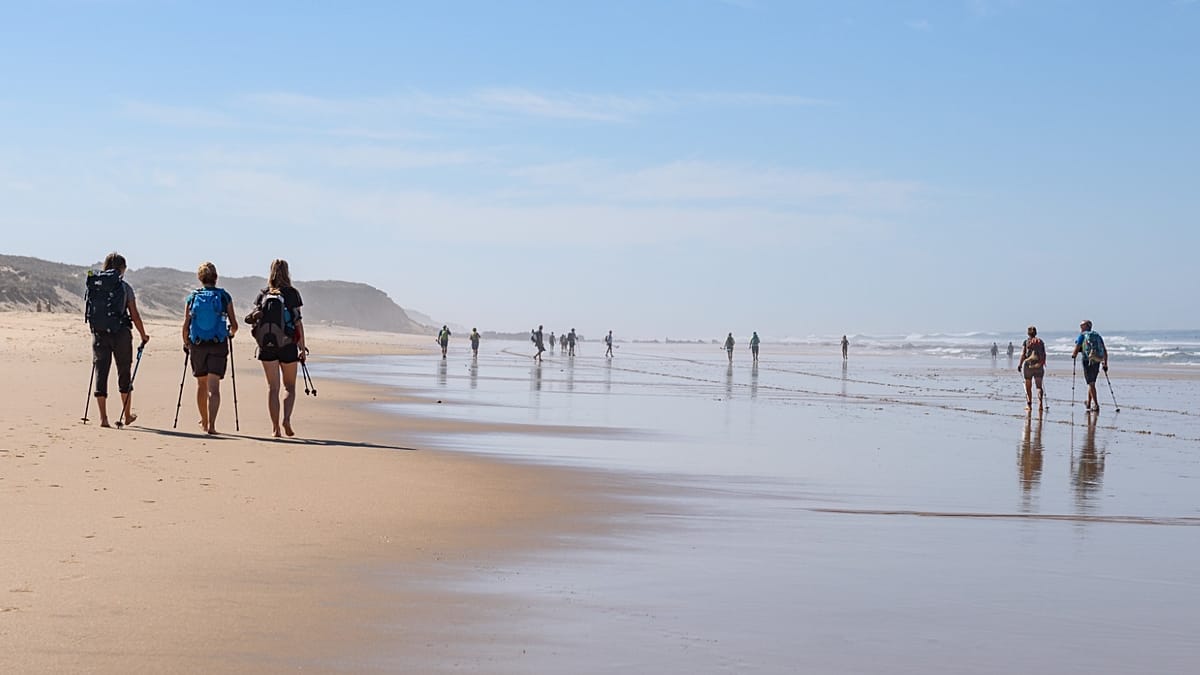
For Ricardo Estêvão, manager of Portuguese walking specialist Vincentina Travel, walking holidays open up another side to the Algarve than the resorts and busy roads the region is often associated with.
“The Algarve’s southwest coast, particularly along the Fishermen’s Trail, remains one of Europe’s last truly wild coastlines,” he says. This 78km-long path from Porto Covo to Odeceixe is part of the Rota Vincentina, a 450km network of trails crisscrossing the Algarve past some of Portugal’s most spectacular, quiet beaches.
Estêvão loves sunsets at Cabo Sardão – one of the few places in the world white storks nest on the sea cliffs. But, he says, some of the most special moments on the trail aren’t the views.
“Many travellers tell us that their favourite moments are unexpected encounters: chatting with local fishermen repairing their nets in Porto Covo, meeting small café owners who have welcomed walkers for generations, or enjoying freshly grilled fish in a family-run restaurant overlooking the Atlantic.”
He adds: “Walking routes require continuous maintenance, conservation, and visitor education. Supporting official trail organisations like Rota Vicentina and local businesses helps ensure these unique landscapes remain protected for future generations.”
When to go: Estêvão recommends March to June or September to November. He doesn’t operate walking holidays in the summer months. He says that “concentrating visitors outside the peak summer period… provides a better experience for both travellers and local communities”. A week of self-guided walking with Vincentina Travel along the Fishermen’s Trail costs from £420 (€490) per person excluding flights.
The Dalmatian Coast, Croatia
Head for the Pelješac peninsula, where you can hike through the medieval city of Ston and its surrounding vineyards. From here you can also explore Mljet Island, a national park accessible by ferry.
Walking routes range from flat loops around the saltwater lakes of Veliko Jezero and Malo Jezero, through shady pine forests with access to gorgeous swimming spots to the more moderate hike up to Montukuc Peak for wide-reaching views across the Adriatic.
In Dubrovnik, escape the cruise crowds with a hike up Mount Srđ. Trails lead out of the east of Dubrovnik’s Old Town and head uphill for spectacular views over the city.
When to go: Try September to October, when the Konavle Valley and the Pelješac Peninsula come alive with the grape harvest. If you want to walk Dubrovnik’s city walls, do it before 9am or after 4pm to escape the cruise crowds. A seven-day self-guided walking holiday with Responsible Travel, taking in Dubrovnik, Mljet Island and the Pelješac Peninsula, costs from £844 (€985) per person excluding flights.
Sarah Faith is senior values writer at walking holiday experts, Responsible Travel