
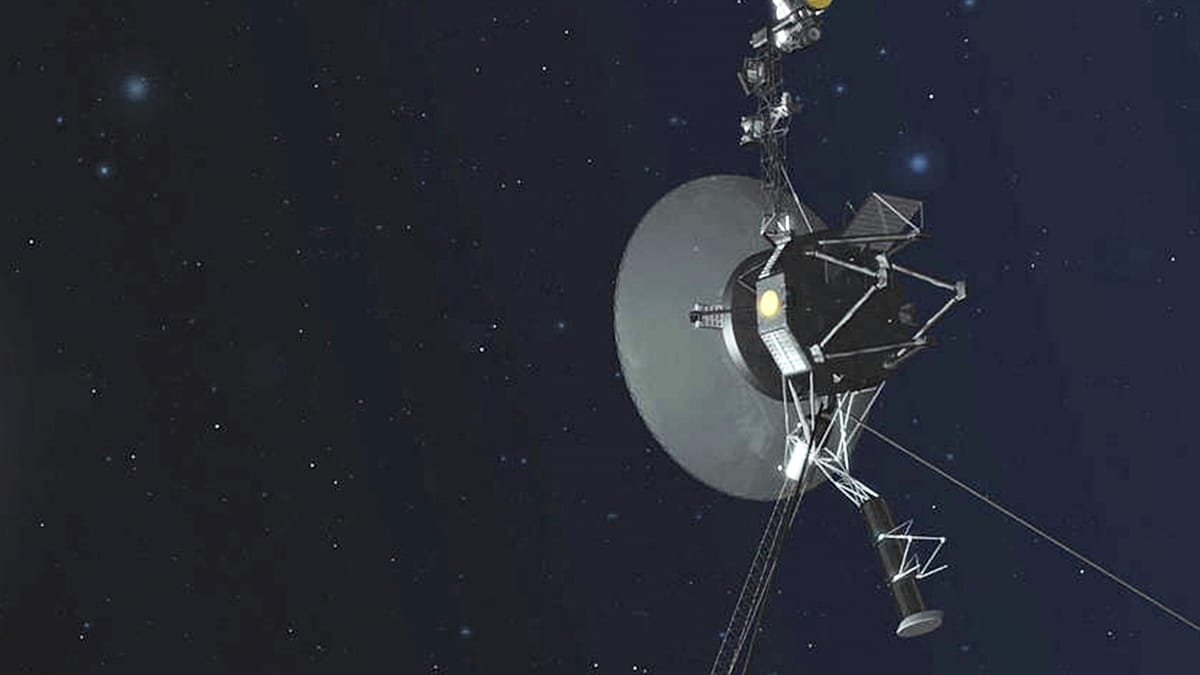
It is an adventure that perfectly embodies one of NASA’s slogans, “Making the impossible possible” (“Rendre possible l’impossible”), and a historic milestone confirmed by the space agency: at this precise moment, 11:16 CET, Voyager 1 is about 25.9 billion kilometres from Earth. No human-made object has ever travelled so far. What is even more remarkable is that this grand old lady of space exploration is still operating, nearly 50 years after leaving our planet.
A journey that began in 1977
It all started on 5 September 1977 at the Cape Canaveral Space Center in Florida. Mounted on top of a powerful Titan IIIE-Centaur rocket, Voyager 1 broke away from Earth with an ambitious mission: to explore the giant planets of the solar system. Its twin, Voyager 2, had actually set off earlier, on 20 August. But Voyager 1 followed a faster trajectory and eventually overtook it.
Today it is travelling at almost 61 000 km/h, about 17 kilometres per second. It gained this speed in particular thanks to the gravitational pull of the planets it flew past. In March 1979 it passed close to Jupiter, revealing its rings and the extraordinary volcanic activity on its moon Io. In November 1980 it flew over Saturn and carried out a close study of its spectacular rings and its moon Titan.
But instead of continuing to explore the other planets, Voyager 1 (source in French) then headed into the depths of space. In August 2012 it became the first human spacecraft to cross the heliopause, the boundary beyond which the solar wind no longer dominates the space environment. It thus entered interstellar space. Its twin Voyager 2 (source in French) joined it in 2018.
This short report from the Jet Propulsion Laboratory (source in French) is well worth a look for space enthusiasts. It dates from the time and explains the missions of the two Voyager probes. The same goes for this NASA gallery (source in French), where you can see how it was built.
A golden record for extraterrestrials
On board, Voyager 1 is carrying something far more poetic than its scientific instruments: a golden record 30 centimetres in diameter, attached to its structure. Conceived in particular by the famous astronomer Carl Sagan, this record is a kind of business card for humanity, intended for any possible extraterrestrial civilisations.
It contains 115 images (source in French), greetings in 55 languages, sounds of nature, heartbeats, whale songs, laughter and a musical selection ranging from Bach to Chuck Berry. It even includes a message from the then US president, Jimmy Carter. A concentrated sample of terrestrial civilisation dispatched into the cosmic immensity.
A journey full of obstacles
After almost half a century in space, Voyager 1 is starting to show its age. In November 2023 a computer problem prevented it from transmitting its scientific data correctly. It took engineers several months to find a solution, working remotely on a computer designed in the 1970s.
In 2024 it was the thrusters that began to show signs of weakness, as tiny pipes gradually became clogged. The team then had to switch to another system to keep its antenna pointed towards Earth.
More recently, a drop in its power output, generated by the decay of plutonium, has forced NASA to switch off certain instruments to save energy.
In April 2026 a new scientific instrument was turned off. The probe nevertheless continues to send back data thanks to the equipment that is still working.
What will happen to it in the coming decades, and then the coming centuries?
Voyager 1 has no more planets to visit and now continues its journey through interstellar space. (source in French) Its trajectory will take it towards the Oort Cloud, the vast reservoir of comets surrounding our solar system. But it will take about 300 years to reach the inner part of the cloud, and perhaps 30 000 years to leave it completely, if it does not by chance collide with one of the comets.
In around 40 000 years the probe will pass at about 1.7 light-years from the star Gliese 445, a red dwarf in the constellation Camelopardalis. A very relative encounter on a cosmic scale, as it is not expected to come close enough to be captured by that system.
Long before that, Voyager 1 will probably have stopped communicating with Earth. Its energy reserves will eventually be too low to power its instruments and its radio transmitter.
But the probe will continue its journey. It could drift through the galaxy for millions or even billions of years. Its golden record may remain intact long after every trace of our civilisation and our solar system has disappeared.
There is a little of 2001: A Space Odyssey in this story, a hint of Star Trek and a great deal of human genius. Voyager 1 will probably never have an audience to applaud its achievement, nor any little green man to retrieve its golden record. Yet it continues on its way, silent, where none of our kind has ever gone. And that alone commands admiration.