
Uzbekistan is preparing to launch its first domestically developed scientific satellite while also outlining plans to send its first national astronaut into orbit.
Both initiatives remain at an early stage, but together they mark a structured attempt to build technical capacity, secure independent data and gradually enter the global space sector.
Officials in Tashkent present the programme primarily as an economic and institutional project, as demand for remote sensing data has tripled over the past five years. More than ten government agencies and all regional administrations now use satellite monitoring in sectors such as agriculture, natural resource management and regional planning.
“The most important thing is that through space data, we are identifying economic opportunities that cannot be seen with the naked eye and turning them into real sources of income. This shows that the mechanisms and culture of managing state resources are changing,” said Uzbekistan’s President Shavkat Mirziyoyev, at a recent high-level meeting.
A CubeSat as a starting point
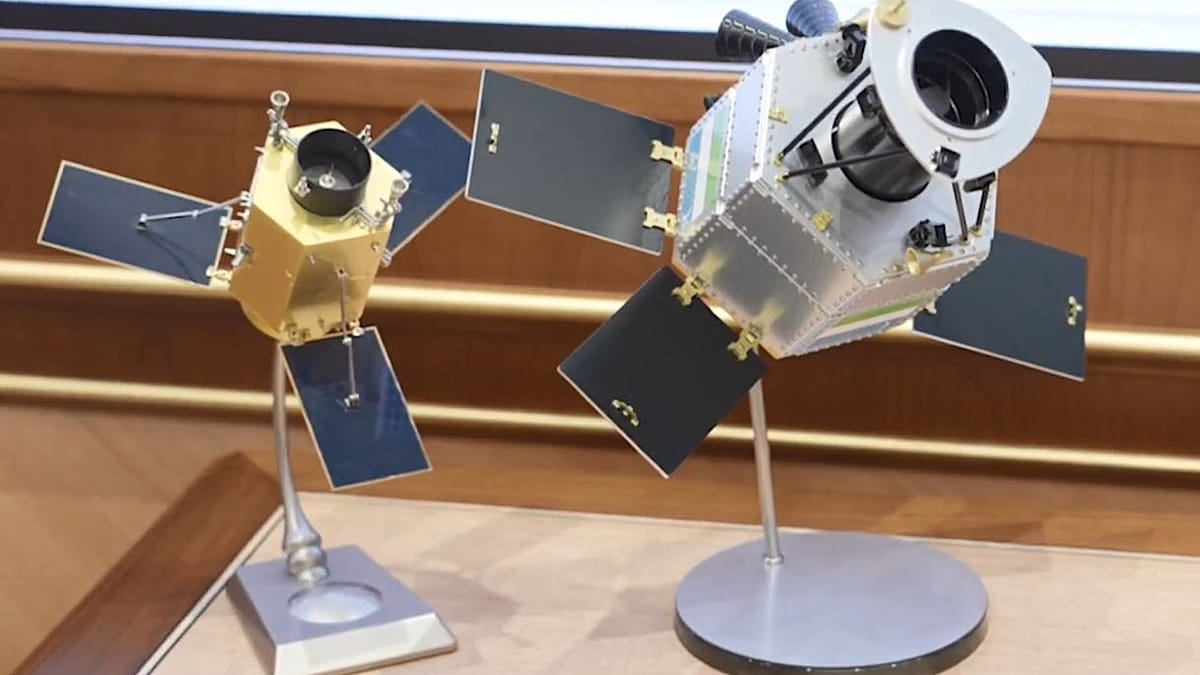
Uzbekistan confirmed plans to launch a 6U CubeSat named “Mirzo Ulugbek” in 2028.
A 6U CubeSat is a small, modular satellite built according to the CubeSat standard, where “U” stands for “unit”.
In practical terms, a 6U CubeSat usually measures about 10 × 20 × 30 centimetres, depending on configuration, and weighs under 12 kilograms.
A 6U CubeSat is suitable for serious Earth observation, technology demonstration missions, communications testing or scientific experiments, while remaining far cheaper and faster to build than traditional large satellites.
For a country without prior satellite manufacturing experience, the project is designed as a capacity-building step rather than a large-scale operational mission.
The satellite is expected to strengthen Uzbekistan’s national Earth observation database, supporting agriculture, forestry and environmental monitoring. Technical requirements for precision and payload have already been defined following a review of international experience.
Muhiddin Ibragimov, Deputy Director of the Uzcosmos Agency, said the focus is on building sustainable expertise.
“We were very much interested in building capacity in satellite and space-related technologies,” he said.
“We studied the experience of different countries and found that for emerging nations like Uzbekistan, this is a suitable path requiring relatively moderate investment.”
Training the first generation
Some seven Uzbek master’s students have been selected to design and prepare the satellite. They are currently studying at Japan’s Kyushu Institute of Technology, combining theoretical instruction with practical training.
“The programme includes both theoretical and practical components, allowing these young specialists to fully understand how satellite technologies work,” Ibragimov added.
The Institute has already launched more than 30 CubeSats.
“A few weeks ago, we deployed another 3U CubeSat called ‘Leopard’. It was an incredible experience to witness its deployment live. We are gaining hands-on experience in real space technology”, said one of the students, Muhammadsolih Adhamjonov
“My task is to maintain the communication link between the satellite and the ground station. I am learning directly from experienced engineers, which is extremely valuable”, he explained.
Burkhan Uvraimov, responsible for the camera payload, said that their training has started by “focusing more on the theoretical phase. The hardware stage will come later. This is a very valuable experience that will help us in the future.”
Asilbek Shukurov, working on the Attitude Determination and Control System, added: “This means we control the satellite’s orientation and movement. We read telemetry data and navigate the satellite based on commands programmed into the system.”
A first astronaut in preparation
Alongside satellite development, President Mirziyoyev has identified the training of Uzbekistan’s first national astronaut as a strategic priority. The proposal foresees a short-duration orbital mission of 10 to 14 days in cooperation with international partners.
“This achievement will not only strengthen the country’s international image but also contribute to scientific development, new technological initiatives and increased interest among young people in science and technology,” the President said.
Potential research areas include medicine and biology, plant genetics and materials science.
In 2028, Samarkand will also host the International Astronautical Congress (IAC), the world’s largest space industry gathering. Leading space agencies from the United States, Europe, China, India, Russia and other countries have expressed interest in participating.