

Published on
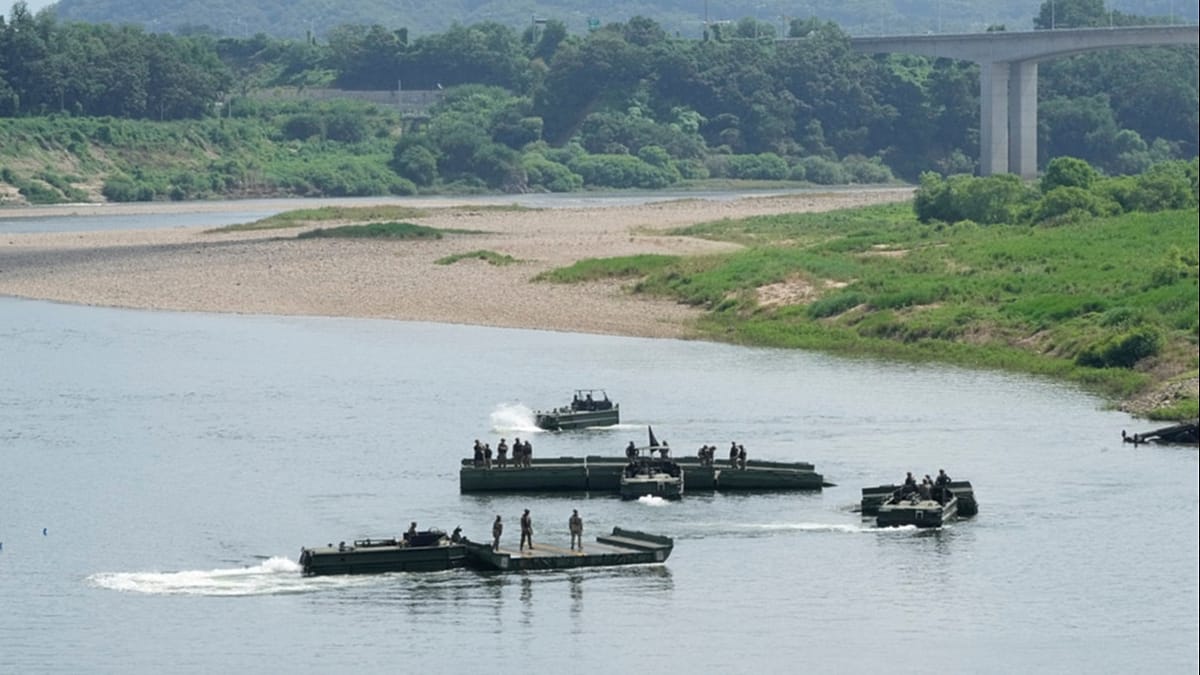
The South Korean and US militaries have agreed to shorten their drills at the Washington’s request, according to officialss in Seoul, a move that likely reflected President Donald Trump’s hopes to reengage with North Korean leader Kim Jong Un but could undermine US-South Korean defence readiness.
Earlier in the week, Trump had ordered his Pentagon chief to “substantially reduce” the allies’ summertime Ulchi Freedom Shield exercises, just before they began on Monday.
Trump cited what he said was a “very good relationship” with Kim and South Korea’s refusal to join the US war against Iran as the primary reasons behind his decision to pull back from the drills he viewed as “totally inappropriate and hostile” to Pyongyang.
South Korea’s military said in a statement the ongoing drills with the US would end on Friday, instead of 27 August as initially planned. It said the allies also agreed to downsize some joint field training exercises.
The statement said Seoul and Washington will discuss and carry out various steps to achieve objectives of their drills and establish combined defence postures.
Ulchi Freedom Shield is largely a computer-simulated command post exercise meant to boost the allies’ readiness to deal with potential North Korean aggression. The two countries usually hold a set of training directly addressing diverse threats within the security environment.
The drills and a similar springtime exercise are a central pillar of the alliance, which dates back dates since the 1950-53 Korean War.
But it’s also a long-running source of tensions with North Korea, which has denounced the exercises as a rehearsal for an invasion and responded with provocative missile tests. Days before this month’s drills began, North Korea launched two ballistic missiles into the sea.
This month’s drills were reportedly supposed to be held in two phases — the first part until this Friday with a focus on defensive operations in simulation of North Korean attacks and the second part until 27 August to practice counteroffensive operations. Pyongyang is typically extremely sensitive to counteroffensive drills.
Kim Jong Un hasn’t responded to Trump’s overture, but earlier on Wednesday, the country’s state news agency, KCNA, published a commentary slamming the military drills as “frantic” and “extremely dangerous”, vowing to completely frustrate its rivals’ hostilities.
“The dangerous escalation of the war drills staged by the US and its vassal forces is posing a more serious threat to the security rights of North Korea,” the commentary said.
“Our exercise of its right to self-defence will continue to completely neutralise the enemies’ military threat.”
Many experts said Kim, now emboldened by his advancing nuclear programme and expanding military cooperation with Russia, won’t likely embrace Trump’s overture anytime soon unless he’s promised bigger concessions.
In response to Trump’s previous outreach, Kim suggested last year that he can return to talks only after the US drops its demand of a North Korean denuclearisation as a precondition for diplomacy.
Trump and Kim met three times from 2018-2019 but their high-stakes diplomacy eventually fell apart over wrangling over a North Korean demand for extensive sanctions relief in return for limited denuclearisation steps.
On Monday, South Korea’s President Lee Jae Myung’s office expressed hopes that a “friendly relationship” between Trump and Kim would lead to “meaningful dialogue” between their countries to promote peace on the Korean Peninsula.
This drew a strong backlash from conservatives, who alleged Lee’s government was prioritising the resumption of Kim-Trump diplomacy over security concerns caused by Trump’s move.
Additional sources • AP