
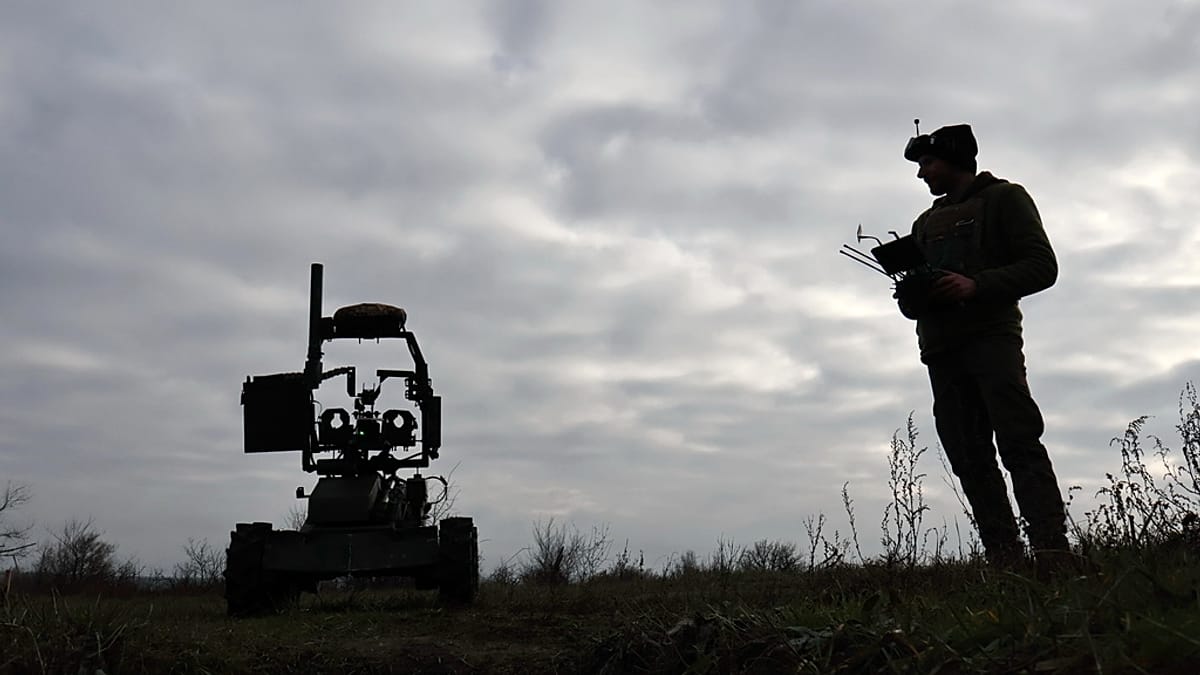
In the garrison town of Riihimäki in Finland, a small place with fewer than 30,000 inhabitants, the Defence Innovation Network Finland (DEFINE) is showcasing drone technology from 17 different companies already in use or soon to be deployed on the battlefield in Ukraine.
Jan-Erik Saarinen, founder of Double Tap investments, has just returned from a six-week stint on the frontline in Kherson with the Ukrainian armed forces. His technologies are having an active impact on how soldiers engage against the invading Russian army.
He explained to Euronews drones and unmanned vehicles are the most important tools to keep Ukraine defending its territory given the scale of the manpower ratio of Russian to Ukrainian men.
That disparity is compounded by the “meatgrinder” tactics deployed by the Russian army, which sends thousands of poorly trained soldiers to the front in order to detect Ukraine’s firing line with no care for how many come back. The loss of Russian soldiers thus averages around 1,200 per day, and some days as many as 2,000.
“We were testing some technologies there, with the very innovative teams in the battalions on the east of Ukraine,” Saarinen told Euronews in Riihimäki. “We have acoustic sensors out there that alarm the drones, we have counter tactics, countermeasures that directly target the Russians.”
His smaller hand-held kamikaze drones have technology which can clear a trench, much like a hand grenade or artillery shell but from a far greater distance – and soldiers can carry several at a time for greater effect with far less risk.
“Since (the Russian army) have more men, we need to clear trenches without losing our men”, he explained. “Think of it like a hand grenade, but it can go 500 metres; several soldiers can throw the small drones ahead. It’s far more effective.”
“These drones are small enough so you have two or three in a backpack, but once we develop the technology to make them even smaller, soldiers will be able to carry even more.”
In addition, Double Tap is also developing kamikaze drones for operating on rivers, as well as detecting and destroying landmines.
According to the UN, Russia has laid millions of mines across Ukraine since the full-scale invasion in 2022, making it “the most dangerous place for unexploded weapons today.”
“This will be a huge thing for the future”, said Saarinen. “We need to provide them with better technology – and remember, the enemy is good as well. You know, their technology is good, and when they find something that works, they ramp it up really fast.”
‘It’s a very smart enemy’
Oleksandr Voitko, a Ukrainian soldier on two weeks leave from the frontline in Kherson, said modern technology is “highly critical because we don’t have much of our infantry now”.
“We rely mostly on drones now”, he said. “We use all types of drones. Small kamikaze FPV (First-Person View) drone bombers, ISR (Intelligence, Surveillance, and Reconnaissance) drones and middle strike kamikazes – all types of drones”.
But he also warned that the enemy is evolving with just as much determination.
“Russians are learning all the time too. They improved their drones too. So, it’s not a dumb enemy, it’s a very smart enemy,” he told Euronews.
Voitko, who currently serves as Deputy Commander of the 413th Unmanned Systems Forces Regiment, first volunteered for the army in the east of Ukraine after Russia’s initial invasion in 2014.
He conceded it will be difficult for Ukraine to recapture the territory taken by Russia, but at least with drone technology to hand, Ukraine’s position in any negotiations will be strengthened.
“At least we can kill so many Russians so Russia will agree to peace talks,” he said. “Modern war is a war of drones now, and I think soon there’ll be flying drones with a ground robotic system. Maybe we will see some (humanoid) robots with rifles in several years.”
Defending Europe
On NATO’s eastern flank, frontline states such as the Baltics and Poland have seen a high volume of drones and weather balloons violating European airspace in recent months.
From October to November, Lithuania’s airspace was restricted for one-quarter of the working days at Vilnius and Kaunas airports at peak hours, according to the country’s defence ministry.
And on 9 December, Lithuania declared a “nationwide emergency situation” following months of provocations from weather balloons carrying pallets of cigarettes coming from Belarus.
“Already in eastern countries, we see a danger of drones or balloons coming from Russia from Belarus,” Gediminus Guoba, CEO of Lithuanian drone tech company Granta Autonomy, told Euronews.
He said that plans to establish a so-called “drone wall” comprised of various systems from interceptors to “destroyers” will be a useful development for defending European airspace, though he also warned of the potential damage caused by shooting drones down, which could pose a threat to civilians and civilian infrastructure.
“We imagine (the) drone wall as a system of systems which could protect us from hostile drones and other measures,” he said. “Because balloons, currently at least in Lithuania from where I came, are the biggest threat these days.”
“The simplest way of course is just to penetrate, destroy the balloon and shut it down in that way. But at the same time it’s really dangerous, because they bring 40-50 kilogram boxes and they fly at 8 kilometre or even higher altitudes.”
“If you destroy the balloon, it means a 40 kilogram box falling down from 8 kilometres’ altitude. It can create really huge damage.”
The solution to these latest version of hybrid threats is only at its inception given European defence forces are constantly responding to threats as opposed to anticipating what may lie ahead.
Guoba said that Europe needs to learn how to use drones as countermeasures, and fast.
“It’s a new challenge for everyone.”