
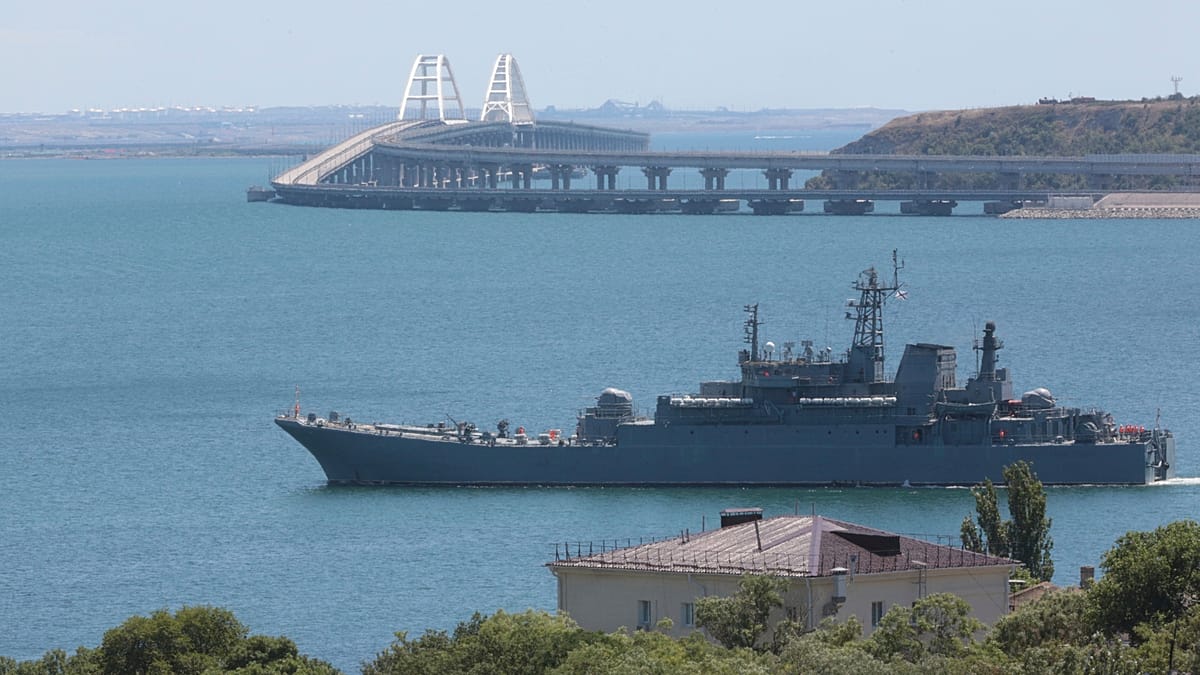
Russia’s initial invasion of Ukraine, launched 12 years ago, started with the annexation of Crimea, a strategically important peninsula in southern Ukraine jutting into the Black Sea.
Since then, Ukraine repeatedly said that for Kyiv the war will not be considered fully over until Crimea is liberated and restored to Ukrainian sovereignty and returned to its indigenous Crimean Tatar community.
For Moscow, Crimea is the most prized trophy of its invasion and the war against Ukraine, and is the territory Russia is likely to relinquish last if at all.
But with Ukraine’s strengthened intensity and efficiency of drone strike campaign, Kyiv is now trying to cut Crimea off from Russian control and make life for Russian invaders on the peninsula as impossible as it can be.
Since the early days of the full-scale invasion Russia launched in February 2022, Ukraine has repeatedly fired missiles and drones to try to dislodge Moscow’s hold on the territory.
The Ukrainian military sank several Russian warships in the Black Sea and at their Crimean bases, crippling Moscow’s naval capability and forcing it to redeploy its fleet to Novorossiysk.
Ukraine has also methodically targeted munitions depots, airfields and Putin’s prized asset, the Kerch bridge — the only link between annexed Crimea and Russia.
The span was struck in October 2022 by a truck bomb, killing five people, blowing up two sections of the bridge and resulting in months of repairs. More attacks on the bridge followed in 2023 and 2025.
Now Kyiv is targeting Russia’s ability to sustain its forces in Crimea, making military operations and Moscow’s presence on the peninsula progressively untenable
Cutting ground line of communication
Crimea’s geographic position is both strategically important and unusually complex, sitting between mainland Ukraine, Russia and the wider Black Sea region.
In the north, Crimea is tied to Moscow‑occupied southern Ukraine by a narrow land corridor across the Perekop isthmus and a web of roads and rail lines running through the parts of Kherson region that have been under occupation since 2022.
Moscow is using these ground lines of communication to move troops, ammunition and fuel to the peninsula.
This is the area that Kyiv has been systematically targeting to disrupt those flows.
On Thursday, Ukraine confirmed a strike that destroyed 50 military cargo vehicles carrying fuel and ammunition on the Russian-occupied Armiansk bridge linking Crimea with mainland Ukraine.
Ukrainian military command stated that Kyiv forces were able to strike this concentration of vehicles at least in part due to the previous Ukrainian strikes against Mariupol and the road to Berdyansk – cities under Russian occupation on the coast of the Sea of Azov.
Moscow-installed head of occupied Kherson region Vladimir Saldo confirmed more hits, saying that Ukrainian forces struck several bridges connecting the occupied Kherson region and Crimea: a bridge over the North Crimean Canal near occupied Preobrazhenka and Myrne, the Perekop-Armyansk Road Bridge and the Stavky Road Bridge.
These bridges run over the North Crimean Canal and along the M-17 Armyansk-Oleshky highway.
The US-based Institute for the Study of War think tank (ISW) confirmed that Ukrainian forces are increasing their mid-range strike campaign against Russian ground lines of communication across occupied southern Ukraine.
The ISW says Kyiv is disrupting Russia’s ability to safely use supply routes from southwestern Russia to occupied Crimea.
“Continued Ukrainian strikes against Russian GLOCs will likely have cascading battlefield effects and may complicate Russian preparations for offensive operations.”
Fuel crisis worsens
Russia provides its forces in Crimea with petrol, diesel and aviation fuel through three main channels: road and rail tankers over the Kerch Bridge from Russia, shipments by sea, and overland routes running through occupied parts of southern Ukraine.
As Ukraine increasingly targets these links with drones and precision strikes, Kyiv forces have triggered the worst fuel crisis on the Black Sea peninsula since it was illegally annexed by Russia in 2014.
In a rare public acknowledgement, the Kremlin has recognised the scope of the problem.
Moscow-installed Crimean occupation authorities have been increasingly tightening restrictions on gasoline purchases in recent weeks.
Sevastopol occupation so-called governor Mikhail Razvozhaev stated on Wednesday that the Sevastopol occupation administration was unable to issue a new batch of QR codes for fuel purchases because fuel trucks were unable to reach Sevastopol on Tuesday for “unspecified reasons.”
Razvozhaev introduced a policy on 6 June requiring customers to use a pre-purchased QR code, which citizens can only access via the Russian state-controlled Max messenger app, to purchase gasoline in occupied Sevastopol.
Occupation authorities have also tightened restrictions to 20 litres per week, down from the previous 20 litres per day, as shortages continue to worsen.
Ukraine aims to isolate Crimea from Russia, drone commander says
Commander of Ukraine’s Unmanned Systems Forces Robert Brovdi said Ukraine’s aim is to isolate occupied Crimea from Russia by disrupting key military supply routes to the peninsula.
Brovdi, known by the call sign “Madyar,” said Russian military cargo traffic along the R-280 “Novorossiya” highway, which connects Russia with occupied Crimea through occupied Mariupol, Berdiansk, and Melitopol on the coast of the Sea of Azov, has fallen by 71% over the past two weeks due to Ukrainian strikes.
“Within another month, we will have total control over the road,” Brovdi said.
He explained that Ukraine’s broader objective is to make it increasingly difficult for Russian troops and defence industry personnel to operate in Crimea and other occupied territories of Ukraine.
“We will create conditions that will make it extremely difficult for any military personnel or those working in the defence industry to remain in Crimea, in the temporarily occupied territories, or use the access routes to them,” Brovdi said.
“We will isolate Crimea in the near future.”