
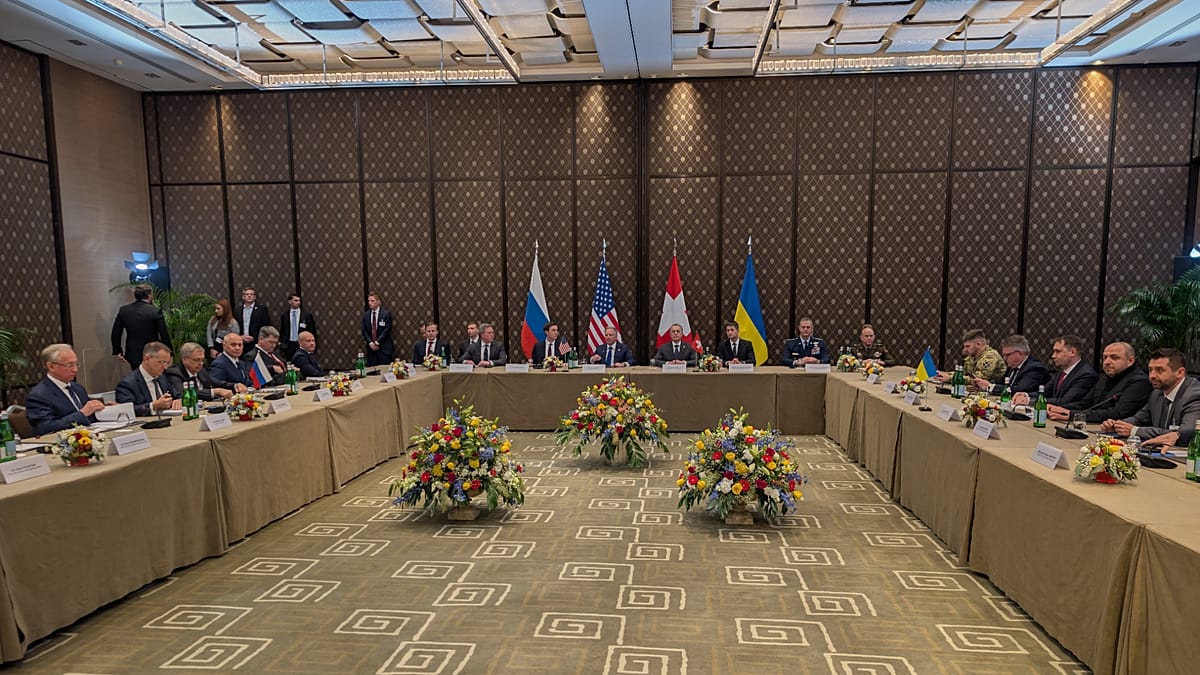
Ukraine and Russia wrapped up the second day of the diplomatic talks in Geneva after just under two hours of talks on Wednesday.
Ukrainian President Volodymyr Zelenskyy confirmed that the negotiations included two tracks: military and political.
“All three sides were constructive on the military track”, he said, referring to the initial briefing by the Ukrainian delegation, adding that “the military basically understand how to monitor a ceasefire and the end of the war, if there is political will.”
“They have basically agreed on pretty much everything there. Monitoring will definitely involve the American side. I consider this a constructive signal,” the Ukrainian leader said.
Zelenskyy did not provide more details, as he said the delegation and specifically the head of Ukraine’s General Staff Andrey Hnatov will report “ in greater detail upon return”.
But the political track is more complex, Zelenskyy admitted. He said this aspect includes issues related to Ukraine’s territories temporarily occupied by Russia, the Moscow-occupied Zaporizhzhia Nuclear Power Plant (ZNPP), and other “sensitive issues”.
Although there are developments, “so far the positions differ”, Zelenskyy said, adding that the talks on this track “were not easy”.
“On the military track I heard progress; on the political track there was dialogue – they agreed to move forward and to continue. I did not hear the same level of progress there as on the military side.”
Head of Zelenskyy’s office Kyrylo Budanov, who participated in the talks in Geneva, said the next meeting will take place “in the near future”.
Russian chief negotiator Vladimir Medinsky called the talks “difficult but practical”.
Allegedly, his presence as the head of the Russian delegation made the political track more complicated.
Medinsky is one of the fiercest supporters of Moscow’s all-out war against Ukraine and is known for unrealistic maximalist demands he voiced in the past.
During the 2025 talks in Istanbul, Medinsky reportedly warned that Russia was prepared for a prolonged war if Kyiv rejected Moscow’s maximalist demands.
Core issues of the political track
Russia-occupied territories of Ukraine remain the biggest sticking point in negotiations.
Kyiv maintains that freezing current positions offers the most realistic foundation for a ceasefire at this stage.
But Moscow is demanding that Ukrainian forces withdraw from the Donbas as a precondition for any agreement.
This demand includes parts of Ukraine’s Donetsk and Luhansk regions which Russia never controlled and still cannot occupy despite 12 years of attempts. Kyiv has repeatedly rejected this request.
Washington also floated the idea of establishing a free economic zone in the war-affected eastern region as a potential compromise. Neither Ukraine nor Russia expressed strong support for the proposal.
Another point is the ZNPP, which Russia has occupied since the early days of the full-scale invasion in 2022. The largest nuclear power plant in Europe, the ZNPP generated roughly 20% of Ukraine’s electricity.
Washington suggested that under the US peace framework, the facility would be jointly operated by Ukraine, the US and Russia, with shared economic benefits.
Kyiv sees this idea as legitimising Russia’s occupation.
European partners on the ground in Geneva
Officials from the UK, France, Germany and Italy were present in Geneva and held talks with the Ukrainians on the sidelines of the two-day trilateral meeting.
But the European representatives still struggle to be included in the US-led diplomatic process.
Zelenskyy himself said that the European participation was “indispensable” for any final agreement.
Ukraine’s president also noted on Wednesday that as soon as the Kyiv delegation returns with a full and detailed briefing after the Geneva negotiations, he would also contact Ukraine’s partners in Europe.
“Europe’s presence is very important for us,” he concluded.