


The United Kingdom’s Minister for EU relations, Nick Thomas-Symonds, said that his government is on course to sign a triple deal designed to bolster post-Brexit cooperation with the European bloc when both sides convene for a summit on 22 July.
The deal would seek to slash barriers to agri-food trade by aligning sanitary and phytosanitary rules, bring the UK back into the EU’s internal electricity market and grant special visas to young Europeans and Brits under a youth experience scheme.
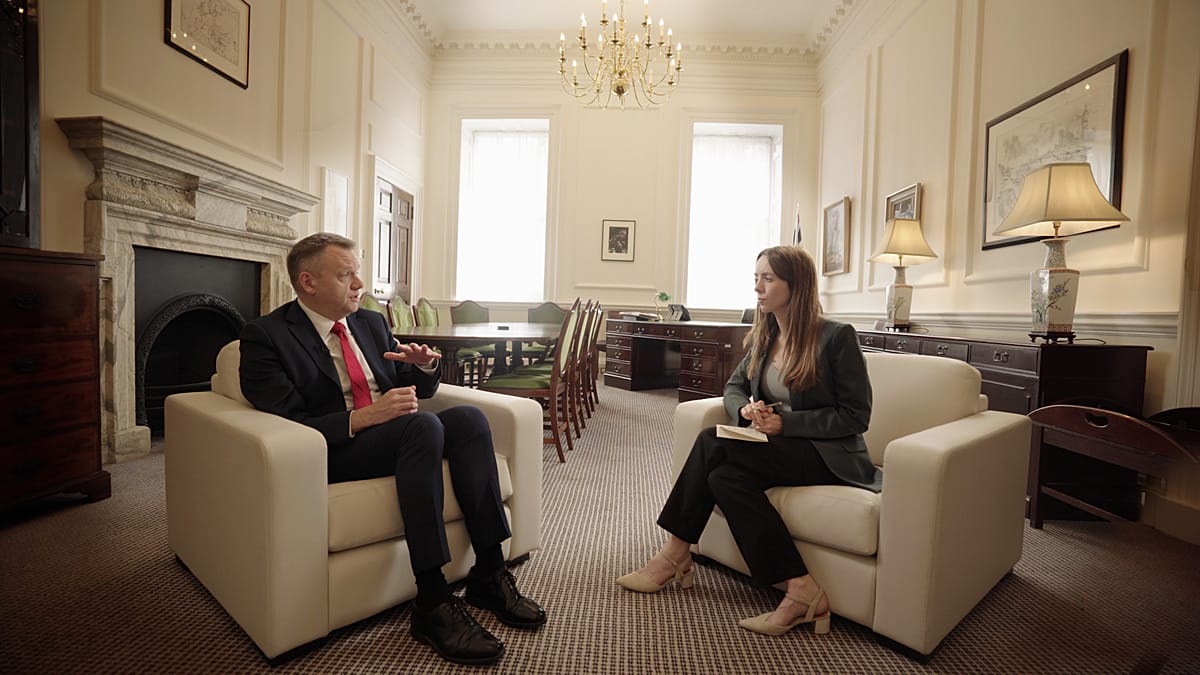
“Of course, we will get moments of difficulty, as you always do in the final parts of the negotiations, but I’m very confident of closing this deal,” Minister Thomas-Symonds, who is leading negotiations on resetting the UK’s post-Brexit ties with the EU, said on Euronews’s interview programme 12 Minutes With.
Talks on the youth experience scheme had been plagued by difficulties, prompting fears that the summit could be derailed. EU countries and the UK have both been seeking to restrict the number of young people who can enter and the length of their stay.
However, on Tuesday, the EU and the UK announced that the summit would go ahead on 22 July, following talks between European Commission chief Ursula von der Leyen and UK Prime Minister Keir Starmer at the G7 summit.
While refraining from speculating on the number of young Europeans the UK could be able to accept under the scheme, he suggested it could resemble the UK’s existing programmes with countries such as Australia, Canada, and New Zealand, which in the year up to September 2025 received just 21,900 applications.
As part of the programme, EU negotiators have also been urging London to lower UK university tuition fees, which for domestic students in England and Wales are around €10,000 per year, for European students. The UK has tried to exclude this from the scope of the agreement.
Despite this, Minister Thomas-Symonds said he expected to find a landing zone on a “very broad scheme around study, work and travel” and that this would be something to “celebrate” at the July summit.
“When I reflect on the last ten years, the post-Brexit consequences, (the loss of) opportunities for young people is one of the things that really bothered me,” he explained, adding that he was “very proud” of the opportunities that Brussels and London are looking to present together.
Defending Starmer amid turmoil
His comments come just ahead of the 10th anniversary of the Brexit referendum, and as a crisis at the heart of the UK government led by Starmer thrusts Brexit back to the centre of the political debate in the UK.
Starmer has been undermined by the recent abrupt departures of his health and defence secretaries, with major figures within the Labour Party now lining up to imminently challenge his leadership.
The former health secretary Wes Streeting this week said he had secured the required support of 81 Labour lawmakers to trigger a leadership contest, while Manchester mayor Andy Burnham is also expected to join the race if he secures a seat in parliament in a by-election (to fill an office that has become vacant between general elections) on Thursday.
Streeting has aimed to use public discontent over the UK’s post-Brexit arrangements to bolster his own leadership bid, saying last month that leaving the EU was a “catastrophic mistake” that has left the UK “less wealthy, less powerful and less in control”.
He has also said that the UK’s future “lies with Europe and one day, back in the European Union”, in an apparent bid to lure Brexit-opposing voters who have defected from Labour to the Greens and the Liberal Democrats.
Recent IPSOS polling suggests that as much as 60% of the UK population would support rejoining the EU.
But Minister Thomas-Symonds claimed that “public opinion is not far from where the government is”, adding that voters on the doorsteps do not want to rerun arguments of the past but that there is “support for a closer UK-EU relationship.”
He also defended Starmer’s “ambitious” post-Brexit reset with the EU, which was outlined in Labour’s electoral manifesto in 2024 ahead of Labour’s landslide victory.
“This has always been a top priority for the Prime Minister,” he said, arguing that Starmer “has always shown not just ambition but also that he and this government can deliver.”
Starmer is not only facing a revolt within his own party but a slump in support among the electorate. Reform UK, the party of arch-Brexiteer Nigel Farage, is topping national polls at around 26% of the voting intention.
Asked whether his government was looking to Farage-proof fresh deals with the EU to avoid them being torn up by a possible future Reform-led government, Thomas-Symonds said: “If a party at the next general election wants to put the costs back on businesses or take away the options of young people that this government has delivered, I would relish that debate.
“The best thing to make any deal durable is to ensure that it’s delivering for young people, it’s delivering for businesses, it’s delivering for the British public, but also Europeans as well. I am very confident that we are going to do that.”
You can watch the full interview on Euronews at 21.15 CET on Wednesday, 17 June.
Nick Thomas-Symonds has been the UK’s Minister for EU Relations since July 2024, following an election which saw the Labour Party retake power after 14 years of consecutive Conservative governments.
He leads negotiations with the EU as his government seeks to “reset” the economic, trading and political relationship with the European bloc.