




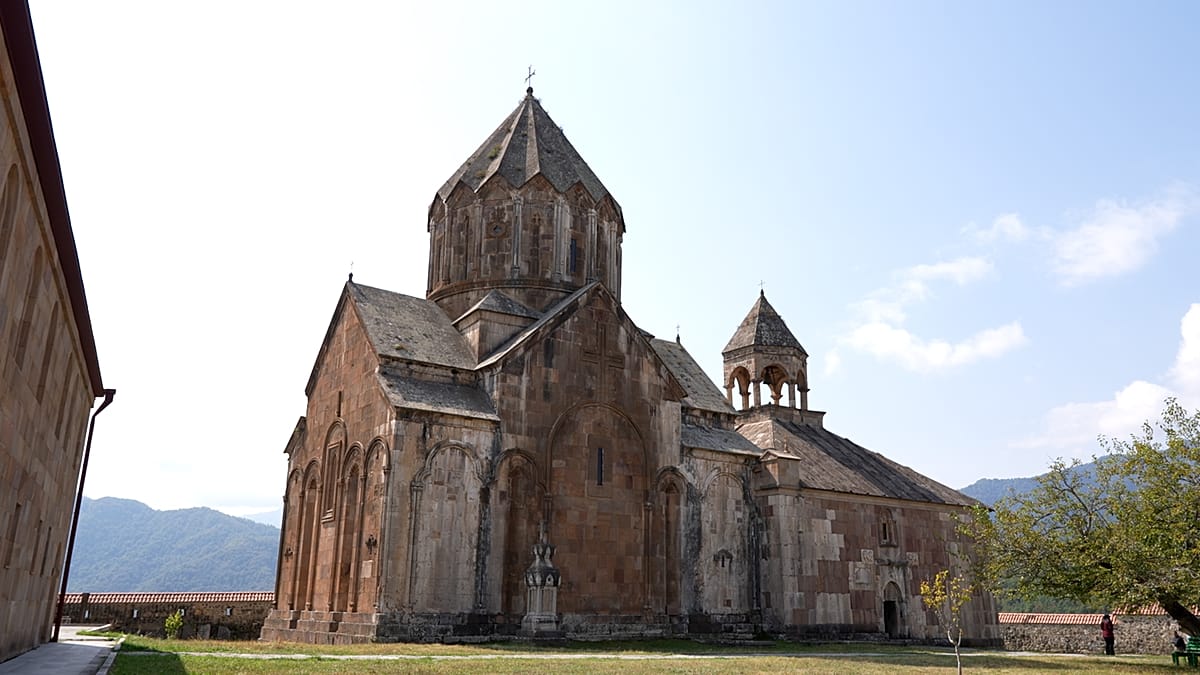
With peace returning to the region, Azerbaijan’s Udi Christians continue their centuries-old practice of pilgrimage and prayer at Karabakh’s historic Christian sites, as Azerbaijan showcases the preservation of religious sites whose historical identity remains contested.
For local communities and officials, these sites mean more than religious practice, as they project the safeguarding of Christian identity in the region.
As part of a government programme to explore the region’s Christian heritage and religious traditions, Euronews and other media outlets met a congregation of Udi Christians for their religious service at the ancient monastery of Gandzasar, near Vangli village in Azerbaijan’s Aghdara district, and talked to representatives involved in the preservation and maintenance of the site.
Prince Hasan-Jalal Dawla built the monastery’s main church between 1216 and 1238. Azerbaijan identifies it with the Caucasian Albanian Christian tradition, while Armenia identifies it with the Armenian Apostolic one, as competing interpretations continue to challenge the historic peace process between the two countries.
The Udi people are an indigenous, predominantly Christian ethnic group in Azerbaijan, primarily based in the village of Nij.
For the pilgrims, returning to Gandzasar represents restoring a deep historical link.
“Today, thanks to the acquisition of independence, we are in the monastery built by our holy fathers. We are proud of our history,” said Danakari Rafiq Arami, Deputy Chairman of the Alban-Udi Christian Community, emphasising the emotional weight of holding a service in the native Udi language.
Azerbaijan’s Udi community make pilgrimages to historic Christian sites associated with their heritage, including other monasteries in the Karabakh region, such as Khudavang, Ağoğlan and Amaras, which Azerbaijan identifies as historic Christian sites in Karabakh in its preservation programme.
Khudavang is located in the Kalbajar district, while Ağoğlan Monastery is in the Lachin district and Amaras Monastery is in the Khojavend district.
Christianity has a long history on the territory of present-day Azerbaijan, which prides itself on the peaceful coexistence of Muslims, Christians and Jews. UNESCO’s documentation on the Historic Centre of Sheki states that Christianity was introduced in the region as early as the 1st century CE.
One of the principal sites associated with this history is the church at Kish, near Sheki. The wider Udi Christian legacy is also represented in Nij, in the Gabala district, where the Udi community continues to practise Christianity.
The media visit comes shortly after a diplomatic delegation visited Gandzasar and Khudavang monasteries on 12 September.
Representatives of the diplomatic corps accredited in Azerbaijan were briefed on the history and architecture of the sites, as well as Azerbaijan’s claims about alterations to the monuments, which ignited a row with Armenia over the sites’ heritage and identity.
EU Special Representative for the South Caucasus Magdalena Grono, who took part in the diplomatic visit, said there were still “deeply divergent views and narratives” concerning the origins of some sites.
Grono stressed the importance of addressing unresolved historical disputes as part of the broader reconciliation process.