
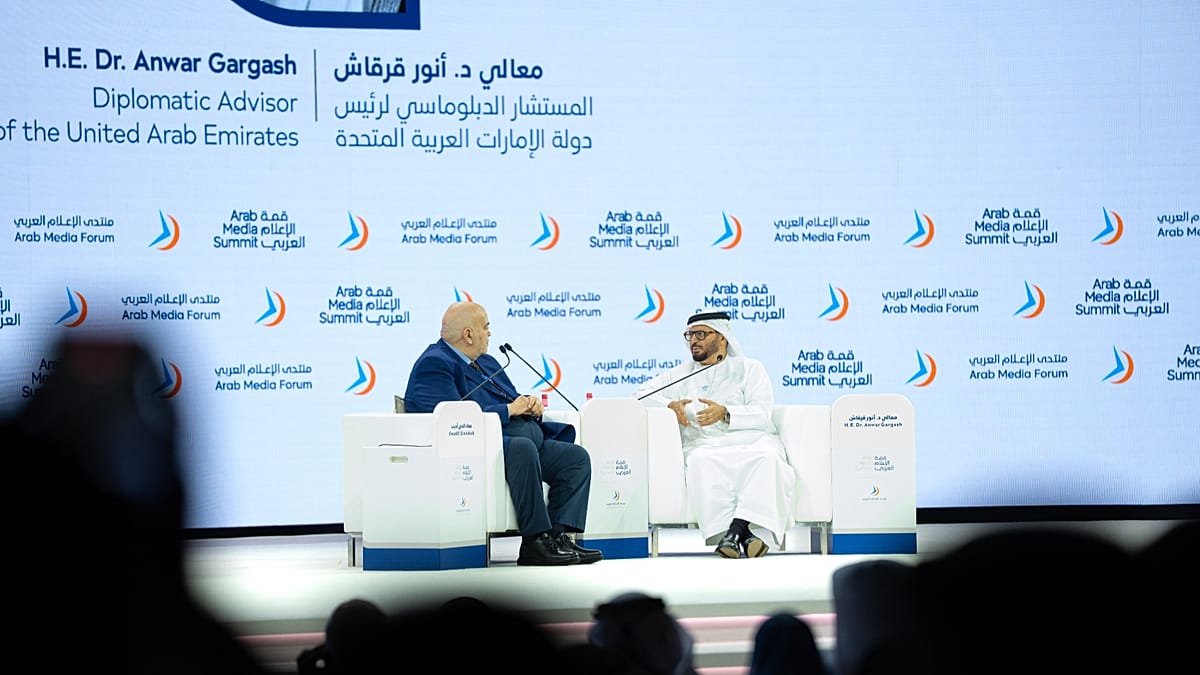
Trust between the United Arab Emirates and Iran will take years to rebuild, UAE president’s diplomatic adviser Dr Anwar Gargash said on Thursday.
Speaking at the Arab Media Summit in Dubai, he said relations with Tehran had to continue because the two countries were neighbours, but that confidence was a separate question after the attacks on the Gulf states.
Gargash said the UAE was managing the crisis while also assessing the future of the relationship.
“At the end of the day, we are neighbours, geographically neighbours. We have very complex relations with Iran, and certainly there is a collapse in the security regiment in the region. Thus, we have to find some new channels of understanding,” he said.
He set out the UAE approach in three parts. “Our role, or rather our approach, is based on three elements. First, to defend our sovereignty, and then to be flexible,” he said. The third was continuity of economic development through the crisis, he said, citing the president’s visit to Germany.
“We have to try. To maintain our development, our economic uproar, and the visit of our president to Germany was successful because we don’t want to stop our economy in the midst of this crisis,” he said.
Asked about his 7 September statement that UAE confidence in Iran was broken, Gargash said he had drawn a deliberate distinction.
“Actually, I differentiated between the relations and the trust, and I said that the relations are a must and we should have communication and relations with Iran based on open dialogue and a dialogue that would overcome the daily matters,” he said.
“Confidence building, I believe, will take us a long time. We need years to rebuild this trust.”
“The Iranian president said that the aggression from Iran on the GCC countries was a big mistake,” he said.
“I think it is a geostrategic mistake that created a more complex situation for Iran that would affect its future.”
‘UAE is a nice country but not an easy target’
He said Iran’s use of proxy militias kept it close to the aggression, and that the Gulf states would be the parties to broker Tehran’s return to its international place, trade and commerce, once the attacks stopped.
“They can’t negotiate a new future while they are still threatening and being aggressive against the neighbourhood,” he said.
Asked whether the UAE had taken any measures of its own against Iran, financial or political, he said it had not.
“No, we have only defended ourselves, and we continue to defend ourselves, and we still extend our hands for friendly relations”, he said.
Gargash said Iran was made of different circles and that decision-making there was no longer held in one place, as it had been under the previous Ayatollah Ali Khamenei since 1989, and that the voices arguing against confrontation with the Gulf needed to be louder.
On the meeting between Sheikh Khalid bin Mohamed and Iranian President Masoud Pezeshkian at BRICS, Gargash said the two sides had agreed on the direction if not on everything.
“There was not a complete agreement between them. But there was an agreement on the fact that we should start a new page and look to the future,” he said.
“The future should never be like what we have now. It is not in the interest of Iran nor the GCC countries.”
He said President Sheikh Mohamed bin Zayed had set the balance between flexibility and strength from the beginning of the war.
“The UAE is a nice country, but we are not an easy target,” Gargash said. “He was so clear in saying that Iran is going to be away from stability for decades to come.”
Houthi control of Bab el-Mandeb ‘concern for everyone’
Asked about the drone and rocket fire that triggered alerts in Saudi Arabia’s city of Jeddah and Islam’s holiest site of Mecca, Gargash said that “targeting Mecca is completely denounced and rejected.”
“The security and the sovereignty of Saudi Arabia is part of our security, and the stability of the GCC countries is interconnected,” he said.
The region had suffered from militias, Gargash said, naming Hezbollah in Lebanon and the Houthis in Yemen, and that “any arms outside the state are harmful for the countries and the region”.
“Yes, the channels are open. And as you are aware, and strategically speaking, the safety, security, and prosperity of Saudi Arabia is in our interest,” he said, asked whether relations with Riyadh remained open.
On the Houthis’ offensive to take control of the Bab el-Mandeb strait, Gargash said that “the Houthis’ control over the strait is a concern for everyone,” and not just a regional issue.
“This is not related to the region, but rather to the international economy,” he said. “We go back to the basic principle that these straits are international. This is the international definition.”
Gargash set out no timetable for further contacts with Tehran, saying the UAE did not choose the war but defended itself when it started, and that “this is a beginning for a political dialogue that should be started”.