


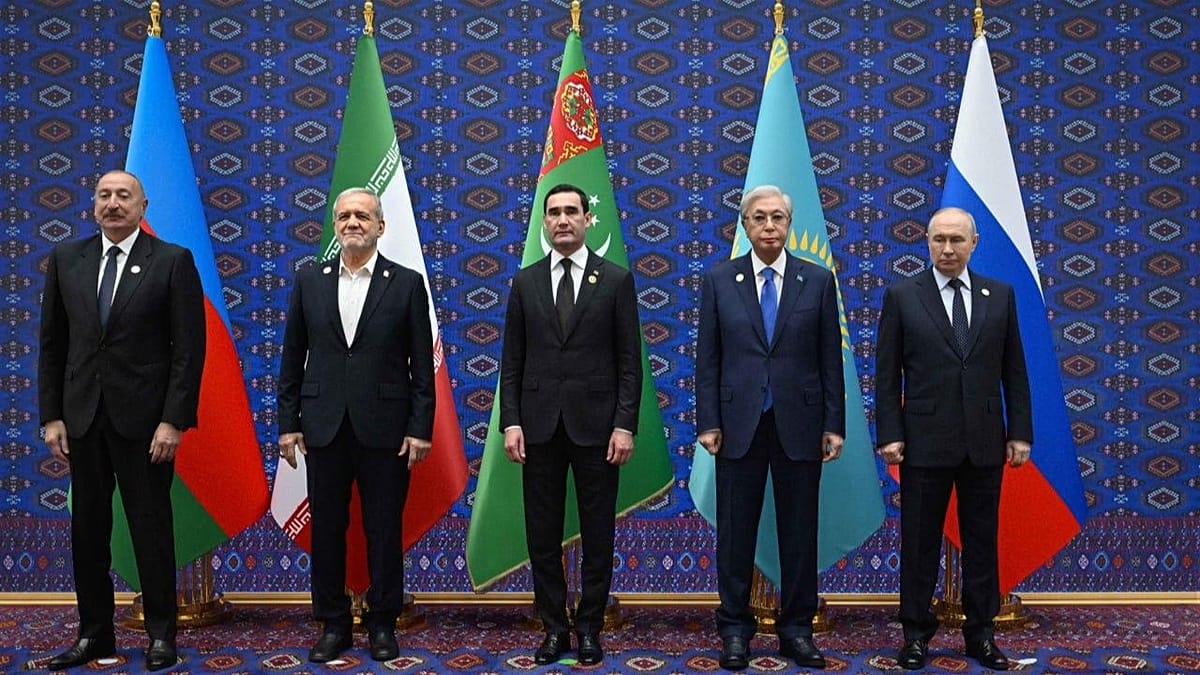
Ten presidents gathered in Avaza on Turkmenistan’s Caspian coast on Thursday and Friday for three simultaneous summits on regional security, economic integration, and a rapidly shrinking sea that leaders warned has become as much an economic crisis as an environmental one.
The gatherings — the eighth Consultative Meeting of the Heads of State of Central Asia, the CIS Council of Heads of State and the first Caspian Ecological Forum — brought together leaders of post-Soviet states as the region marks 35 years of independence.
Azerbaijan attended the Central Asian consultative meeting as a full member for the first time, having been admitted at the previous summit in late 2025.
President Ilham Aliyev thanked Turkmenistan’s leadership for supporting the accession and said Azerbaijan’s trade with Central Asian countries had grown by more than 50% over the past year. Baku will chair the format in 2027.
Regional trade among participating states reached approximately €11.6 billion last year, around 8% of their combined total, according to figures cited at the summit. Leaders set a target of raising it to at least €17 billion.
Host President Serdar Berdimuhamedov opened the meeting by calling for deeper cooperation, saying the six states’ mutual trust was sufficient to accomplish “all the tasks outlined.”
Kazakh President Kassym-Jomart Tokayev offered the group’s most pointed assessment of its track record. Since 2018, he said, more than 200 initiatives had been put forward but only a fraction carried out.
“I believe that the effectiveness of our work should be determined not so much by the number of proposals and initiatives as by their practical value and results,” Tokayev said.
Leaders also discussed transport, including the Trans-Caspian International Transport Route and the East-West and North-South corridors, as ways to connect the region with international markets.
Tokayev said construction of the Aral-Caspian highway, which began in August and will run more than 1,500 kilometres, would cut the road route from China to Europe by roughly 1,000 kilometres and reduce transit delivery times to three days.
World Bank projections cited at the summit put Caspian Sea freight traffic at a potential fourfold increase by 2040 if planned infrastructure is built.
Uzbek President Shavkat Mirziyoyev proposed an Infrastructure Development Council to coordinate cross-border projects, describing the region as a potential “key land route for global trade” but warning that roads and railways alone would not be sufficient.
Other proposals included a joint low-carbon energy strategy, coordinated water and pollution management, expanded collaboration on critical minerals and connecting national data centres to support artificial intelligence development. A joint statement was signed at the close of the meeting.
CIS: Long-term strategy proposed
The CIS Council of Heads of State met in Avaza as the organisation marked its 35th anniversary.
Tokayev called on member states to agree a development strategy through 2035 and answer a fundamental question: “how do we envision the Commonwealth in the long term, and what place should it occupy within the rapidly changing geopolitical architecture of Eurasia?”
He also proposed a CIS+ format to expand the organisation’s engagement beyond its current membership.
Mirziyoyev called for closer industrial cooperation, fewer trade barriers and better transport connections, arguing the group should move “from the simple exchange of goods to the joint creation of full-fledged value chains.”
He proposed linking special economic zones and industrial parks across CIS countries, mutually recognising product conformity certificates, and expanding access to public procurement markets.
Iranian President Masoud Pezeshkian attended as a special guest. Uzbekistan assumed the CIS chairmanship, with the next heads-of-state meeting scheduled for October 2027 in Bukhara.
Leaders backed Turkmenistan’s proposal to designate 2029 as the Commonwealth’s Year of Transport Connectivity.
Caspian Sea decline raises further concerns
The first Caspian Ecological Forum, proposed by Berdimuhamedov at the UN General Assembly in 2023, was convened to address what participating leaders described as a crisis that has moved well beyond the environmental sphere.
The sea’s surface area has shrunk by more than 16,000 square kilometres since 2000, with the coastline retreating by tens of kilometres in some areas as reduced river inflows, rising temperatures and human activity press on the ecosystem. The Caspian seal population has fallen from an estimated one million to around 270,000 over the past century.
“This is no longer an environmental crisis, but an economic crisis with dangerous consequences,” Pezeshkian said. The retreating coastline threatens shipping and port infrastructure, fisheries, energy installations and coastal communities.
Tokayev proposed a shared digital platform to monitor water levels, coastline changes, biodiversity, pollution, and river inflows, along with a joint portfolio of restoration projects.
He pointed to Kazakhstan’s partial recovery of the North Aral Sea — its surface area has grown by 36%, improving water quality and fish stocks — as evidence that coordinated action can deliver results.
Kazakhstan has also proposed establishing a UN Water organisation to coordinate international efforts on water security.