
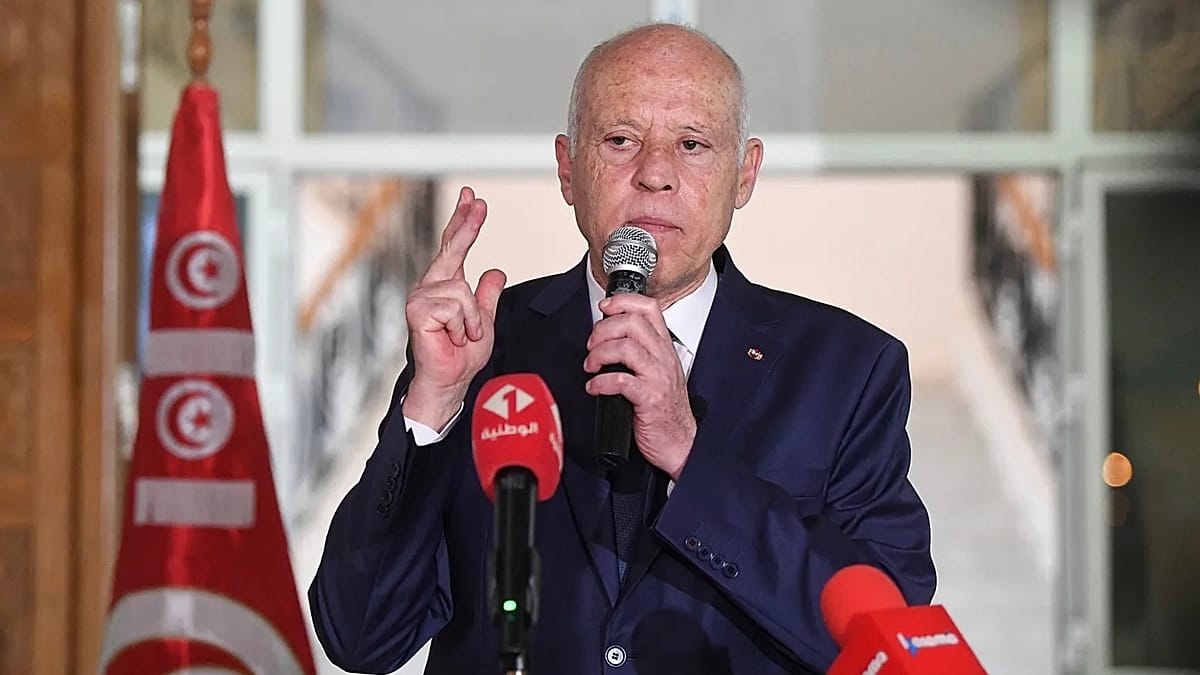
Five years after President Kais Saied suspended parliament and assumed emergency powers, Tunisia is marking the anniversary of 25 July 2021 amid its worst infrastructure crisis in memory, with between 150 and 200 people reported dead since power cuts began more than a week ago during an exceptional heatwave that has also brought severe water shortages.
The death toll was reported by the Organisation of Young Doctors in Tunisia. The Tunisian authorities have not confirmed or responded to those figures.
At least five deaths directly linked to power cuts — including a cancer patient — were reported by local media in the opening days of the crisis, when power failures caused home medical equipment including oxygen devices to stop working.
President Saied ended his public absence to acknowledge the crisis on Saturday, describing the pace of outages as “not normal” and saying those responsible must “assume their responsibility,” without announcing specific measures.
The state electricity and gas company, STEG, attributed the outages to record demand driven by what its director general Faysal Tarifa described as “excessive use of air conditioning,” telling local media that national consumption reached a record 6,000 megawatts on Tuesday.
He said the controlled outages were a “preventive measure” to protect the national grid and prevent total collapse, and urged citizens to use no more than one air conditioning unit during peak hours between 1 pm and 5 pm.
The date has long carried significance in Tunisia’s national calendar — it was the day the republic was proclaimed in 1957. Since 2021 it has split the country into two camps: those who regard the day as a moment that rescued the state from paralysis, and those who call it a coup against the constitution and elected institutions.
On that evening, Saied invoked Article 80 of the 2014 constitution to announce a series of exceptional measures: parliament’s powers were frozen for 30 days, the immunity of all its members was suspended, Prime Minister Hichem Mechichi was dismissed, and Saied assumed executive authority, which he exercised with a government he appointed himself. The public prosecution service was placed under his direct supervision.
Those decisions set in motion a political restructuring that culminated in 2022 in a new constitution establishing a presidential system.
Power centralised with the presidency
The 2022 constitution gave Saied considerably broader powers than those set out in the 2014 text, assigned the president primary responsibility for setting state policy and narrowed parliament’s role substantially. The document was approved in a referendum held on 25 July 2022, but with turnout far below that of previous elections, after most opposition parties boycotted the process.
Between Saied’s emergency declaration and the adoption of the new constitution, he governed by decree, stripped parliament of its legislative and oversight role and dissolved it definitively in March 2022.
In September 2021, Presidential Decree No. 117 formalised his assumption of wide executive and legislative powers.
In 2022, Saied announced the dissolution of the High Judicial Council. Dozens of judges were dismissed by presidential order — a move described by judges, opposition parties and human rights organisations as an assault on judicial independence. Legislative elections held at the end of 2022 recorded a first-round turnout of just 9%.
From early 2023, judicial proceedings multiplied against opposition figures, politicians, businesspeople and journalists. Among the most prominent detained are octogenarian leader of the Ennahda movement Rached Ghannouchi, opposition figure Chaima Issa and activist Jawhar Ben Mbarek.
Courts have handed down prison sentences against several of them which opposition groups and international human rights organisations have described as politically motivated. The Tunisian authorities say the cases are unrelated to political activity and concern acts they regard as threats to state security.
Saied and his supporters argue that the period before his emergency measures was defined by paralysing inter-party conflict and institutional deadlock, and that the new political framework has restored state effectiveness.
Saied has repeatedly framed his project as a response to popular demand, saying in a December 2025 address to the nation that “social justice is the primary condition for stability and for further creation of wealth and employment opportunities,” and that work was under way to “overcome all obstacles and inherited and fabricated difficulties.”
Critics — including domestic opposition groups and international organisations — say the changes have weakened the separation of powers and the rule of law.
Persistent economic difficulties, limited growth
The promises of economic renewal that accompanied the July 2021 measures have not translated into meaningful improvements in the main indicators. Economic growth has remained modest, private investment cautious, and access to external financing restricted.
International financial institutions, including the IMF, have warned that rising public debt and weak growth are constraining the state’s ability to fund investment.
IMF negotiations stalled for an extended period, financial support programmes slowed, and European and US assistance has become increasingly tied to economic and political conditions.
The Tunisian authorities describe their approach as one of “self-reliance” — reducing dependence on external actors and mobilising domestic resources. A community-owned companies project has been a centrepiece of that strategy, though it has yet to produce measurable results.
The Tunisian Forum for Economic and Social Rights said in a statement published this week that it was following “with great concern” the worsening electricity and water crisis across all of Tunisia’s regions since the start of July, noting that the National Meteorological Institute had described temperatures as exceeding seasonal norms by between 8 and 14 degrees Celsius.
Unemployment, emigration and rising costs
Unemployment stood at 15% in the first quarter of 2026 and is particularly acute among young graduates. More than a decade after the revolution whose demands included work, freedom and national dignity, job opportunities remain scarce. The cost of living has risen sharply — inflation has exceeded 5% this year — while wages have not kept pace.
Irregular migration attempts across the Mediterranean have continued. Inland regions remain significantly underdeveloped compared with coastal areas. According to available figures, 65 suicides and suicide attempts were recorded in the first six months of 2025.
Initial criticism from the US, EU and international rights organisations following Saied’s emergency measures gave way to a gradual thaw from 2023, driven largely by European interest in Tunisian cooperation on irregular migration.
A memorandum of understanding on a strategic partnership between Tunisia and the EU was signed in July 2023, covering the economy, energy and migration.
Relations with Algeria have grown closer, with frequent high-level visits and enhanced security cooperation.
Relations with Morocco broke down in 2022 after Tunisia hosted Polisario Front leader Brahim Ghali at the TICAD summit in August of that year. Both countries withdrew their respective ambassadors after that. Tunisia has also expanded cooperation with China and Russia.
Tensions arose with several African governments after Saied gave a speech in February 2023 describing what he called a “criminal scheme” to change Tunisia’s demographic make-up through irregular migration from sub-Saharan Africa.
The remarks were condemned by the African Union as discriminatory and prompted Côte d’Ivoire, Guinea and Mali to organise evacuations of their nationals from Tunisia after migrants were subjected to attacks.
Freedoms narrowing
After the 2011 revolution, Tunisia was regularly cited as a regional model for press freedom and political pluralism, ranking higher in international freedom indices than at any point under former presidents Habib Bourguiba and Zine El Abidine Ben Ali.
Human rights, trade union and media organisations have repeatedly warned that this space has contracted since July 2021, citing the arrest of journalists, activists and bloggers.
One case involved a death sentence handed down against a man over Facebook posts; the sentence was later reversed following a presidential intervention.
Bassam Tarifi, president of the Tunisian Human Rights League, told domestic outlet Anbaa Tounes this week that he was raising “an alarm signal” about prison conditions in the country amid the heatwave, calling for urgent intervention.
Decree 54, on combating offences related to information and communication systems, has been at the centre of that debate. Critics argue it can be applied to prosecute journalists. The authorities say its purpose is to combat disinformation and protect public security.