


In a world crippled with uncertainty, one thing is for sure: 2026 will go down in history as the year that Donald Trump single-handedly unravelled decades of climate progress.
Since his return to the White House, the POTUS and his administration have turned their back on science, ruthlessly retreating from global pledges and institutions to prioritise the profits of big polluters.
It’s stripping the US – which remains the world’s largest historical polluter – of any kind of accountability, while the world edges dangerously close to irreversible climate disaster.
But here’s the thing, climate change and its devastating effects do not stop at country borders. What one nation does impacts us all.
It’s why Euronews Green has consistently covered Trump’s unwavering climate setbacks – from his “drill baby drill” attitude over Venezuela’s oil reserves to repeatedly describing wind energy as a “con”.
Keeping up with these fast-moving stories can be hard, which is why we’ve created the Trump Tracker – documenting every single action the POTUS is taking to bolster fossil fuel giants and sabotage progress.
Just two months into 2026, and we’re already struggling to keep up.
February: More retreat and less science
‘Beautiful clean coal power’
On 11 February, Trump signed an executive order directing the defence department to buy more electricity generated by coal – which is considered the dirtiest, most polluting way of producing energy.
“When burnt, coal releases more carbon dioxide than oil or gas, so it’s by far the worst fuel when it comes to climate change,” says Greenpeace. “Coal also produces toxic elements like mercury and arsenic, and small particles of soot which contribute to air pollution.”
The order does not mention climate change or the environmental impacts of burning coal. Instead, it is referred to as “beautiful clean coal power”.
Repeal of the endangerment finding
On 12 February, the Trump Administration is slated to revoke a scientific finding that has long been the central basis for US action to regulate heat-trapping gasses and fight climate change.
The Environmental Protection Agency (EPA) will issue a final rule rescinding a 2009 government declaration known as the endangerment finding. This Obama-era policy determined that carbon dioxide and other greenhouse gases endanger public health and welfare.
The endangerment finding is the legal underpinning of nearly all climate regulations under the Clean Air Act for motor vehicles, power plants and other pollution sources that are heating the planet. It is used to justify regulations, such as auto emissions standards, intended to protect against threats made increasingly severe by climate change – deadly floods, extreme heat waves, catastrophic wildfires and other natural disasters in the US and around the world.
“The Trump administration is abandoning its core responsibility to keep us safe from extreme weather and accelerating climate change,” says Abigail Dillen, president of the nonprofit law firm Earthjustice.
“There is no way to reconcile EPA’s decision with the law, the science and the reality of disasters that are hitting us harder every year. Earthjustice and our partners will see the Trump administration in court.”
January: UN withdrawal, Venezuela’s oil and legal fights
‘What happened to global warming?’
In the last week of January, a dangerous winter storm has swept across much of the US, leaving at least seven dead, cutting power to thousands of homes, and causing thousands of flights to be cancelled.
Trump used the weather event to cast further doubt on ‘global warming’, writing on American conservative-focused social media platform Truth Social: “Record Cold Wave expected to hit 40 states. Rarely seen anything like it before.
“Could the Environmental Insurrectionists please explain – WHATEVER HAPPENED TO GLOBAL WARMING?”
More than a dozen scientists tell news agency AP that the president’s claims are wrong. They point out that even in a warmer world, winter and cold occur, and they never said otherwise. They note that even as it is cold in the eastern United States, more of the world is warmer than average. They also stressed the difference between daily and local weather and long-term, planet-wide climate change.
Meteorologists also said that global warming over the past couple of decades may make this cold seem unprecedented and record-smashing. But government records show it has been much colder in the past.
“This social media post crams a remarkable amount of inflammatory language and factually inaccurate assertions into a very short statement,” says climate scientist Daniel Swain of the California Institute for Water Resources. “First of all, global warming continues – and has in fact been progressing at an increased rate in recent years.”
‘Stupid’ wind turbine rant
Speaking at the World Economic Forum (WEF) in Davos on 21 January, Trump made several dubious claims about Greenland, NATO and renewable energy.
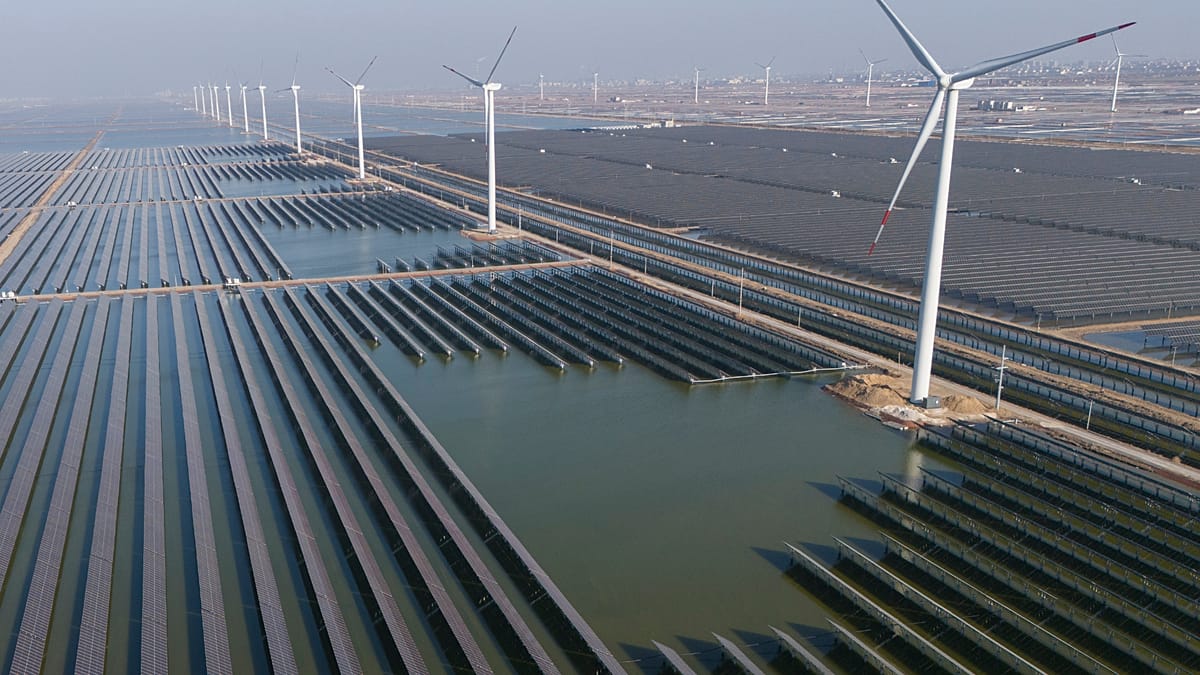
In a speech that lasted over an hour, Trump claimed that China makes “almost all” of the world’s wind turbines, which he continues to refer to as “windmills”.
“Yet I haven’t been able to find any windfarms in China,” he said. “Did you ever think of that? It’s a good way of looking. China is very smart. They make [wind turbines].”
Trump went on to argue that China sells wind turbines to other countries for a “fortune”. “They sell them to the stupid people that buy them, but don’t use them themselves,” he added.
According to energy think tank Ember, China’s wind generation in 2024 equalled 40 per cent of global wind generation. In April 2025, wind and solar power generated more than a quarter of the country’s electricity.
China is also home to the world’s largest wind farm, which is visible from space. Located in the vast desert region of western Gansu, construction of the Gansu Wind Farm began in 2009, with the first phase being completed just a year later. It already features more than 7,000 turbines.
Blocking clean energy grants
On 11 January, a federal judge ruled that the Trump administration acted illegally when it cancelled $7.6 billion (around €6.52 billion) in clean energy grants for projects in states that voted for Kamala Harris in 2024.
The grants supported hundreds of clean energy projects in 16 different states. This includes battery plants, hydrogen technology projects, upgrades to the electric grid and efforts to capture carbon dioxide emissions.
The Energy Department says the projects were terminated after a review determined they did not adequately advance the nation’s energy needs or were not economically viable. Russell Vought, the White House budget director, said on social media that “the Left’s climate agenda is being cancelled”.
However, US District Judge Amit Mehta said the administration’s action violated the Constitution’s equal protection requirements.
Anne Evens, CEO of Elevate Energy, one of the groups that lost funding, said the court ruling would help keep clean energy affordable and create jobs.
She told AP: “Affordable energy should be a reality for everyone, and the restoration of these grants is an important step toward making that possible.”
Trump’s interest in Greenland
Trump’s growing obsession with Greenland has triggered concerns from environmentalists over its critical mineral resources, which are seen as “essential” for the green energy transition.
A 2023 survey found that 25 of the 34 minerals deemed “critical raw materials” by the European Commission were found in Greenland. The nation is estimated to hold between 36 and 42 million metric tons of rare earth oxides, making it the second-largest reserve after China.
Tapping into these resources could help the US reduce its dependency on China, which currently processes over 90 per cent of the world’s rare earth minerals, and empower the US as demand rises.
Since his first term, Trump has been trying to tackle this issue – passing bills to increase American mineral production and stepping up deep-sea mining within both US and international waters.
However, some experts believe Greenland’s mineral reserves could just be a smokescreen for Trump’s real motives.
New dietary guidelines
The US Department of Health and Human Services and the Department of Agriculture have come under fire after releasing their 2026 dietary guidelines, which encourage American households to prioritise diets built on “whole, nutrient-dense food.”
The new food pyramid puts an image of a red steak and ground beef at the top under the “protein” section, despite beef being responsible for 20 times more greenhouse gas emissions per gram of protein than plant-based alternatives such as beans and lentils.
Neither of these foods appears on the food pyramid, but they are mentioned in the full dietary guidelines.
“While there are many ways to meet our protein needs, not all protein sources have the same impact on people or the planet,” says Raychel Santo, a food and climate researcher at the World Resources Institute (WRI).
“Beef and lamb, in particular, have some of the highest environmental costs of any protein-rich food – with significantly higher greenhouse gas emissions, land use, and water pollution per ounce of protein than most alternatives.”
Controlling Venezuela’s oil
After US special forces snatched Venezuela’s President and his wife in a lightning raid, Trump has shown a clear interest in the country’s oil reserves.
Venezuela holds the largest proven crude oil reserves in the world, sitting on an estimated 303 billion barrels (Bbbl) – outranking petrostates like Saudi Arabia and Iran.
Trump immediately confirmed the US would be “very strongly involved” in the country’s oil industry, with plans to send large US firms to fix Venezuela’s oil infrastructure and “start making money for the country”. In an interview on 8 January, he said the US could tap into Venezuela’s oil reserves for years.
“The only safe path forward is a just transition away from fossil fuels, one that protects health, safeguards ecosystems, and supports communities rather than sacrificing them for short-term profit,” Christensen adds.
US pulls out of UN climate treaty
The POTUS was accused of “sinking to a new low” after pulling the US out of a key climate treatyin a sweeping withdrawal from global institutions.
In a Presidential Memorandum signed on 7 January, Trump argued it is “contrary to the interests of the US” to remain a member of, participate in, or provide support to more than 60 international organisations, treaties and conventions.
This includes the United Nations Framework Convention on Climate Change (UNFCC) – which aims to stabilise greenhouse gas emissions – and the Intergovernmental Panel on Climate Change (IPCC), the world’s leading authority on climate science.
“At a time when rising seas, record heat, and deadly disasters demand urgent, coordinated action, the US government is choosing to retreat,” says Rebecca Brown, President and CEO of the Center for International Environmental Law (CIEL).
“The decision to defund and withdraw from the UNFCCC does not absolve the US of its legal obligations to prevent climate change and remedy climate harm, as the world’s highest court made clear last year.”
On 27 January, Trump also officially exited the Paris Agreement – a move he initially put in motion on his first day in office on 20 January 2025. It leaves the US the only country to have withdrawn from the pact, which aims to limit global warming from reaching 1.5°C above pre-industrial levels. Iran, Libya and Yemen are the only countries that didn’t join the agreement.