
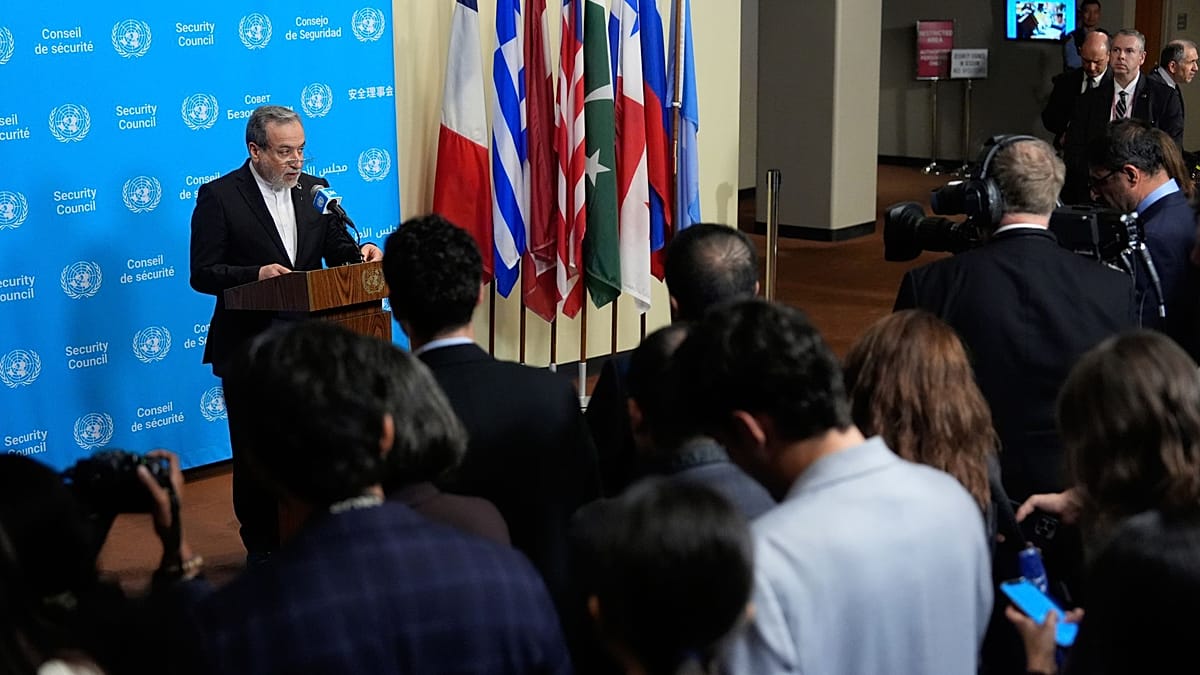
US President Donald trump has reportedly rejected an Iranian plan to reopen the Strait of Hormuz, a strategic waterway that has been at the heart of tensions between Washington and Tehran since late February.
The Wall Street Journal, citing US officials, reported on Friday that Trump had refused a proposal for a seven-day ceasefire and the reopening of the Strait, telling his aides that he expected to resume a bombing campaign against Iran after the US’ midterm elections in November.
Trump later posted an image on Truth Social showing an image of the Strait of Hormuz rebranded as the “Trump Strait.”
On Friday, Abbas Araghchi, Iran’s foreign minister, said that “if the necessary conditions are met, the strait can be reopened, and normal maritime traffic can resume within seven days,” adding that the “choice now rests with the United States.”
Referring to the June memorandum of understanding between Iran and the US, he added: “The actions that the US needs to take are not new. All of them were previously outlined in the memorandum of understanding.”
“If the American side is serious about reaching an agreement and reopening the Strait of Hormuz, everything is now ready,” Araghchi went on.
According to the Associated Press, Tehran has proposed that if the US were to lift its naval blockade of Iranian ports, cancel sanctions on Iranian oil sales, and observe a ceasefire that includes Lebanon, Iran would reopen the Strait of Hormuz within seven days and resume talks regarding its nuclear program.
Araghchi noted that the seven-day timeline of the plan would begin as soon as the US agreed. He said that completing the initial steps would take four to five days and that the Strait would reopen on the sixth day.
Referring to the start of nuclear talks, Araghchi added: “On the seventh day, negotiations with the US will begin to reach a final agreement on issues agreed upon by both sides.”
He also said it would be “better” if an agreement with Washington were reached before the US midterm elections.
Masoud Pezeshkian, the president of Iran, also emphasized during an interview with CBS on Friday evening that if the US accepted Iran’s seven-day proposal, then Tehran would honour everything to which it has committed.
According to AP, Iran’s proposed plan closely resembles the June memorandum of understanding, but its timeline is more condensed. The June MoU had given the two nations 60 days to reach a final deal.
An American official familiar with the talks between Tehran and Washington said that the US government was conducting positive and constructive discussions through mediators but that it would not rush to reach an agreement.
Additionally, a US official speaking to Reuters confirmed the continuation of “positive and constructive” talks with Iran, adding that discussions regarding “nuclear issues” were also ongoing.
Ali Vaez, Iran project director at the International Crisis Group, said: “This is a clever move. They know this proposal is very tempting for President Trump because it ends an unpopular war and lowers energy prices on the eve of the midterm elections.”
“At the same time, it revives an agreement that was largely to Iran’s benefit,” Vaez continued. “The condensed timeline to reach the nuclear issue should also be attractive to a president who is in a hurry”.
Diplomatic efforts and friction within Iran’s leadership
Pezeshkian stated during his speech at the UN General Assembly in New York on Wednesday that Iran was not afraid of continuing the war, yet Tehran remains ready for diplomacy.
In the latest diplomatic push, Pezeshkian hosted Mohammed bin Abdulrahman Al Thani, the prime minister and foreign minister of Qatar, on Friday morning. Qatar has acted as a mediator in talks between the US and Iran.
But signs of disagreement among the Iranian leadership have also been emerging, with some hardliners criticising diplomatic steps taken by Pezeshkian and Araghchi.
Before leaving US soil, Pezeshkian reiterated his country’s readiness to resume negotiations.
He also explained that foreign policy decisions were deliberated by a six-member team representing various institutions, including the security forces, parliament, and government bodies, with decisions reached through coordination among these members.
But Ebrahim Rezaei, a member of the Iranian Parliament’s National Security and Foreign Policy Commission, wrote on X: “The Ministry of Foreign Affairs is an executor, not a policymaker.”
“The foreign minister must explain under what authorisation and policy guidelines his meeting with the representative of the aggressor enemy took place. Iran’s conditions have been communicated to the US, and illegal meetings under the pretext of conditions yield nothing but a sign of weakness,” he continued, adding: “Do not beg for agreement and understanding.”
“Instead of manufacturing authorisations, repent, apologize, and make amends. The message of weakness previously imposed a 40-day war on the people and the country; do not repeat the mistake.”