
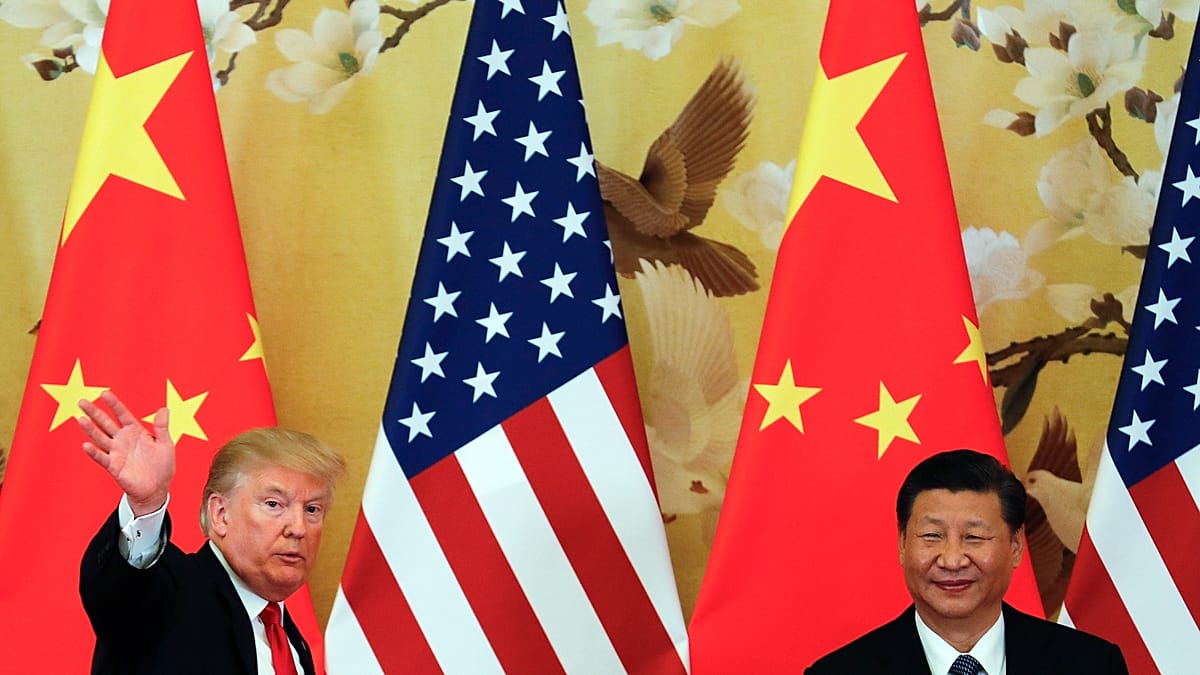
As US President Donald Trump arrives in Beijing on Wednesday for a three-day summit set to wrap on Friday, the symbolism alone carries considerable significance.
It is the first state visit to China by a sitting US president since Trump’s previous trip in 2017, nearly nine years ago, during the early phase of his first term.
The geopolitical backdrop of this visit is markedly more unstable than it was at the time. The Iran war has unsettled global energy markets, disrupted shipping routes and renewed concerns about a broader regional escalation.
Meanwhile, China has attempted to position itself as a source of economic continuity and diplomatic stability, strengthening commercial ties across Southeast Asia, the Gulf and parts of Africa and Latin America.
Apart from its involvement in the Middle East, the US is also actively consolidating its influence across the Western Hemisphere through a revamped “Monroe Doctrine”.
The Trump administration has effectively redirected the Venezuelan regime away from China through military action, economically pressured Cuban rule to the brink of collapse via sanctions and created a new security coalition with several Latin American and Caribbean nations dubbed “Shield of the Americas”.
The American strategy has reasserted military and economic primacy in the region with the clear aim of mitigating Chinese influence and securing critical supply chains. For instance, the US and China are currently in a heated dispute for port control in the Panama Canal.
The US is still richer but China has reshaped the global economy
Since Trump’s visit to China in 2017, the US has continued to lead the global economy.
According to the IMF’s latest projections released in April, the US nominal GDP is expected to exceed $30 trillion (€25.5tn) in 2026, compared with approximately $20 trillion (€17tn) for China, representing around a 25% and 17% share of the global economy respectively.
The US and China have occupied the first two places in the nominal GDP ranking for well over a decade, but the gap, while large, is gradually narrowing as China grows faster.
As per IMF figures, China’s real GDP annual growth rate has been 5.48% on average since 2017 while the US’ is 2.5% and the world’s 3.26%. Essentially, the Chinese economy is growing at twice the rate of its American rival and substantially above the global pace.
A very significant contributor to China’s above-average performance was the fact that it was the only major country to end 2020 with economic growth after the Covid-19 pandemic ravaged the global economy.
For this year, China’s real GDP annual growth is projected to be 4.4% while the US’ is 2.3% and the world’s 3.1%.
China also surpassed the US to become a larger share of the global economy on a purchasing power parity (PPP) basis in 2016, widening the gap ever since. The measure adjusts for domestic price levels and reflects the real scale of production and consumption within an economy.
That shift underlines how China has become central to global manufacturing, supply chains and commodity demand.
However, living standards between the two countries remain sharply different.
IMF projections place US GDP per capita in 2026 at over $94,000 (€79,850), while China’s is near $15,000 (€12,750) and the world’s is almost $16,000 (€13,600).
Despite decades of rapid expansion, China’s economy still faces structural challenges including weak domestic consumption, high youth unemployment, a property sector slowdown and demographic pressures linked to an ageing population.
Confrontations over supply chains and exports
The most recent quarrel over supply chains was triggered in April when US Secretary of State Marco Rubio accused China of “bullying” by holding up dozens of Panama-flagged ships after the country invalidated contracts allowing a Hong Kong subsidiary of China’s CK Hutchison to manage two port terminals earlier this year.
Trade tensions remain central to the US-China relationship despite several rounds of negotiations over the past year.
Although both countries eased some tariffs and export restrictions in late 2025, disputes continue over semiconductors, electric vehicles, AI and access to critical minerals.
The roster of business leaders joining US President Donald Trump on this trip to China underscores the main topics under discussion. The group of more than a dozen top executives includes Elon Musk, outgoing Apple CEO Tim Cook and Nvidia CEO Jensen Huang.
The Trump administration has restricted sales of Nvidia’s H200 AI chips to China citing their possible use for military purposes. Exports are limited under a series of conditions such as third-party testing to confirm performance capabilities before shipping to Chinese customers.
Nvidia has been heavily lobbying the White House to lift restrictions ever since.
Overall, Washington accuses Beijing of using state subsidies and industrial policy to distort global markets, while Chinese officials argue that US export controls are designed to slow China’s technological development.
China’s foreign reserves
Beijing retains significant financial firepower as it continues to grow.
Based on data from the Chinese State Administration of Foreign Exchange and reports from the state-run Xinhua news agency, China’s foreign exchange reserves remain the largest in the world at more than $3.2 trillion (€2.8tn).
These funds provide policymakers with substantial capacity to manage financial volatility and support the Chinese yuan or renminbi.
The US holds comparatively smaller reserves but continues to benefit from the global dominance of the dollar, which remains the primary currency used in international trade and central bank reserves.
Gold holdings reflect another dimension of the rivalry. According to the World Gold Council, the US continues to officially hold the largest national gold reserve with over 8,100 tonnes.
Nonetheless, China has steadily expanded its own holdings in recent years as Beijing seeks to diversify reserves away from dollar-denominated assets and strengthen long-term confidence in the renminbi.
As of this month, the People’s Bank of China has been on an 18-month buying streak, which is the Chinese central bank’s longest unbroken gold purchasing spree. Total holdings have hit new records and stand at over 2,300 tonnes.
AI and military spending have become central battlegrounds
Economic competition between Washington and Beijing is also increasingly inseparable from military and technological rivalry.
According to data published last month by the Stockholm International Peace Research Institute (SIPRI), the top three military spenders in the world remain the US, China and Russia respectively and together they account for 51% of the global total.
In 2025, the US spent $954 billion (€810.3bn) which was actually around 7.5% lower than the prior year but only because no new financial assistance to Ukraine was approved.
The country still increased investments in nuclear and conventional military capabilities with the goal of maintaining dominance in the Western Hemisphere and deter China in the Indo-Pacific, which are stated priorities of the new US National Security Strategy.
Spending approved by the US Congress for this year has already risen over $1 trillion (€849.4bn), which represents an increase of more than 5% from 2025, and it could jump further to $1.5 trillion (€1.275tn) in 2027 if US President Donald Trump’s latest budget proposal is accepted.
The SIPRI estimates that China’s defence budget for 2025 was around $336 billion, but several analysts believe broader security-related spending may technically push the real figure higher.
China has modernised its military rapidly over the past decade, expanding naval capacity, missile systems and cyber warfare capabilities while the US still maintains a significant advantage through its global alliance network, including NATO partnerships and security ties across the Indo-Pacific with Japan, South Korea and Australia.
Taiwan remains the most sensitive issue in the relationship. Beijing views the self-governed island as part of its territory and has repeatedly criticised US military assistance to Taipei.
Washington maintains that preserving stability in the Taiwan Strait is essential to regional security and global trade flows, particularly given Taiwan’s central role in advanced semiconductor production.
Technology, namely AI, has emerged as perhaps the defining arena of competition.
The US retains major strengths in advanced chip design, aerospace, software and research capacity. Meanwhile, China has built dominant positions in electric vehicle batteries, renewable energy infrastructure, telecommunications equipment and industrial manufacturing.
Chinese companies now account for more than 90% of global solar photovoltaic manufacturing capacity and over 70% of the global EV battery market, according to reports from Bruegel and SNE Research.
These sectors are viewed by Beijing as strategically important for future economic influence.
At the same time, Washington has tightened restrictions on advanced semiconductor exports amid concerns over AI and military applications.
Trump’s visit is therefore likely to be judged less on immediate agreements than on whether it helps prevent further deterioration in relations between two powers whose rivalry increasingly shapes global trade, investment and security.
The US remains the dominant military and financial power, supported by the dollar’s global role and the depth of American capital markets.
China, however, has evolved into a systemic challenger with the industrial scale, export reach and state-backed investment capacity to influence supply chains, infrastructure and geopolitical alignments worldwide.
For Beijing, the summit offers an opportunity to project confidence and stability amid wider international uncertainty. For Washington, it is a test of whether the US can continue to shape the economic and strategic rules of an increasingly multipolar world.