
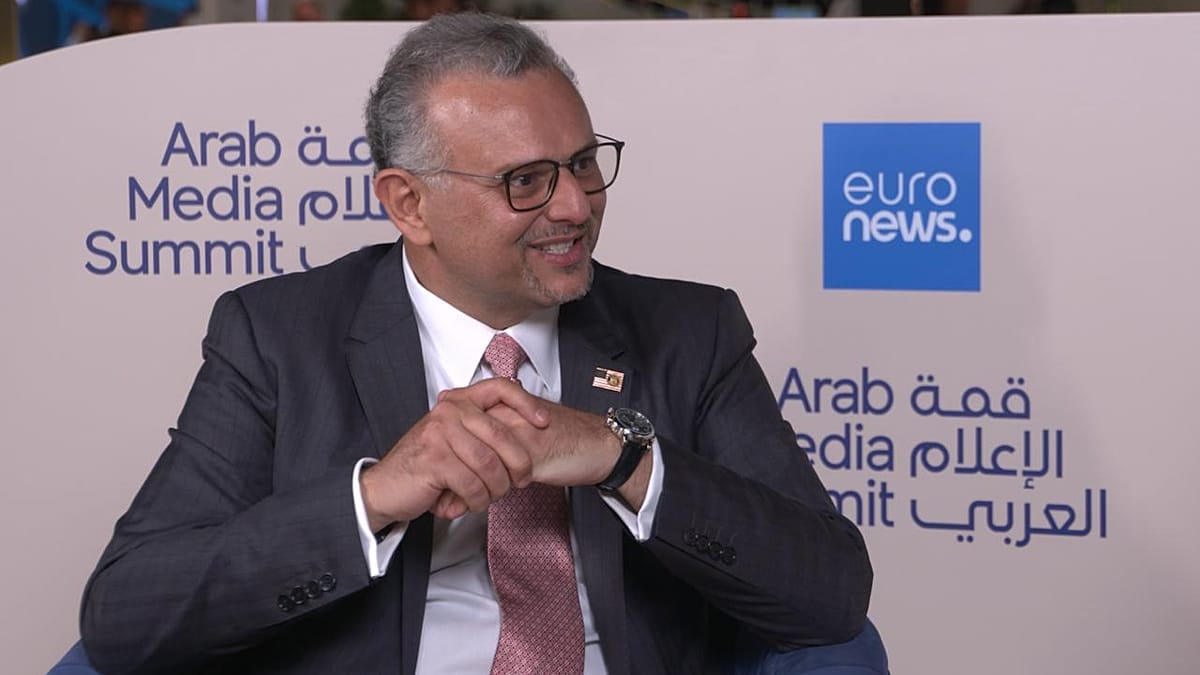
US President Donald Trump expects the war across the Middle East to end soon and is determined to bring it to a close, his senior adviser on Arab and Middle Eastern affairs Massad Boulos told Euronews.
Boulos declined to give a timeline, saying the moment would be Trump’s to choose.
“The president believes that it’s going to end soon, and he’s determined to make it end. And he’s working towards that,” Boulos told Euronews at the Arab Media Summit in Dubai.
“He’s a person who delivers, and we’ve all seen President Trump deliver on his promises. There’s no promise that he didn’t deliver on, whether it’s a campaign promise or any other promise that he made,” he explained.
Pressed on when that would happen, Boulos said, “That will be for the president to determine.”
“But we are very hopeful, and we are absolutely solidly behind him and behind his leadership,” he added.
Boulos set the nuclear question as the condition that has to be settled before the war stops, repeating that Tehran will not be permitted to acquire a nuclear weapon.
“Somebody had to tackle and had to address this nuclear issue. As President Trump has said repeatedly, there is no way we can allow Iran to have a nuclear weapon,” Boulos said.
“Just imagine a world, just imagine this region with a nuclear Iran. Just imagine that for a moment,” he added.
“He’s giving negotiations and talks a chance. He’s been extremely patient. And we hope that ultimately peace will prevail.”
“He’s firm on that and he’s determined. We are in full support of his vision, and so are his partners in the region. Nobody wants war.”
Boulos, who described Trump as “the president of peace”, said that Trump had already brought other conflicts to an end and was working on two more.
“We know that he’s the only president, at least in recent history, but definitely in the world, that has solved eight conflicts and eight wars so far. And he’s working on the ninth and the 10th,” he said.
“If you look at the Pakistan-India conflict, just talk to them and they will tell you that what President Trump was able to achieve saved them at least probably 4 or 5 million lives.”
He gave no detail of which conflicts he was referring to and did not expand further on the casualty figure.
Gulf states Washington’s ‘true partners’
Boulos said expansion of the Abraham Accords, four of which were signed during Trump’s first term, had been interrupted by the 2020 election and would resume once the current war was resolved.
“If it wasn’t for the re-election campaign, there were many more that were ready, lined up and ready to sign the Abraham Accords,” he said.
“We do believe that this should be addressed soon, and then we can go back to our peace initiatives.”
Gulf states including the UAE and Qatar have questioned in recent months whether existing arrangements do enough for their security.
Boulos said the relationship with Washington was strong at the leadership and working level, naming Saudi Arabia, Egypt and Jordan alongside them.
“These are true partners. They are true allies. He has an excellent relationship, including a personal relationship with them, and an excellent rapport and chemistry with these leaders,” he said.
“There are coordination’s happening at all sorts of different levels and departments within our administration. So, I can assure you that it’s working out quite well, just like any good partners.”
Asked about public opinion in the region, Boulos, who worked on Trump’s campaign with Christian, Muslim and other communities in the US, said support rested in part on social conservatism.
“I travel all over the Middle East and I meet with Middle Eastern leaders and with the people of the Middle East. They all love President Trump,” he said.
“If you look at the social aspect, the values, family values, and those principles that are deeply entrenched in Middle Eastern culture,” Boulos explained.
“His campaign was about fighting the woke ideology, and the Middle Eastern communities fully support that.”
Humanitarian support for Sudan
Boulos singled out Sudan as the administration’s most pressing humanitarian file, and said the president wanted that war ended quickly as well.
“Sudan today is the world’s biggest humanitarian catastrophe,” he said. He put the number of Sudanese people in need of aid at 35 million, of whom he said 25 million were living in famine-like conditions.
He said the US remained the single largest humanitarian contributor there, with more than $3 billion provided since the start of the war.
Washington has provided no support beyond humanitarian aid and diplomatic effort, Boulos said, pointing to an arms embargo the US is pursuing at the UN Security Council.
On domestic politics, Boulos said the US president was campaigning intensively ahead of the midterm elections and had held what he described as the first-ever midterm convention in Dallas, adding that the Iran war was unlikely to directly shape the result.
“There are many domestic issues usually that are predominantly in terms of priority. With the American voter, with the average US voter, there are many other domestic priorities,” Boulos concluded.