



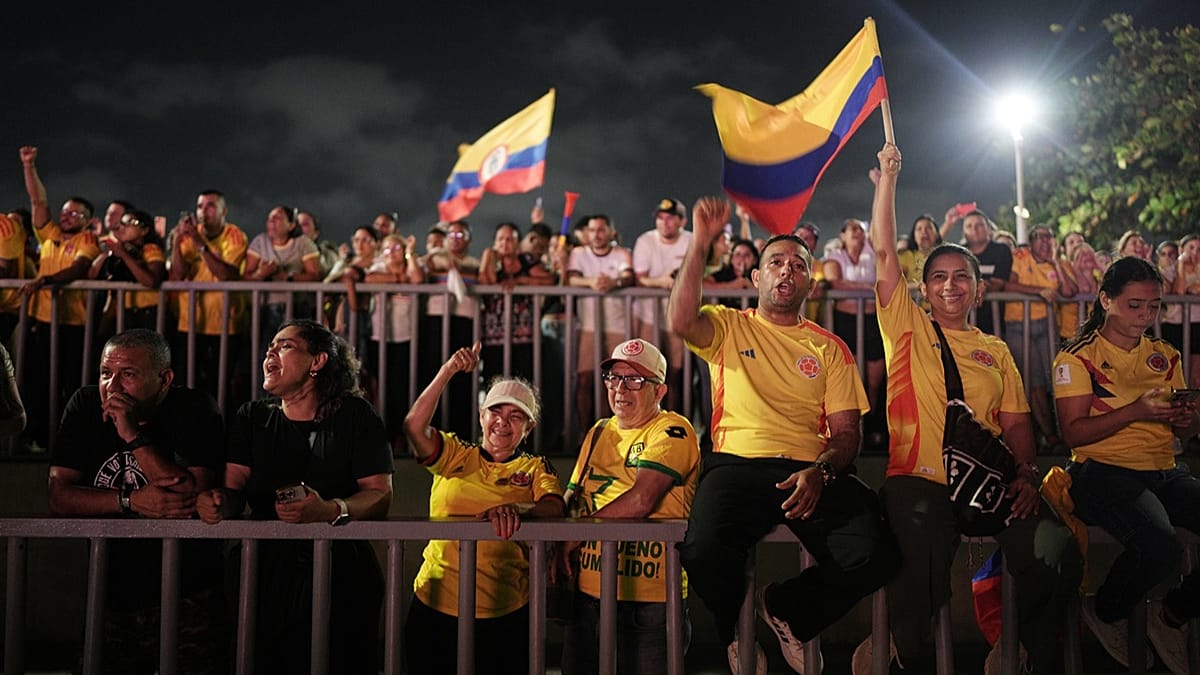
Right-wing candidate and Trump ally Aberaldo de la Espriella took the lead in a closely contested first-round presidential vote in Colombia, setting up a runoff with Iván Cepeda, an ally of Colombia’s outgoing President Gustavo Petro.
Cepeda won 41% of the vote, while de la Espriella won 44% of the votes, with 99.98% of the results counted by electoral authorities.
It was a stronger-than-expected showing for 47-year-old De la Espriella, a pro‑Trump lawyer, singer and clothier who calls himself “The Tiger” and has billed himself as a political norm-smashing outsider.
Cepeda is a progressive senator who has promised to carry on a fraught plan to achieve “total peace” by negotiating peace pacts with guerrillas and criminal gangs.
He was consistently leading polls in the run up to the Sunday vote, but in the weeks leading up to the election de la Espriella rapidly gained support with a promise that he would crack down on armed groups.
But Cepeda and Petro sowed doubt in the results of the first round, claiming without evidence that hundreds of thousands of votes were manipulated and that foreign actors manipulated the results of the election.
Cepeda said he was waiting for electoral authorities to scrutinize the results before accepting the election.
“Only when the vote-counting commissions have fully clarified what happened will we comment on tonight’s results,” Cepeda said, though he acknowledged the vote was likely going to a second round.
He vowed to defeat the “fascist extreme right” in the June 21 second round, linking his rival to mafiosos and plutocrats.
Result could redefine US relations
The polarized vote comes as the Trump administration is playing a more aggressive role in Latin America than any U.S. government in decades, placing mounting pressure on countries like Colombia, Mexico, and Ecuador to crack down on crime.
The election has also underscored two sharply diverging visions for the future of peace in a country marked by years of conflict.
On one side, Cepeda has promised to continue Petro’s progressive agenda and a largely failed effort to negotiate peace pacts with armed groups, following a plan that’s likely to sharply contrast with Trump’s vision for Latin America.
On the other side, de la Espriella has promised to fiercely crack down on criminal groups and build 10 mega-prisons, echoing the war on gangs policy of El Salvador’s President Nayib Bukele, which has driven down homicide rates but fueled accusations of human rights abuses.
The election — 10 years after Colombia signed an historic peace pact with guerrillas of the Revolutionary Armed Forces of Colombia, or FARC — as seen as a referendum on Petro’s policies.
The deal a decade ago had offered hope to break the nation’s vicious cycle of fighting between rebel groups and the government. But violence has since roared back, in part because armed groups have taken advantage of peace negotiations with Petro’s government to make territorial gains.
That came to a head in the lead-up to the election. Criminal groups have increasingly launched drone strikes, armed attacks have plagued the race and last June, 39-year-old politician and presidential hopeful Miguel Uribe Turbay was fatally shot at a political rally.
Still, Cepeda and Petro have maintained strong support among many because of progressive policies pushed forward under Petro, such as boosting the minimum wage.
The neck-and-neck results likely spell trouble for Cepeda in the run-off election, as de la Espriella is expected to scoop up support from voters who threw their support behind another conservative candidate in the first round.
Additional sources • AP, AFP