

Kazakhstan, Central Asia’s largest country, is often associated with vast steppes, but much of the country’s natural beauty remains undiscovered. One of the best examples is the Zhetysu region.
This corner of southeastern Kazakhstan brings together deserts, forests, waterfalls, mountain lakes, ski resorts, ancient monuments and archaeological sites, all within a single journey. To understand why Zhetysu is so diverse, start with its location.
The region borders China and has long been a bridge between East and West. As part of the ancient Silk Road, it connected people, cultures and goods from different parts of the world.
Natural wonders of the Dzungarian Alatau
The Dzungarian Alatau is one of Kazakhstan’s most underrated mountain regions. Stretching along the country’s border with China, it offers alpine lakes, glaciers, waterfalls and dense forests.
The Dzungarian Alatau is a great place for hiking and exploring nature. Every spring, nearby villages celebrate the Sievers Apple Blossom Festival, dedicated to the wild Sievers apple.
Genetic studies suggest it is the original ancestor of the modern apples. It’s a chance to walk through blooming orchards, taste local food and enjoy traditional music.
One of the mountain range’s most remarkable features is the Dzungarian Gate, a natural mountain corridor about 50 kilometres long. In the 13th century, it served as a strategic route for Genghis Khan’s armies as they conquered lands across Central Asia.
Among the most picturesque destinations in the Dzungarian Alatau are Lake Zhasylkol and Burkhan Bulak waterfall.
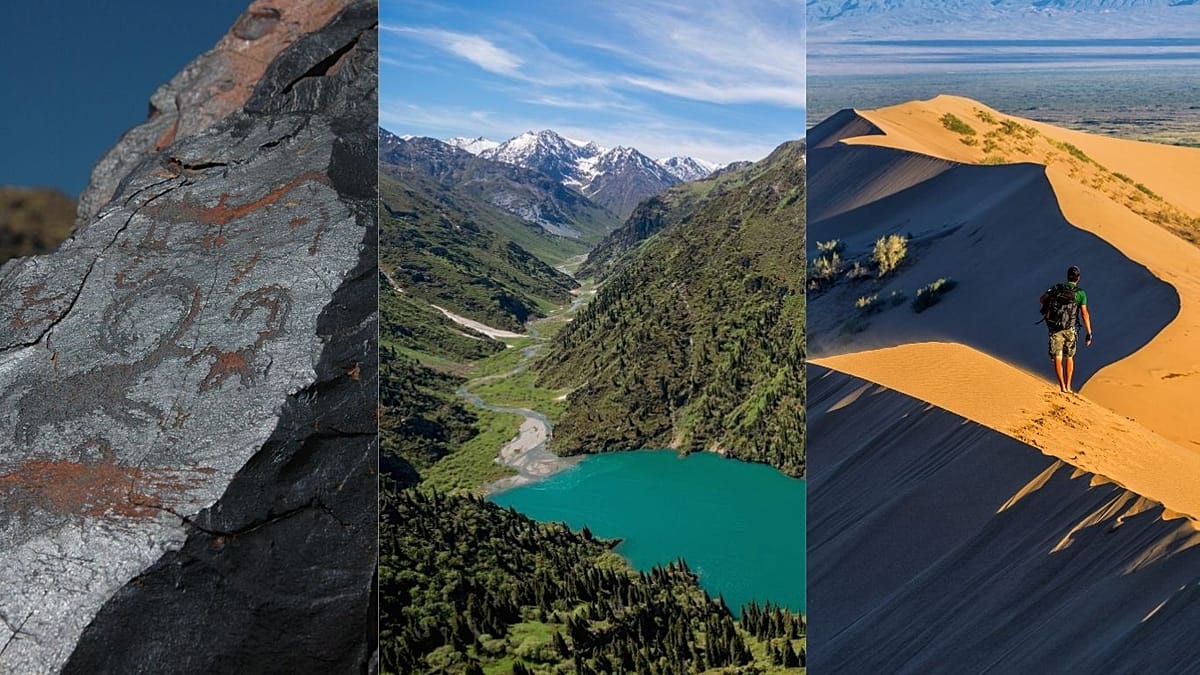
Lake Zhasylkol, whose name means “green lake” in Kazakh, is known for its emerald water. Surrounded by forests and mountain peaks, it is a popular stop for hiking, camping and photography.
Altyn-Emel National Park
Located between Taldykorgan and Almaty, Altyn-Emel National Park is best known for its “Singing Dune”. So why does it sing? As sand slides down the slope, the grains rub against each other and produce a sound. To hear it, you’ll need to climb to the top of the dune and walk back down.
Many compare the sound to the qobyz, a traditional Kazakh musical instrument, while others say it resembles a flute or even the hum of a plane.
Just a short drive away, the Aktau Chalk Mountains reveal a completely different landscape. Their white, yellow, pink and crimson layers were formed around 400 million years ago, when this area lay beneath an ancient ocean.
Visitors can explore the Singing Dune and the Aktau Mountains on daily tours departing from Almaty or Taldykorgan.
Lake Alakol
Lake Alakol is one of Kazakhstan’s most popular beach destinations. But long before it became a holiday hotspot, people came here for a different reason. The lake is known for its mineral-rich waters and therapeutic mud.
During the Soviet era, cosmonauts came to Lake Alakol to recover after long space missions. This lake also became a place of recovery for children affected by the Chernobyl nuclear disaster in 1989, who came here for rehabilitation and health treatments.
Today, visitors can choose from a wide range of hotels, guesthouses and resorts along the shore. The lake is easy to reach with seasonal flights from Astana and Almaty or by road from Taldykorgan.
Lake Balkhash
Imagine a lake where one half is fresh and the other is salty. That’s Lake Balkhash, one of the world’s rare natural phenomena.
Stretching more than 600 kilometres across southeastern Kazakhstan, the lake is divided into two distinct parts, with fresh water in the west and saline water in the east.
Beyond its unusual geography, Lake Balkhash is a favourite summer destination for locals. Visitors come for beaches, fishing and boat trips.
Zharkent Wooden Mosque
Besides its national parks and natural wonders, Zhetysu is also home to remarkable historical landmarks. One of the most impressive is the Zharkent wooden mosque.
Standing near the historic trade routes between Kazakhstan and China, it reflects how different traditions, religions and architectural styles came together along the Silk Road.
At first glance, the Zharkent mosque looks more like a Chinese temple than a traditional mosque. The building dates to around 1886. At that time, Zharkent was a small Uyghur settlement. The entire structure of the mosque was built without using a single nail.
Today, the mosque serves as a museum. It is open daily from 9 am to 4:30 pm.
Why Khorgos is the modern Silk Road’s gateway?
Speaking of the Silk Road and the Dzungarian Gate, it’s worth remembering that they still exist in a different form.
What was once a route for camel caravans has transformed into the Khorgos trade corridor (International Centre for Boundary Cooperation), one of the world’s largest dry ports and a major gateway for trade between China, Central Asia and Europe.
Walking through Khorgos, it can be hard to tell where one country ends and the other begins. You’ll hear both Kazakh and Chinese, see signs in different languages and find shoppers, traders and tourists from both sides of the border.
Many visitors come simply for the duty-free shopping, while others visit to experience one of the world’s most unusual cross-border zones.
Ancient petroglyphs
If you want to travel even further back in time, head to Zhetysu’s ancient petroglyphs. Carved into rocks thousands of years ago, they depict hunting scenes, wild animals, rituals and mysterious sun-headed figures.
These ancient carvings tell the story of Bronze Age communities and early nomadic societies. Many are well preserved.
Among Zhetysu’s lesser-known landmarks is the Buddha Stone near Tekeli. Who created it remains a mystery. The rock is carved with a Buddhist inscription in Tibetan script, believed to have been created during the 17th or 18th century.
Zhetysu is also becoming a destination for adventure sports. Mountain rivers are ideal for rafting, while the surrounding peaks and valleys offer excellent conditions for paragliding, climbing and hiking.
Whether you’re interested in nature, history or outdoor adventures, Zhetysu brings together an unusual mix of landscapes and experiences. That’s what makes this region one of Central Asia’s most distinctive destinations.