
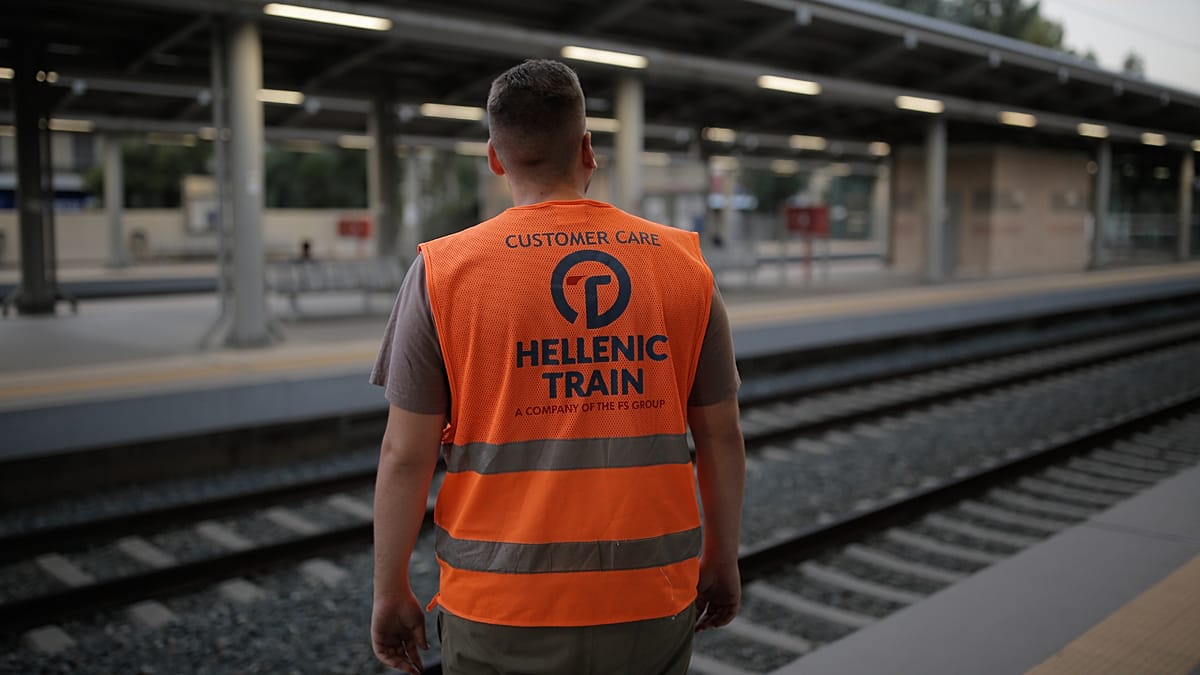
Three years after a fatal railway accident in Greece, the effects are still being felt.
The head-on collision of a passenger train and a freight train between the Greek villages of Tempi and Evangelismos resulted in the deaths of 57 people.
A Euronews investigation has delved into how safe trains are in Greece today, and how much Greeks trust the railway system.
Effects of fatal train crash still felt today
Greece does not have a railway culture comparable to that of countries in Central Europe. But data shows that passenger traffic fell sharply after the Tempi incident.
More recent statistics now show signs of stabilisation and recovery, but passengers are still wary.
A small Euronews poll at Larissa Station, Athens’ main railway station, found that ordinary people are divided. Some feel perfectly safe, others, not so much.
Yannis Ornerakis, a member of the Board of Directors of the Panhellenic Federation of Railway and Fixed-Track Vehicles, argues that the human resources working in the Greek railway are among the best in the world.
He agrees that since Tempi, the situation has improved significantly, but adds that this is not enough. There needs to be continuous employee training.
**”**We would certainly like to increase the level of training. In fact, we would like the training to be more frequent and of longer duration. The engine driver is a professional who needs to be constantl_y_ educated,” said Ornerakis.
What changed since Tempi?
Is Greek railway travel safe enough today? Euronews put the question to Konstantinos Kyranakis, the Deputy Transport Minister, and his answer is clear.
**”**Today, trains are safer than in Tempi and much safer than they were in 2019. In 2019 on the Athens-Thessaloniki line we had just 1% of the telecommand system, just 5 km of the 500 km where it should have been installed,” he said.
“Today we have 80% and in the summer coming up, in six months, we will have 100% signalling, 100% telecommand and 100% ETCS [European Train Control System]. So all these safeguards add security to the railway.”
“But safety is also about people who operate these systems, whether they are in the driver’s cab, in stations, in command centres, who have to activate and operate these systems correctly,” Kyranakis adds.
“Therefore, we have upgraded the level of training and evaluation of these people who are on the front line in terms of reflexes, incident management under pressure, and simulator training, so that we can all together upgrade the level of safety that Greek society demands.”
The new ultrafast simulators
Greece is now trialling train simulators for the first time. The technology from Germany has been installed at rail company OSE’s professional training centre in Renti, where it is being used to train employees already serving on the Greek railway in real-life conditions.
Thanks to these state-of-the-art machines, drivers can be trained with modern methods. They can simulate driving day or night, with weather conditions ranging from sunshine to fog, storms and heavy snowfall.
If at any time the driver gives an order that exceeds the specified safety conditions, the machine takes control of the train and slows down. This automatic braking system is now installed on every train.
“Both employees and passengers, and the whole of society, are rightly demanding that the level of safety on the railways be upgraded,” Kyranakis said, “So the most important thing has been the integration of safety systems, the so-called telecommand, which was not present at the time of the crash.”
Train geolocation using Starlink
The simulator is not the only safety upgrade for the Greek railway. A state-of-the-art train geolocation system was also developed in cooperation with Elon Musk’s Starlink satellite system, a European first, officials claim.
railway.gov.gr uses HEPOS (Hellenic Positioning System) to provide real-time tracking for all trains across the country.
The new system was presented on Wednesday and has already been put into operation. It gives the position of trains with an accuracy of five centimetres. It is similar to ‘Flightradar’ for planes and ‘Marintraffic’ for ships, “but with much greater accuracy, which is essential for railways,” as Kyranakis explained.
“This system is pioneering for Europe. It is a cutting-edge technology which, with satellite internet, ground stations and precision transmitters, can completely change the model by which the railway operates and add a safeguard against human error,” Kyranakis argued.
New trains after 20 years
The railway fleet in Greece is being renewed, with new trains arriving for the first time in two decades.
“It is a very important development. New trains are coming after 20 years, which is very positive and an upgrade for the Greek railway.” Ornerakis said.
“The fleet is being renewed with the CORADIAs already in Thessaloniki, and the first tests have begun. So we also have an upgrade in rolling stock. This is the main thing: we need infrastructure and rolling stock. I believe and hope we will have them soon.”
The Recovery Fund
To a large extent, the modernisation projects of the Greek rail network are financed by the EU’s Recovery Fund, including entire projects on the central axis between Athens and Thessaloniki.
In agreement with the Commission, the Greek Government has adopted an action plan for the progress of several projects and for the country’s implementation of EU rail legislation.
The action plan is the basis for addressing the identified shortcomings. The European Commission itself claims that “satisfactory progress is being made in its implementation,” noting that the country submits regular reports, adding that there is still much to achieve.
Euronews concluded by asking Kyranakis whether people can feel safe today on the Greek railways, and if the state can guarantee that Tempi will not repeat.
“By seeing the exact location of the trains on their mobile phone via Google Maps, each citizen gains visibility into the level of safety,” he said.
“In other words, the announcements of a politician, a minister, a government are no longer enough for them, but they see in practice that the system now operates digitally, with modern technologies and safety controls, which did not exist before.”