
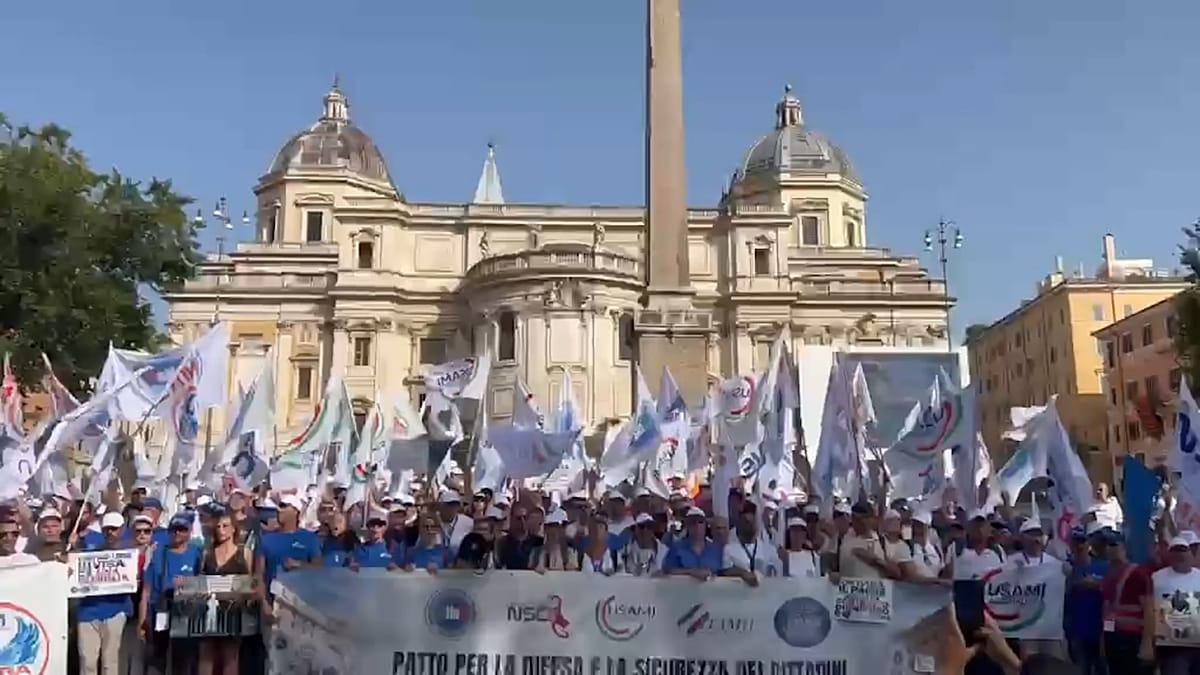
Around 6,000 members of Italy’s armed forces and security services marched through Rome on Saturday, demanding higher pay, better pensions and stronger workplace protections.
The demonstration brought together representatives of the Army, Navy, Air Force, Carabinieri and Guardia di Finanza in the first joint protest organised by the country’s main defence and security unions.
The rally came just days after the government renewed the collective agreement covering around 430,000 military and security personnel. The deal includes a gross monthly pay rise of €188 and a one-off back payment of €2,448, as well as a commitment to open talks on pension reform.
Several unions, including Sinafi, the New Carabinieri Union (NSC), Usami Aeronautica, Itamil and Silmm, refused to sign the agreement, arguing that it does not go far enough to address pay and retirement concerns. They organised Saturday’s protest to press the government for further measures.
Marching under the slogan, “Every day we serve Italy. Today we demand respect”, protesters carried banners through the streets of Rome.
In a statement issued ahead of the rally, the unions outlined four main demands: reform of the supplementary pension system and an end to plans to raise the retirement age to 65, stronger legal protections for security personnel, pay increases that keep pace with the rising cost of living, and greater investment in recruitment, training and modernising the profession.
The protest concluded with a conference on the future of Italy’s security, defence and emergency services, attended by representatives of several unions, including the New Carabinieri Union (NSC), which refused to sign the new pay agreement.
“The reasons why we did not sign this agreement and rejected it are simple: what we were supposed to receive from an economic point of view has not been delivered,” said NSC secretary-general Massimiliano Zetti.
“Because inside those uniforms working for the state, under the state’s emblem, there are not silhouettes, there are families, there are people, women and men who work. It is only right that they should be paid fairly. Security has a cost.”
Law enforcement protests in Europe
Although rare, protests by members of the armed forces and law enforcement have taken place in several EU countries in recent years.
In Italy, police unions organised demonstrations in 2023 to demand more funding for pay rises, salary increases in line with inflation and additional recruitment to tackle staff shortages.
In France, police unions staged strikes and pickets in early 2024, calling for bonuses and guarantees on shifts and leave ahead of the Paris Olympics, which required a major security operation.
In Spain, the Jusapol union repeatedly protested in 2024, demanding pay parity for National Police and Guardia Civil officers with regional police forces such as Catalonia’s Mossos d’Esquadra. Some police unions had also opposed the government’s Catalan amnesty law in late 2023.
Belgian police unions also organised protests in 2022 and 2023, including “white strikes”, roadblocks and a temporary refusal to issue fines for minor offences, with some demonstrations disrupting access to Brussels Airport.