



A little-known French semiconductor company has become one of Europe’s biggest artificial intelligence stock market winners in 2026, thanks to a technology few competitors can produce.
Shares in Soitec SA have risen almost sevenfold this year, from about €23 at the start of January to roughly €154 on Monday afternoon in Paris.
Yet the company reported a 34% decline in annual revenue last year.
Now, Bank of America believes the stock could nearly double again.
On Friday, the US bank upgraded Soitec from Neutral to Buy and raised its price target from €152 to €300, implying more than 90% upside.
So what is driving this rally, and how much of it rests on a single product?
The French company behind a critical AI technology
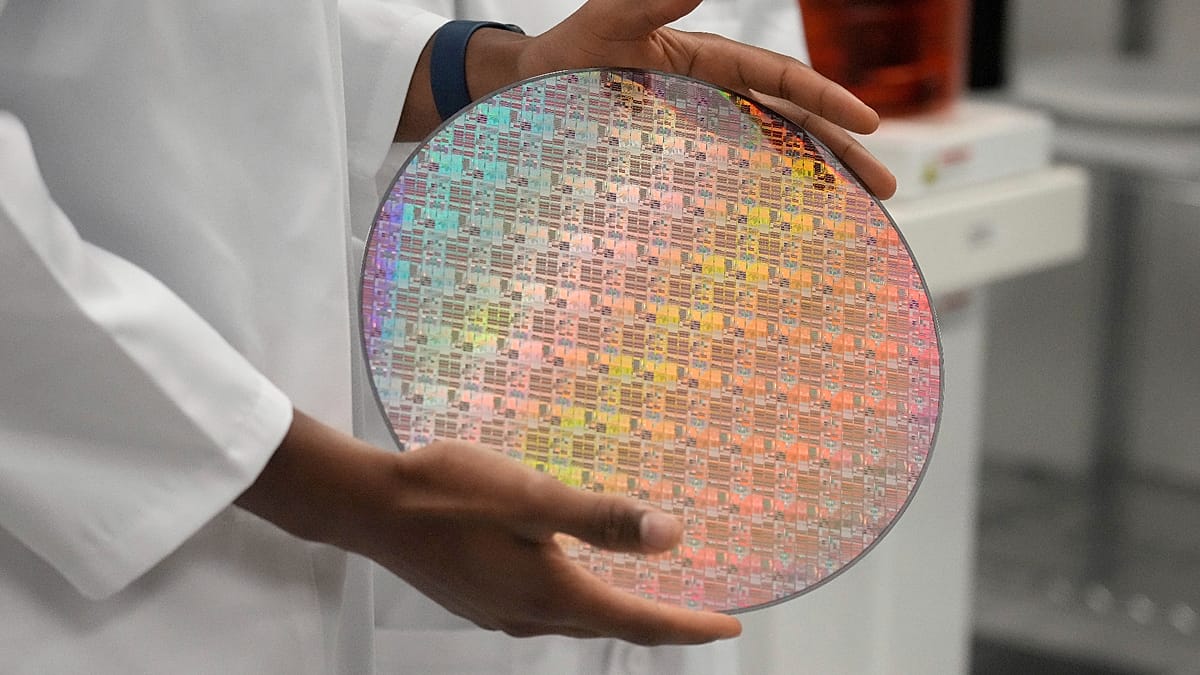
Soitec does not make the processors that train artificial intelligence models. It makes the engineered silicon wafers on which other semiconductor companies build their chips.
Based in Bernin, near Grenoble, the company was spun out of French research institute CEA-Leti in 1992.
It employs more than 2,000 people and holds more than 4,700 patents.
Earlier this month, Euronews journalist Valérie Gauriat visited Soitec’s production facilities for the Made in Europe series.
Inside its clean rooms, silicon wafers undergo dozens of manufacturing stages, allowing the company to manipulate incredibly thin layers of material.
“Our job is to run faster than the competition,” Chief Technology Officer Christophe Maleville told Euronews.
That expertise is becoming increasingly valuable as AI data centres need to transfer enormous amounts of information between processors.
Silicon photonics offers a faster, more energy-efficient alternative to traditional copper connections by using light instead of electrical signals.
Soitec supplies the specialised silicon wafers used to manufacture these optical chips, giving it a critical role in the expanding AI infrastructure market.
Why Bank of America sees a near monopoly in AI photonics
“We estimate that Soitec currently holds ~95% market share in supplying Photonics-SOI wafers,” Bank of America analyst Oliver Wong and his colleagues said.
Rivals, including Taiwan’s GlobalWafers, are attempting to enter the market.
However, the bank expects Soitec’s technological expertise and decades of manufacturing experience to protect its dominant position.
That advantage could become increasingly valuable as AI data centres grow larger and require more optical connections between processors.
Bank of America estimates that the total wafer area required for photonic chips will expand by approximately 60% annually between 2026 and 2030.
In other words, demand for Soitec’s materials could grow considerably faster than the number of AI processors themselves.
The company’s latest forecasts already suggest a major acceleration.
In September, Soitec projected that photonics revenue would reach between 2.5 and three times the previous year’s level in the financial year ending March 2027.
It also forecast approximately 50% growth in total revenue for the September quarter.
Meanwhile, Soitec expects to secure multi-year capacity agreements with eight of its roughly ten largest photonics customers.
These agreements could make future demand more predictable, supporting investment in additional production capacity.
How AI could reshape Soitec profitability
Until recently, Soitec depended heavily on the smartphone industry, which accounted for roughly half of its revenue last fiscal year.
But in the June quarter, its broader Edge & Cloud AI division generated 57% of sales.
Bank of America expects that transformation to accelerate.
It projects photonics revenue will climb from €92 million in fiscal 2026 to approximately €680 million in fiscal 2029.
That would represent almost half of projected group revenue of €1.43 billion, compared with just 16% last fiscal year.
More importantly, profitability could grow even faster than sales.
The bank estimates that photonics wafers retain about 80 cents from every euro of sales after raw material costs, compared with 56 cents for Soitec’s other products.
As photonics becomes a larger part of the business, Bank of America expects the company’s gross profit margin to rise from 16% to 44% by fiscal 2029.
“We believe FY26 gross margin of 16% marked the trough for Soitec,” Wong and his colleagues said.
That expected recovery underpins their forecast of €10.62 in earnings per share for fiscal 2029, approximately 71% above the Visible Alpha analyst consensus.
Why a nearly 600% rally still carries substantial risks
Soitec’s transformation is far from complete.
Annual revenue declined 34% to €592 million in fiscal 2026, while mobile communications sales plunged 43%.
The smartphone division contracted another 10% in the June quarter as customers continued reducing inventories.
Bank of America expects the mobile business to reach its lowest point this fiscal year, but a recovery is not guaranteed.
Meeting growing demand for photonics will also require substantial investment.
The bank expects Soitec to announce an extension of its Singapore manufacturing plant in the coming months, potentially costing around €700 million.
Valuation presents another challenge.
At approximately €154 per share, Soitec trades at nearly 96 times Bank of America’s projected earnings for the financial year ending March 2027.
Such an elevated valuation leaves investors vulnerable if AI infrastructure spending slows or competing technologies gain ground.
Soitec will publish its first-half results on 18 November, offering a fresh test of its ambitious growth outlook.
At the beginning of 2026, investors were focused on shrinking smartphone sales and deteriorating profits.
Today, Soitec is increasingly being valued as a critical supplier to the global AI industry.
The question is whether its photonics business can grow fast enough to justify a share price that may have already anticipated an extraordinary transformation.
This article is for informational and educational purposes only and does not constitute financial advice, investment advice, or a recommendation to buy or sell any financial instrument. Readers should conduct their own research and consult a qualified financial adviser before making any investment decisions. Investing involves risk, including the potential loss of capital. Past performance is not indicative of future results.