
Sisters Ariela and Alice had already been using Portugal’s bottle return scheme to earn money but since June they have upped the ante: now, instead of just returning their own bottles, they are asking their neighbours’ for their empty plastic bottles and making money off those too.
Since April this year, when the Volta scheme launched, plastic bottles in Portugal have a €0.10 deposit included in the cost. If you return the empty bottle to a supermarket with a Volta machine, you’re given a receipt which can be exchanged for discounts or cash.
Ariela and Alice have big plans for their cash: Alice, who is ten, wants to do a three-week exchange in South Korea. Her sister Ariela, 13, wants to do the same in the United States
“They wrote little letters and I printed them with their project and the time when they were going to collect the bag,” explains their mother, Karina Lauro, who moved to Portugal from Rio de Janeiro in 2024. “They leave the bag at people’s doors and every day, at nine o’clock in the evening, they go back to pick up that bag with the bottles.”
The empty bottles are then exchanged for money. With a clear goal: by June next year they aim to collect 120,000 bottles so they can make €6,000 each.
It was the girls who came up with the idea of using Volta to raise funds and to involve the neighbours, after their mother warned them that just using the bottles from home would not make them much money. “It was very little, wasn’t it? Because it was just the bottles from our house,” says Karina Lauro. “Basically, if it were only us, there would be no way.”
Some people go through rubbish bins to find bottles to return
Under the Volta scheme, plastic bottles of up to three litres now carry a deposit charge of ten cents. This money can then be reclaimed if the bottles are returned. The bottles are returned via machines in supermarkets, which issue a receipt that can be converted into discounts or cash. Kiosks are also starting to appear in other busy locations or to process large quantities of bottles.
This system, run by SDR Portugal, is the country’s way of responding to the Single-Use Plastics Directive (DSUP), which requires 90 per cent of deposit bottles to be collected by 2029. The directive allows European Union countries to set up deposit systems in order to reach this target.
In Portugal, the system was rolled out in April. As consumers were getting used to it, reports began to appear of bins being rummaged through, leaving rubbish scattered on the ground. In Lisbon, several residents and parish councils complained about the rubbish pile-ups. At the end of July, the PSP arrested a man for rummaging through bins, whom it described as a “rubbish miner”.
This scenario was not entirely new. In an interview with Euronews last year, the president of the Portuguese Environment Agency (APA), José Pimenta Machado, spoke about possible associated environmental risks. The report also noted that in Germany, which has had a deposit return system since 2003, it is common for homeless people to rummage through rubbish in search of bottles.
But not everyone who looks for bottles is homeless. Some are doing it as a way of earning a bit of extra money and, for some young people, it has become a real summer challenge.
That is the case for two young men who work at a beach concession in Loulé. In an interview with Rádio Renascença, they insist that they do not go “digging around in the rubbish”, but simply put into Volta the bottles they already have to pick up at work.
Karina Lauro is aware of the phenomenon of people searching through bins for bottles, including “people who are indeed saving them to have an income”. But in this case her daughters do not go through rubbish either.
“No, they’re always given to us. We don’t pick anything out of the rubbish,” the mother explains. “Besides, we don’t go out on the streets looking for them; we go straight to people’s homes.”
This is also an environmental project, supporting recycling, already with another of Alice’s dreams in mind: studying at Harvard.
“The aim behind this is for them really to reach that recycling figure, so that it also counts as an environmental project for Alice,” the mother explains, recalling the entry criteria for North American universities.
Plastic bottles are funding food for rescued cats
António Casa Branca is the owner of Gatil Original, a sanctuary in Vendas Novas that takes in older, sick and vulnerable cats. Around a month and a half ago he had an idea: to set up partnerships with local businesses.
Partner businesses hand over their empty bottles to the cattery, which takes them back and keeps the money. The funds are then used to buy food for the animals.
“In Vendas Novas there are lots of ‘bifana’ [a classic Portuguese sandwich] shops and we try to set up a partnership whereby every week we go and collect the bags they set aside from that recyclable rubbish, those plastic bottles and cans,” he explains. “We then go to the machine, exchange them for vouchers and go to the supermarket to swap them for pâté.”
On the first attempt, donations from one bifana restaurant filled a van.
“One of the bifana owners filled my van with bags of litre-and-a-half bottles and tiny ones. I filled the van and it came to around €50,” António says.
The cattery already has five partnerships, which also involve a pastry shop, and there is even an accountancy office keen to help by donating the bottles used by its staff. António Casa Branca’s plan is to go around the partner businesses every day after work. “For me it’s gold. I don’t mind going out to ask, to beg,” he says.
“If we can get €50 a week from each restaurant, from three or four restaurants, that is already enough to cover the animals’ food.”
It’s working: António Casa Branca manages to buy all the food for the roughly 40 cats he has at the cattery. Other costs, such as the vet’s bill and medicines, are still unaccounted for.
Volta machines give the option to send the money to charity. Volta’s website gives the examples of the Portuguese Firefighters’ League, Caritas, the League for the Protection of the Environment and the Portuguese League for Animal Rights. The organisations available depend on the machine.
But some organisations are going further in this fundraising drive. They are asking donors to bring them refund vouchers or even the bottles themselves, taking on the task of depositing them at collection points.
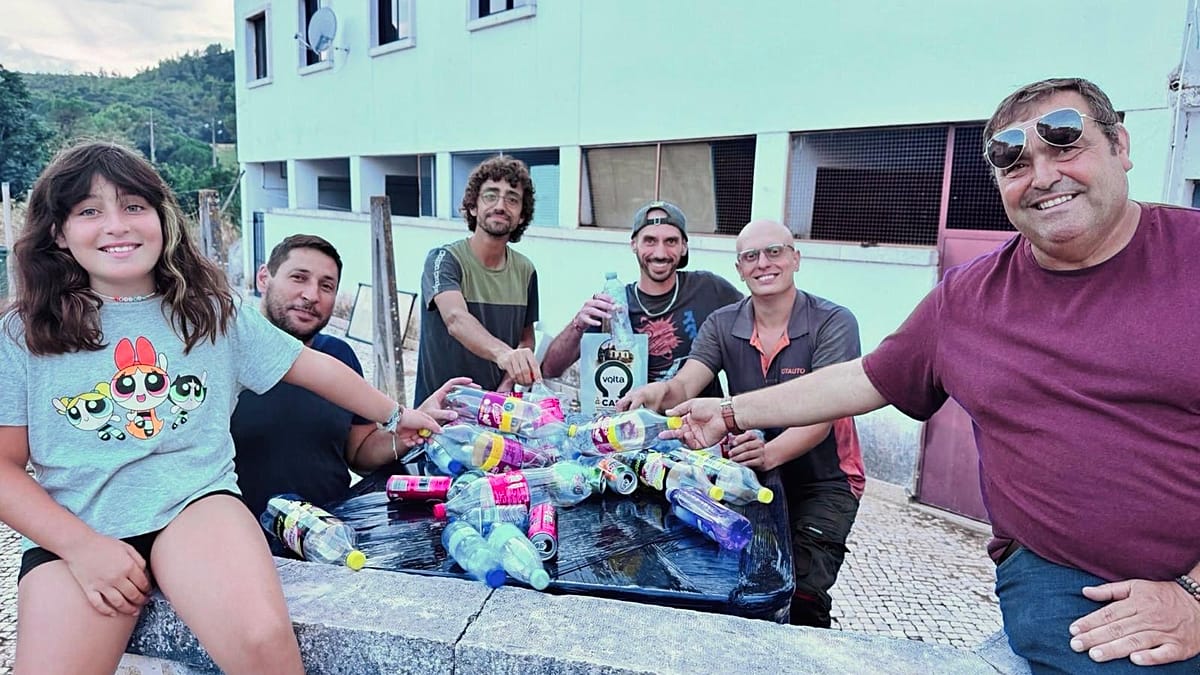
“We can’t let this fall apart”
For the past two weeks there has been a bin at Ota Parish Council’s office for residents to leave their empty plastic bottles. In the centre of the parish a 1,000-litre container has also been left for bottles to be deposited – it filled up with bottles in just a few days.
“As we have a lot of people using it, we’re thinking of putting out two more containers, one at each end of the parish,” explains Nelson Mota.
Nelson grew up in Ota and remains closely connected to the area. He is part of Guarda à Casa, a civic movement that wants to restore the building where the forest rangers of the Serra da Ota used to live.
“We decided that we can do something; we can’t let this fall apart,” he says. “If the competent authorities can’t reach us, because this year, with the deluges we’ve had, it’s normal that the councils can’t support certain projects.”
Then the idea emerged of using the Volta system to raise money.
“Volta is an easy way to raise some money. It’s not substantial amounts, but the kind of sums you need to start organising some events.”
As well as the containers, the group also has the support of the Recreational and Sports Association, which is donating the bottles from its bar. Members of the civic group are also collecting bottles from friends and at work and then, themselves, reclaim the money at a Volta machine.
“I myself made a deposit yesterday; it came to €11.60. In other words, it was 116 bottles,” explains Nelson Mota. “I handed in 116 bottles, which didn’t take up space in the car, and it gave me €10 with no difficulty. I think it’s worth it, isn’t it?” he tells Euronews.
The success of the initiative does not surprise Nelson Mota: “Of course we’re getting a good reception. People in Ota, whenever there are initiatives of this kind, always try to help. That’s just how people are there.”
“I never imagined it would get this big”
Ariela and Alice’s project is being given a big boost by social media. Their “Sonho na garrafa” pages explain the collection process and keep a running tally of how many bottles they have managed to gather so far.
“I wanted to create that social-media presence and show this project so that it would reach people and be recorded for her future,” says Karina Lauro, referring to her daughter’s university dream. “But I never imagined it would get this big, because people started to embrace it.”
The Instagram account has more than 12,000 followers and the TikTok has more than 250,000 likes. In this way more people have started to send encouraging messages and also to want to contribute, including people living abroad.
“Once the internet started to see them, people began wanting to donate bottles as well, to donate the money from exchanging bottles,” says the mother, adding that she only accepts donations if they come from bottle deposits.
“There is a person in Ireland who sends money every week. In Ireland it’s 25 cents per bottle, so she exchanges them there and sends it to the children.”
Another big boost came from restaurants, which also wanted to get involved in the project. It is the mother herself who now collects the bottles from the restaurants, once a week.
By mid-August they had collected more than 5,300 bottles and €537.
“But now more messages have started to come in from other restaurants, wanting to help as well. So, with the restaurants coming on board, that number will probably double.”