
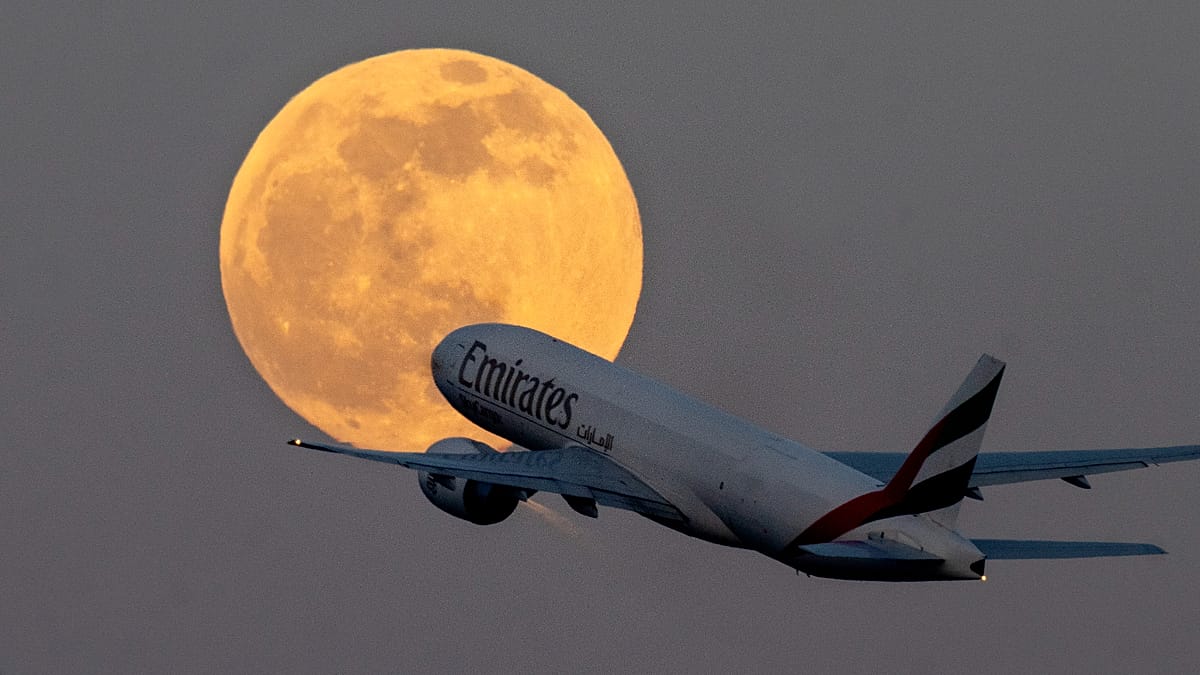
Airlines posted record profits in their most recent financial results, with the top nine carriers together clearing $25.11 billion (€22bn), according to an analysis by the Dubai-based investment firm One Investments of net earnings across the industry.
Emirates leads the pack for a second consecutive year, but the fine print, and the calendar, matter enormously.
Emirates reported a record $5.4 billion (€4.7bn) net profit for the first quarter of this year, the best result in its history and, by its own account, the industry’s best, despite what chairman Sheikh Ahmed bin Saeed Al Maktoum described as significant challenges in the final month, after the start of the Iran war shut Gulf airspace at the end of February.
Delta follows at $5 billion (€4.3bn), cementing its lead among US carriers, ahead of United with $3.4 billion (€3bn).
Europe’s champions come next.
Ryanair earned €2.26 billion in its year to March, up 40% on surging fares, while Turkish Airlines made roughly $2.4 billion (€2.1bn) on record revenue, though its profit slipped.
Singapore Airlines’ $2.1 billion (€1.8bn) carries the ranking’s biggest asterisk, addressed below. Qatar Airways posted $1.94 billion (€1.7bn), Cathay Pacific around $1.27 billion (€1.1bn) in its third straight solid year, and Japan’s ANA about $1.1 billion (€963 million).
Singapore Airlines’ figure includes a one-off, non-cash accounting gain of S$1.1 billion ($800 million) booked on the Air India-Vistara merger. Its underlying profit was therefore roughly $1.3 billion (€1.1bn).
The list also covers individual carriers only, excluding multi-brand parents such as IAG and Lufthansa Group, which is why British Airways and Lufthansa are absent.
Qatar Airways and Emirates Group are single-carrier groups spanning only their airline, cargo, and duty-free businesses, and they report only at group level, so those figures stand.
The Iran war changes the picture
The rankings capture an industry at its peak just as the ground shifted.
Qatar Airways’ result was actually a decline of nearly 10%, despite a record operating profit, after the conflict closed Qatari airspace in its final quarter.
“It is not often that a single financial year asks an organisation to demonstrate both the best of what it can achieve and the depth of what it can withstand,” said CEO Hamad Al-Khater.
Emirates carried 1% fewer passengers for the same reason, but the pain is only starting to register, and the Iran war now appears to have reignited for the second half of the year.
Jet fuel, which One Investments notes already consumed about 25.8% of airline operating costs in 2025, spiked above $150 a barrel after the war disrupted the Strait of Hormuz, and the International Air Transport Association has warned that global airline profits are on course to halve this year, even though oil is currently trading at around $85 a barrel.
Ryanair, which hedged 80% of its fuel needs at around $67 a barrel, declined to give guidance for the year ahead, citing poor visibility.
The next edition of this ranking could read very differently.