
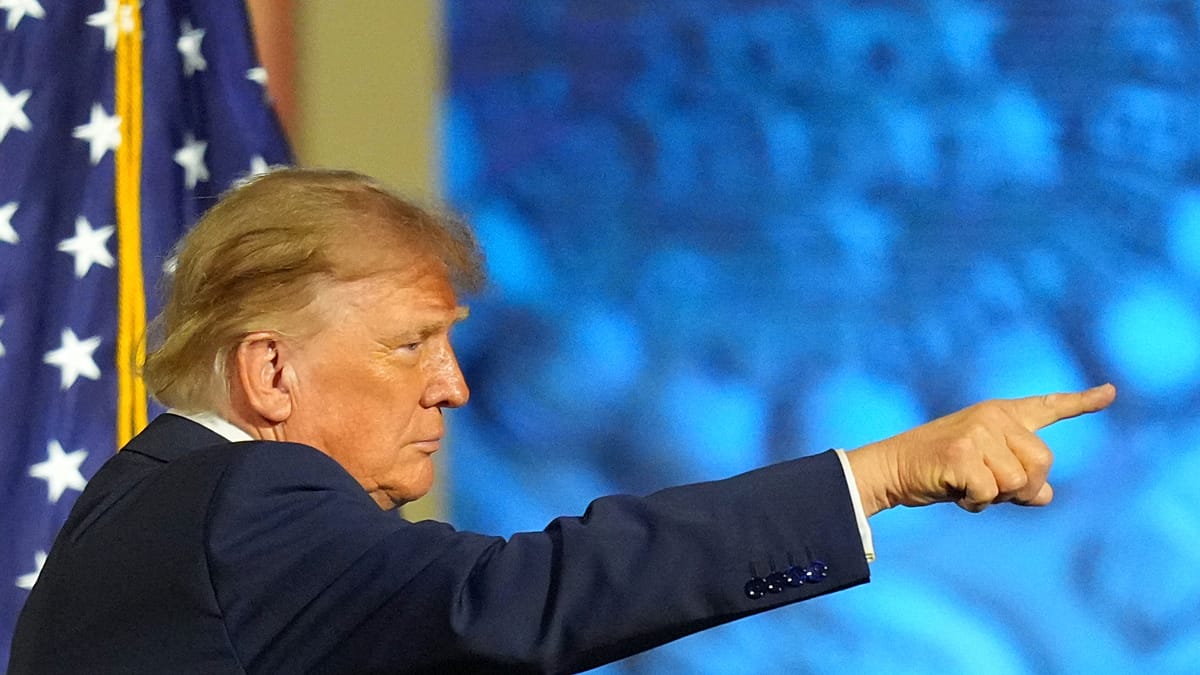
The US president has promised to give every adult citizen a $5,000 (€4,290) payment if Republicans retain control of both the House of Representatives and the Senate.
The proposal could cost almost $1.2 trillion (€1.03 trillion), exceeding the Pentagon’s full 2026 budget request.
“If the Republicans win, you win with us and you get $5,000. It will be called the Trump dividend,” Trump told the Republican midterm convention in Dallas on Wednesday, as the party struggles in the polls against the Democrats.
He compared the payments with the dividends distributed by companies to their shareholders, citing “our tremendous strength and success economically”.
Within an hour, Vice President JD Vance appeared to scale back Trump’s proposal, at least in part, by suggesting that wealthy Americans would not receive the payments.
The US had around 240 million adult citizens at the time of the 2024 presidential election, including 174 million registered voters, according to the latest comprehensive US Census Bureau figures. Only about 70% of the voting-age population was registered to vote.
Giving every adult citizen $5,000 would therefore cost almost $1.2 trillion. That is around $220 billion (€189bn) more than the Pentagon’s entire $961 billion (€825bn) budget request for 2026, according to figures by the Congressional Budget Office. Limiting the payment to registered voters would cost around $870 billion.
A $5,000 cheque would give each adult more than they received through the two rounds of direct federal payments approved during Trump’s first term.
What could it cover?
Average US household spending was $78,535 (€67,400) in 2024, or $6,545 (€5,620) a month, according to the US Bureau of Labor Statistics.
If two adults sharing a home each received $5,000 (€4,290), their combined payment of $10,000 (€8,580) would cover around 11 months of an average household’s total food spending, or about 18 months of grocery spending. These calculations use 2024 expenditure figures adjusted for the 6.45% increase in consumer prices by July 2026.
Housing was the largest expense, accounting for 33.4% of the average household budget. Households spent $26,266 (€22,540) on housing in 2024, equivalent to around $27,960 (€24,000) in July 2026 prices. Two $5,000 payments would therefore cover just over four months of average housing costs.
The combined payment could also cover around eight-and-a-half months of average transport costs or 18 months of healthcare spending. At almost six times the average household’s annual education spending, it could theoretically cover nearly six years of those costs.
However, the education figure is an average across all households, including those with little or no education spending.
What would it cost?
Trump’s proposal comes shortly after the country’s national debt passed $40 trillion (€34.3 trillion) for the first time. The US is also running an annual budget deficit of nearly $1.8 trillion (€1.54 trillion), while inflation remains a concern.
“The idea that we’ve had fiscal success is backwards and bordering on laughable,” said Marc Goldwein, senior policy director at the Committee for a Responsible Federal Budget, a Washington-based think tank. “We don’t have surpluses to give away.”
Concerns about the country’s debt are being compounded by high government borrowing costs.
The yield on the benchmark 10-year Treasury note rose above 4.85% on Wednesday, its highest level in nearly three years, before easing slightly, while the 30-year yield climbed to 5.29%, close to the 18-year high of 5.33% reached in August.
Treasury yields help determine borrowing costs across the US economy, so sustained increases can make mortgages and business loans more expensive, slow economic growth and weigh on share prices.
With the government already running a large deficit, it remains unclear how the proposed payments would be financed.
Vance suggested that they could be funded using US tariff revenue.
The government expects to collect about $406 billion (€348 billion) in customs duties during the 2026 fiscal year, according to the US Treasury Department. This includes all customs duties, not only tariffs introduced by Trump.
That would cover only around a third of the estimated $1.18 trillion (€1.01 trillion) cost of paying every adult citizen $5,000 (€4,290). Even limiting the payments to the country’s 174 million registered voters would cost around $870 billion (€747 billion) — more than twice the projected annual customs revenue.
When Trump discussed a similar payment earlier this year, he proposed a $2,000 (€1,720) dividend and said he did not believe he needed congressional approval.
Last year, Trump gave members of the military a $1,776 (€1,520) cheque that he called a “warrior dividend”.
“I will get a bill ready so that we can get the Trump Dividend passed immediately after the November 3rd election,” Republican Senator Bernie Moreno of Ohio wrote on X late Wednesday. “Because Republicans (and America) will win!”
However, Congress would need to approve the proposed payments.
Trump’s proposal would be legal because the payment would be available regardless of how someone voted — or whether they voted at all — according to New Mexico-based lawyer John Day.
“This is a campaign promise,” Day said. “It’s not a payment to individuals to try to get them to vote in a particular way.”
Republicans are on the defensive as they seek to protect their narrow House majority against strong political headwinds. Trump is unpopular and polls indicate that most Americans oppose the war in Iran. Even the Senate, which Republicans once appeared well placed to retain, is now considered competitive.