
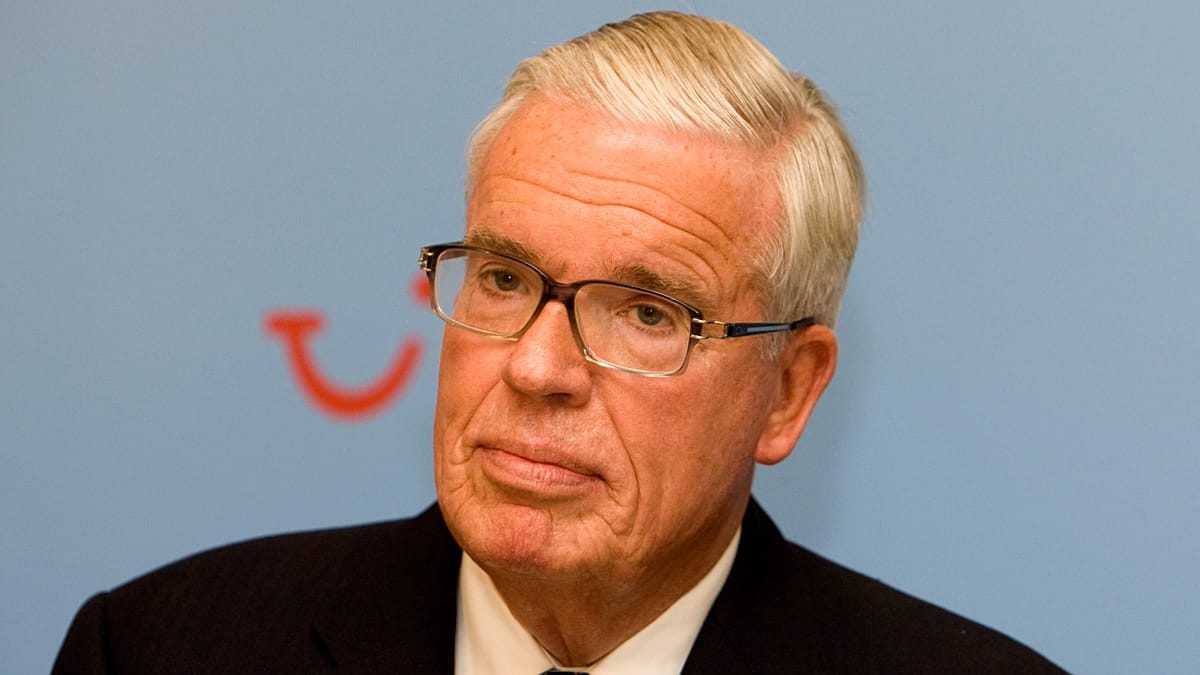
Logistics magnate and (formerly) Germany’s richest man, Klaus-Michael Kühne spent his life buying and rescuing companies on the downturn. It was a strategy that led him to build the world’s single most successful air and sea forwarder, Kühne+Nagel.
Along the way, he also picked up significant stakes in three other transport giants, including Hapag-Lloyd, one of the world’s biggest container shipping lines, and Lufthansa, Germany’s flag carrier.
He also briefly owned a fifth of VTG, Europe’s largest private wagon-hire company, buying in for €160 million in 2016 and selling two years later for €300 million.
It turns out he had one more deal lined up, and he closed it the moment he passed away.
Kühne had no children or direct lines of inheritance set up, so when he died on 24 August 2026, his $49 billion (€42.2bn) fortune did not need to pass through a will, a court or a tax office.
It moved, as planned decades in advance, into the Kühne Foundation, a charity he set up with his parents about 50 years ago.
Overnight, that foundation became one of the biggest in Europe.
A Swiss tax-free haven
The German shipping and logistics tycoon, who built Kühne+Nagel into a global freight giant, died aged 89 in Schindellegi, a village of roughly 5,000 people in canton Schwyz, one of only two cantons in Switzerland that charges no inheritance tax at all, on anyone, whether they are related or not.
Kühne made no secret of his frustration with Germany’s tax and economic system. In a 2022 interview with German broadcaster NDR, he said plainly that the state “cannot manage the economy properly”.
This is widely considered one of the reasons he based his personal and corporate affairs in Switzerland instead, alongside the total absence of inheritance tax in his home canton of Schwyz.
Swiss law does not require private companies to publish annual reports, unlike almost every other jurisdiction in Europe, and German media reports estimate that as much as 30% of Kühne’s true wealth may not be publicly known as a result.
Foundations, too, do not pay inheritance tax because there is no inheritance to tax — in short, nobody personally received Kühne’s fortune.
Instead, his shipping, aviation, chemicals, and real estate empire will be owned collectively by the non-profit, overseen by a board of trustees that includes his wife and a small circle of long-time advisers.
Kühne kept his business empire inside a private vehicle, Kühne Holding, also based in Schindellegi. With his death, ownership of that holding company — and everything inside it, from the Kühne+Nagel stake to Hapag-Lloyd and Lufthansa — passes to the Kühne Foundation, according to Swiss newspaper Neue Zürcher Zeitung.
The foundation already runs 20 subsidiary organisations and has around 800 staff.
Its own reporting puts its 2026 budget at CHF135 million (€144.6 million), split roughly 42% toward logistics education, 20% medicine, 15% climate projects, 11% humanitarian logistics and 7% culture.
The assets now flowing into the foundation are expected to generate dividend income in the region of CHF1 billion a year in an ordinary year, according to NZZ — even if only part of that reaches the foundation itself, it would sharply increase its financial firepower.
Kühne is not the first European tycoon to evade inheritance tax through philanthropy, and once his assets land in the Kühne Foundation, it will sit in genuinely elite company by size, if not quite at the very top.
The world’s largest is the Novo Nordisk Foundation, the Danish charity behind the hit weight-loss drugmaker Novo Nordisk, whose holding company managed roughly €93 billion in assets at the end of 2025.
Below that sit the likes of the Gates Foundation at around $70.2 billion (€60.5bn) and India’s Tata Trusts at upwards of $100 billion (€86.2bn). Britain’s Wellcome Trust, the medical research charity, held about $42.8 billion (€36.9bn) as of its most recent published figures — putting it in roughly the same bracket as Kühne’s estimated incoming inheritance.
Germany’s own Robert Bosch Stiftung, which owns 94% of engineering group Bosch, is a useful contrast in the other direction with around €5.5 billion in total assets — nearly eight times smaller than what Kühne has just handed over, despite Bosch being one of Germany’s most recognisable industrial names.
Denmark’s Carlsberg Foundation follows a similar model to Kühne’s, holding just under 30% of Carlsberg Group’s shares with 77% of the voting power, plus around €1.55 billion in separate investments, funded by roughly a third of the brewer’s annual dividend.
So while Kühne’s foundation will not be the biggest charity of its kind in Europe, it lands squarely among the top ten wealthiest charitable foundations in the world, ahead of long-established names like Bosch and on par with Wellcome — built, unusually, almost entirely from one man’s decision not to have children and to live in the one place in Switzerland where that decision cost him nothing in tax.
A conglomerate funding a charity
What actually moves into the foundation is not simply a bank balance.
It is Kühne’s majority stake in Kühne+Nagel, a 30% holding in shipping line Hapag-Lloyd, a 15% stake in chemicals group Brenntag, a chunk of bus operator Flix, more than a fifth of Lufthansa, and property including Hamburg’s Fontenay hotel.
His net worth had more than quadrupled over the past decade to $49 billion (€42.2bn), according to the Bloomberg Billionaires Index, built largely on an almost 60% stake in Kühne+Nagel itself.
That raises a question with no clear answer yet — what does a charitable foundation do with a controlling stake in a container-shipping empire during the biggest wave of consolidation the industry has seen in years?
In recent years, French shipping and logistics giant CMA CGM struck a deal with FedEx, MSC has pushed into oil tankers, and easyJet has agreed to a takeover. Kühne’s holdings sit in the middle of all of it.
Switzerland’s very specific approach to taxation — or lack thereof — nearly changed the whole calculus for the Kühne Foundation.
In November, the country rejected a proposal for a federal inheritance and gift tax of 50% on estates over CHF50 million (€53.4mn), a measure aimed squarely at the ultra-wealthy residents the country has spent decades attracting.
Finance minister Karin Keller-Sutter, speaking to media in Bern after the result, said the proposal would have “unbalanced our tax system [and] damaged Switzerland’s attractiveness,” calling the outcome a rejection of a “risky fiscal policy experiment”.