


Published on
Calls for a meat tax continue to intensify, as evidence mounts on how our carbon-intensive diets are baking the planet.
Food and agriculture contribute one-third of global greenhouse gas emissions, second only to burning fossil fuels. A 2023 study published in the journal Nature found that greenhouse gas emissions from the way humans produce and consume food could add nearly 1℃ of warming to the Earth’s atmosphere by 2100.
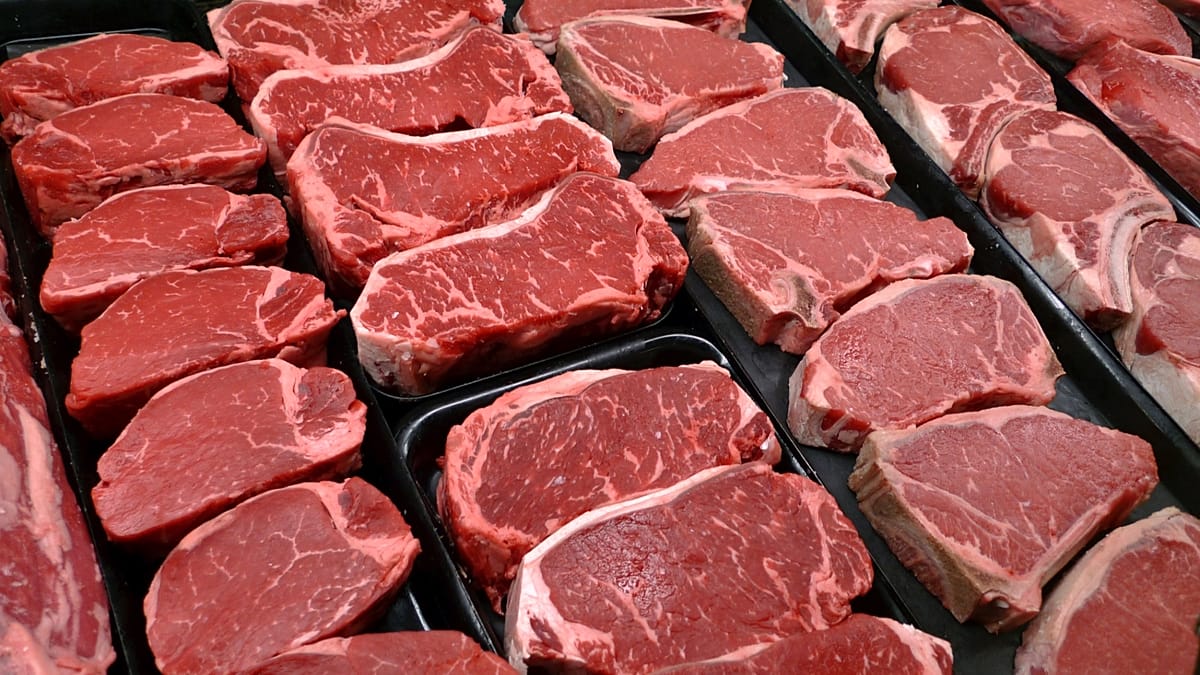
Meat, particularly beef and lamb, is often identified by scientists as one of the biggest culprits of environmental damage. According to CO2 Everything, one 100g serving of beef is equivalent to 78.7 km of driving, releasing 15.5 kg CO2 equivalent.
And still, the EU has shown no concrete plan of introducing a meat tax or encouraging member states to transition towards a predominantly plant-based diet – a move that could slash agricultural emissions by 15 per cent.
What would a meat tax look like?
A new study from the Potsdam Institute for Climate Research (PIK) analyses the ecological footprint from diets along with policy options that could counteract them.
“From an economic perspective, you should add the produced-related environmental costs incurred during production to the price,” says Charlotte Plinke, PIK researcher and author of the study.
“This would mean that the more CO2 is emitted, the more expensive it becomes.”
However, Plinke argues that implementing such a system for the “enormous variety” of foods Europeans consume would be “very complex” and impractical in the short term.
As a result, researchers argue that the simplest option is to target the value-added tax (VAT) of meat products. Food purchased in supermarkets is often subject to a reduced rate compared to food sold in restaurants and cafes (although there are some exemptions).
For example, in Germany, food from shops comes with a seven per cent VAT instead of 19 per cent, which helps prices stay low. In 2023, 22 of the 27 EU member states also applied a reduced tax rate to meat purchases.
Researchers found that subjecting meat to the standard VAT rate could reduce the environmental damage caused by food consumption by between 3.48 and 5.7 per cent, depending on the damage category.
This is likely to be caused by a decrease in sales, which could push consumers into buying more fruits and vegetables. A 2025 from University of College London found that applying full rate VAT to meat and dairy products would decrease the intake of both groups by a portion per week each in EU countries. In the UK, this reduction would double to two portions of each food group per week.
How much would a meat tax cost?
Removing the reduced VAT rate on meat would increase the average annual food expenditure in EU households by around €109. However, researchers say this would be offset by additional tax revenues of €83 per household, which could, in theory, be used to finance social compensation using a per capita payment.
This would mean such a policy would only have to increase annual net costs to €26 per household.
Researchers then calculated a scenario in which the state sets a consistent price difference based on the level of greenhouse gas emissions associated with each product. They predicted that a general price surcharge of around €52 per tonne of CO2 equivalent would help to avoid the same amount of food-related greenhouse gas emissions as removing the VAT rate reduction on meat.
“Such a comprehensive price signal would reduce the other environmental impacts, beyond greenhouse gases, even a little more than the selective VAT price signal for meat,” says Michael Sureth, author of the study.
Over time, this price difference could be increased to account for other climate and biodiversity impacts of meat products, eventually providing capital to address these problems.
Sureth adds that strong social compensation could allow net costs to fall, leaving the average EU household just €12 worse off per year.