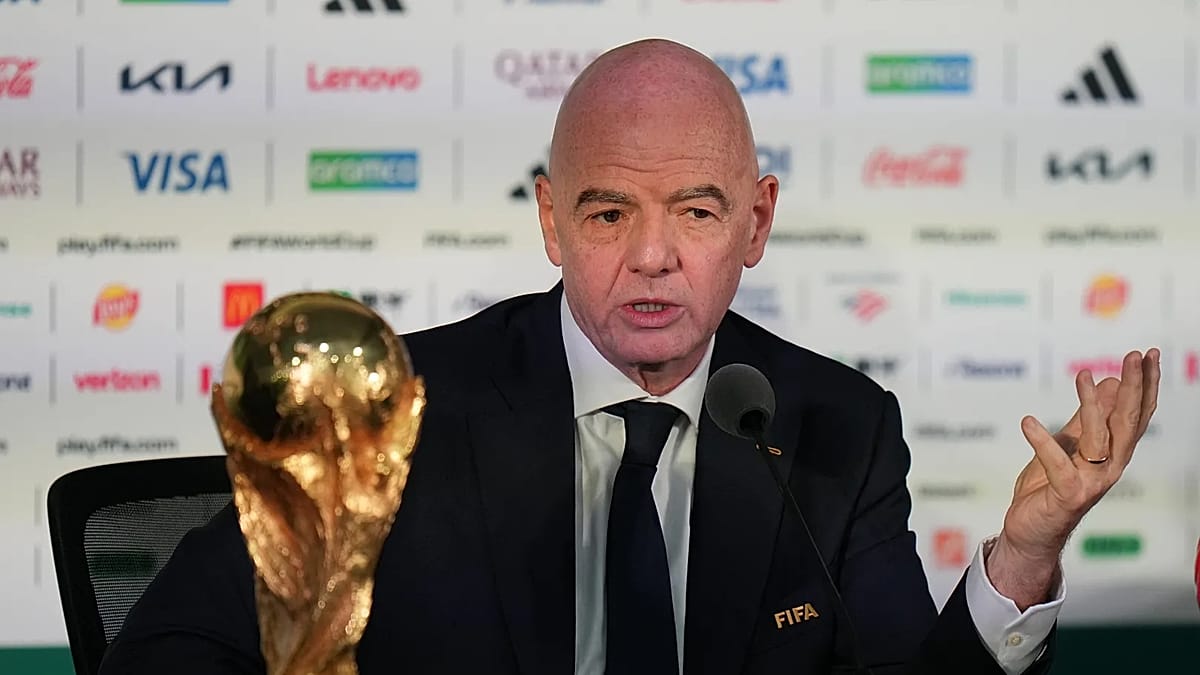





The 2026 FIFA World Cup, which starts on 11 June across the US, Canada and Mexico, is the largest in the tournament’s history, with 48 national teams competing across 16 host cities for the first time.
FIFA itself has staked enormous claims on the economic returns, projecting a $30.5 billion (€26.1bn) windfall for the three host nations combined and that the tournament will generate up to $40.9 billion (€35bn) in additional global GDP.
The organisation also estimates that roughly 824,000 jobs directly or indirectly linked to the event will be created.
However, as the opening whistle of the first match draws closer, analysts are warning that the real numbers, when they finally come in, may paint a considerably more modest picture than the current narrative.
FIFA estimates that total costs for this World Cup, including expenditure from the organisation, host cities and investors across the US, Canada and Mexico, will be around $14 billion (€12bn). The US alone is expected to absorb more than $11 billion (€9.4bn) of that sum.
According to an analysis from Danish bank Saxo, the headline figures flatter the actual impact and experts on average estimate less revenue generation than FIFA.
As an example, for the US, whose economy dwarfs most of its rivals, a projected $17 billion (€14.5bn) boost amounts to less than 0.1% of GDP, rendering the World Cup a marginal growth driver.
Mexico stands out as the relative winner of this tri-national arrangement. With an estimated $3 billion (€2.57bn) in anticipated economic benefits representing between 0.2% and 0.5% of GDP depending on the model used, as the influx of visitors carries greater visible weight in an economy more reliant on tourism and services.
Host cities such as Guadalajara, Monterrey and Mexico City are positioned to feel the economic effect most acutely.
Meanwhile, Canada is projected to see around CAD 3.8 billion (€2.36bn) in benefits, though analysts note these figures must be weighed against the substantial public costs.
A recent study by Oxford Economics also found that while the 11 US host cities would see GDP growth concentrated in leisure and hospitality this summer, with Houston, New York and Dallas among the primary beneficiaries, any job gains would prove temporary.
The research noted that because almost no new infrastructure has been built specifically for this tournament, tourism activity surrounding the matches will largely displace existing visitor flows rather than generate added economic value.
The ‘white elephant’ problem and impact on GDP
Recent history of World Cup tournaments provides a sobering benchmark.
Firstly, final costs for hosting tend to greatly surpass initial estimates. Research by Professor Bent Flyvbjerg at the University of Oxford found that mega sporting events regularly exceed their budgets by an average of 172%.
This ballooning effect is mostly explained by the fact that a World Cup cannot be postponed. When infrastructure projects suffer delays, organisers are forced to accelerate construction at any cost to meet the opening deadline.
In practice, public finances usually absorb these overruns.
Secondly, beyond the actual costs, there is a question of the medium to long-term economic benefit of the large investment made.
Studies show that a significant share of the infrastructure built for the tournaments generates little lasting value once the competition ends. For example, many stadiums become so-called “white elephants” that are costly to maintain but greatly underused after the event.
The 2014 World Cup in Brazil and the 2022 World Cup in Qatar are prominent examples of this problem as they produced a series of stadiums with no sustainable post-World Cup purpose. For instance, the “Arena da Amazônia” in the Brazilian city of Manaus is an enduring symbol of misallocated public spending.
Qatar 2022, at nearly $220 billion (€188.6bn), became the most expensive World Cup on record, transforming an entire country in terms of infrastructure but leaving questions about long-term economic effect.
The 2026 edition does carry a materially different profile in this respect. The US, Canada and Mexico already possess most of the required venues, nearly all of which are operated by profitable professional sports franchises with established fan bases.
The “white elephant” risk is substantially lower this year but the hosts are still expected to go over budget.
What remains a genuine concern is demand.
According to a survey of more than 200 hotels across the 11 US host cities by the American Hotel and Lodging Association, nearly 80% reported bookings tracking below initial forecasts.
Respondents to this survey cited difficulties for overseas visitors in obtaining visas, elevated geopolitical tensions and steep ticket and travel prices dragging on attendance.
Some hotels went so far as to describe the tournament as a “non-event”.
Besides, even if demand were to meet expectations, historical analysis shows that estimates of real impact on GDP must be interpreted with caution as results tend to diverge significantly from initial projections.
Even if growth is observed, it is generally time-limited, highly localised and partially offset by substitution and crowding-out effects.
These terms refer to the macroeconomic phenomenon that occurs when increased government borrowing, spending or market intervention reduces private sector investment and consumption.
Overall macroeconomic benefits therefore remain limited, particularly for economies the size of the US.
In this context, the 2026 World Cup should be understood less as a driver of structural economic transformation and more as a temporary reallocation of activity, with its real scope being often more modest than the narrative suggests.
The bottom line, as Oxford Economics and Saxo Bank also concluded in their analyses, is that some GDP growth will materialise this summer, but it will be temporary, localised and, for the world’s largest economy at least, barely perceptible at the aggregate level.
The biggest football show on Earth, it turns out, may be a far quieter affair for national economies than its organisers argue.