
A long-awaited trial into Greece’s worst train tragedy opened on Monday only to be adjourned until 1 April amid chaotic scenes in a courtroom too small to handle the huge interest in the case, officials said.
Hundreds of people turned up for the trial into the 2023 train collision that left 57 dead, leading to complaints from lawyers that the venue was “insultingly” unsuitable and potentially violated fire safety regulations.
Amid angry booing from the public, presiding judge Georgia Stefanidou said: “The court is adjourned until 1 April, owing to conditions that could cause fainting.”
The hall was so stifling that two lawyers formally complained to the fire department and demanded an immediate inspection.
Maria Karystianou, from the association of victims’ families, told reporters that relatives had been “packed like sardines.”
She said it was “an absolute disgrace”, noting that she and accident survivors had had to sit in the seats of the accused.
Government spokesman Pavlos Marinakis insisted that the venue chosen, a remodelled university lecture hall in the central city of Larissa, was one of the two biggest courtrooms in Greece.
Marinakis told reporters that the hall had seating for over 460 people and blamed the issue on a higher-than-expected number of observers.
Thirty-six people face charges and over 350 witnesses are due to be heard at the trial.
It is being conducted around 30 kilometres from the spot near Tempi, central Greece, where a freight train and a passenger train smashed into each other on 28 February 2023.
Among those to testify are survivors and family members of the victims, some of whom are believed to have burned to death after surviving the initial collision.
Most of the dead were students returning from a carnival weekend.
‘Burned alive’
Karystianou, a paediatrician who led the association of victims’ families for several years and now plans to launch a political party, said no investigation was carried out into how her daughter “burned alive.”
The accused include the station master on duty on the night of the accident, other railway officials and two Italian former employees of the trains’ parent company, Ferrovie dello Stato.
The two trains had run on the same track for more than 10 minutes without triggering an alarm.
The head-on collision exposed the parlous state of safety precautions in Greece’s railway network, despite European Union grants for their modernisation and repeated warnings from unions.
“This trial clearly demonstrates all the corruption of the Greek state, the corruption that killed our children,” Christos Vlahos, the parent of one victim, said outside court.
The trial is expected to last several years.
Thirty-three of the defendants face criminal charges and risk up to life in prison.
None of the accused are currently in jail, although some have served time in pre-trial detention.
The head of the European Public Prosecutor’s Office, Laura Kovesi, said the collision could have been avoided if the signalling system had been modernised in time using EU funds.
Train workers staged a 24-hour strike on Monday, which their union called “an act of collective remembrance (and) protest.”
‘Blatant cover-up’
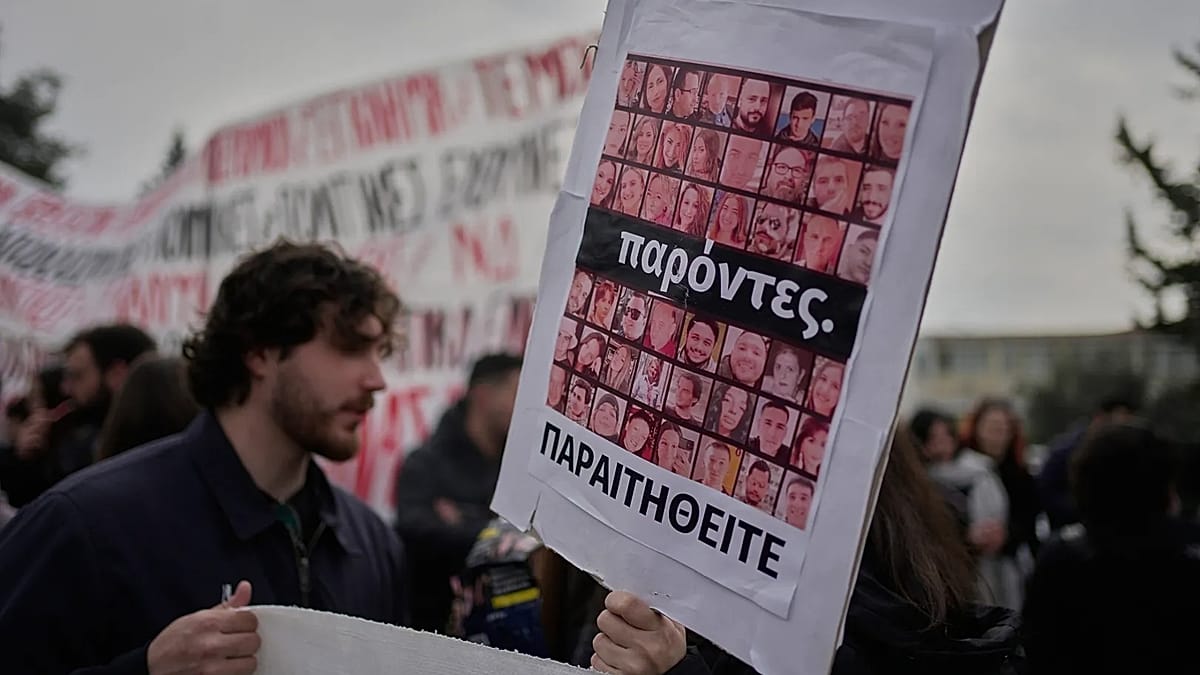
Tens of thousands of people protested nationwide to mark the accident’s third anniversary last month.
The accused include the duty station master, Vassilios Samaras, as well as two station masters who left their posts before the end of their shift.
Managers and employees of rail network operator Hellenic Railways Organisation (OSE) are also on trial, alongside two senior transport ministry officials and two Italian executives from Hellenic Train, a subsidiary of the Italian state’s Ferrovie dello Stato.
No political official will be in the dock.
This has fuelled resentment of Prime Minister Kyriakos Mitsotakis’s conservative government, whose handling of the disaster is widely seen as disastrous.
Valuable evidence was lost when, just days after the collision, a bulldozer levelled the site.
Communist party leader Dimitris Koutsoumbas told reporters on Monday the investigation into the crash had been closed “hurriedly”, leaving “huge gaps” in the case.
He called it a “blatant cover-up.”
Two former ministers, including ex-transport minister Kostas Karamanlis were referred to justice by parliament but face only misdemeanour charges at present.
“There are people who should be here as defendants, such as Kostas Karamanlis, who killed our people,” Pavlos Aslanidis, whose 26-year-old son died, told reporters before the trial.
Despite the disaster, Mitsotakis comfortably won re-election just months later and went on to defeat two parliamentary votes of no-confidence on the issue.