


Nobel prize winners get prestige, a gold medal, and a little over a million dollars. Ig Nobel prize winners don’t get such sublime considerations.
They do get acclaim, but instead of all the Nobel perks, they are instead showered with paper planes and 10 trillion Zimbabwean dollars.
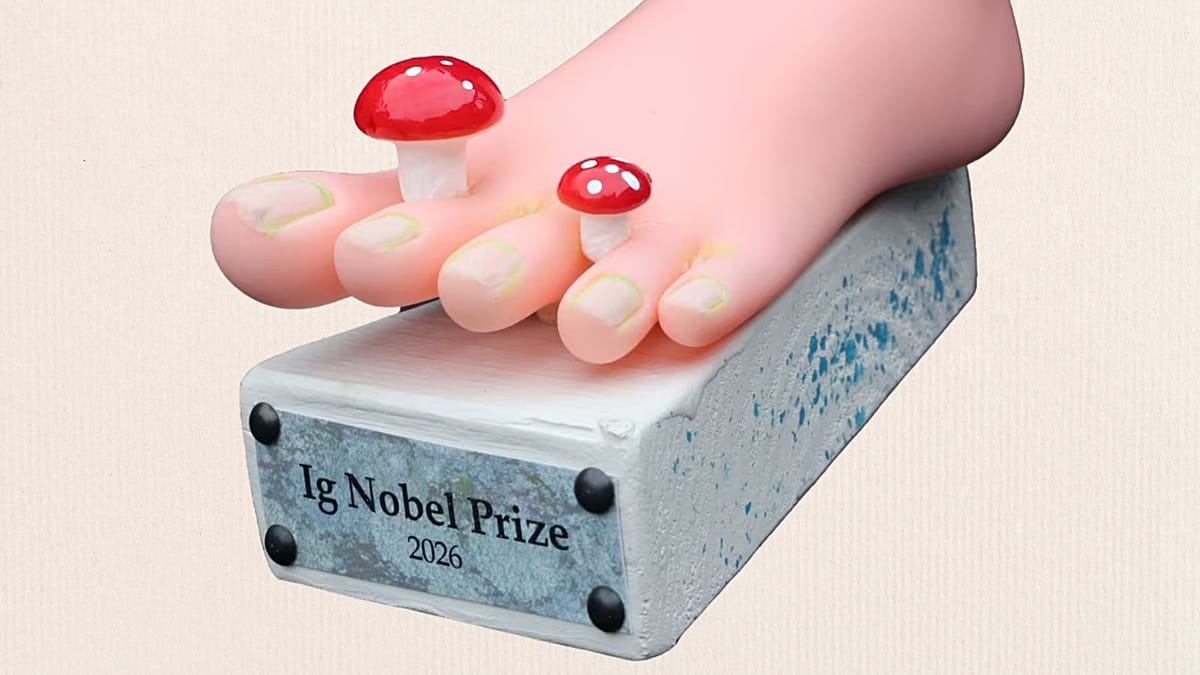
The snag is that the currency cratered years ago, so 10 trillion Zimbabwean dollars is worth next to nothing. Still, last year’s winners went home with a single packaged moist towelette, so swings and roundabouts… Plus, this year’s winners were given a statuette representing a slab of blue cheese trampled on by a foot erupting with toadstools in honour of this year’s “fungi” theme. What’s not to love?
Established in 1991 as a satirical version of the Nobel prize, the Ig Nobels aim to promote public engagement with scientific (and culturally resonant) research, honouring “achievements that first make people laugh, and then make them think”.
This year’s Igs were awarded yesterday at a ceremony in Zurich, Switzerland – a first, as the award ceremony is usually held in the US. The reason, the organisers say, comes down to the hostile climate in the US toward science, as well as international travellers being increasingly reluctant to travel Stateside.
A perfectly ordinary and not at all alarming English sentence.
“During the past year, it has become unsafe for our guests to visit the country,” Marc Abrahams, master of ceremonies and editor of The Annals of Improbable Research magazine, told AP. “We cannot in good conscience ask the new winners, or the international journalists who cover the event, to travel to the US this year.”
Back to this year’s research and winners, who have discovered that the upper classes are more prone to behaving badly, that kissing can be redefined and cockroaches will inherit the Earth in more ways that one.
Here’s a look at some of this year’s winners:
Biomechanics: Evolutionary smooching
Winners: Matilda Brindle, Catherine Talbot, Stuart West (UK, USA).
Rationale: “Devising a more precise definition of kissing – non-agonistic interactions involving directed, intraspecific, oral-oral contact with some movement of the lips/mouthparts and no food transfer” – in ants, polar bears, and humans.
Research: A comparative approach to the evolution of kissing. Dr Matilda Brindle and her colleagues developed a rigorous definition of kissing through the study of different species. They found that kissing occurs in most living large apes and likely in Neanderthals – arguing that early humans and Neanderthals may have even kissed one another. “Next time you kiss someone, you can think, ‘This is a 21.5 million-year-old tradition that I’m honoring here,” said Dr Brindle. “It’s not just a modern human behaviour. It’s really ancestral. And to us, that suggests that it probably has quite a useful evolutionary function.”
Economics: Rich people are the worst
Winners: Paul Piff, Daniel Stancato, Stéphane Côté, Rodolfo Mendoza-Denton, and Dacher Keltner (USA, Mexico, Canada).
Rationale: “Amassing evidence that upper-class people are more likely to snatch from a children’s candy, and engage in other kinds of unethical behaviour.”
Reasearch: Higher social class predicts increased unethical behaviour. The researchers amassed evidence through seven studies that prove rich people are just the worst. They’re more likely to take sweets from children, excel at lying when it comes to their scores during dice rolls, are more likely to cut other cars off at junctions, and view greed as a positive attribute. “The general pattern seems to be that with wealth and rising power, you become less engaged with the needs of others and less burdened by the needs of social relationships,” Piff said. “Taking candy from children might be the least of our worries but it’s emblematic of the tendency to prioritise one’s own needs over those of others.”
Turns out Dorothy Parker was right: “If you want to know what God thinks of money, just look at the people he gave it to.”
Chemistry: Cockroach milk, anyone?
Winners: Sanchari Banerjeee, Nathan Coussens, Francois-Xavier Gallat, Nitish Sathyanarayanan, Jandhyam Srikanth, Koichiro Yagi, James Gray, Steven Tobe, Barbara Stay, Leonard Chavas, Sumabramanian Ramaswamy (India, France, Japan, USA).
Rationale: “Discovering that milk proteins from vivaporous cockroaches contains three times as much energy as milk proteins than from cows.”
Research: Structure of heterogeneous, glycosylated, lipid-bound, in vivo-grown protein crystal at atomic resolution from the viviparous cockroach Diploptera punctata. If that sentence just gave you a headache, it boils down to the authors extracting milk crystals from the guts of Diploptera punctata roach embryos harvested from a brood sac to determine the protein structure of the crystals. Essentially, cockroach milk is powerful.
Physics: The optimization of urination
Winners: Randy Hurd, Zhao Pan, Tadd Truscott, Kaveeshan Thurairajah (Canada, USA, China, Saudi Arabia).
Rationale: “Theoretical and experimental attempts to design a splash-free urinal.”
Research: Splash-free urinals for global sustainability and accessibility. A team of students at the University of Waterloo in Canada worked out that urinal splash is almost entirely eradicated if the stream strikes the urinal at less than 30 degrees. They even designed a urinal whose shape ensures minimal splash regardless of the user’s aim. “I am very proud,” said Dr Zhao Pan. So he should be.
Medecine: Thrusting mucus
Winner: Takuji Unno (Japan).
Rationale: “How to Blow the Nose – An Aerodynamic Study of the Nose Blowing.”
Research: Unno explored the cultural differences between Europeans and Japanese people when it comes to proper nose-blowing, quantifying the key aspects of the practice “to give good instructions to those who do not understand how to blow the nose.” He concluded that the faster the “expiratory thrust” of the blow, the more efficiently one can expel mucus. “A big and long nose blow is therefore recommended to prevent upper and lower respiratory tract diseases.”
Peace: The benefits of vicious friends
Winners: Jaimie Arona Krems, Rebecka Hahnel-Peeters, Laureon Merrie, Keelah Williams, and Daniel Sznycer (USA, Argentina, Australia).
Rationale: “We value friends who are vicious to people we dislike.”
Research: People have nuanced preferences for how they want their friends to behave toward them versus others. No one likes a friend who treats them poorly; but in a broader social context, the authors explored how dynamics shift when it comes to how people want their friends to behave toward their enemies. In those cases, some prefer their friends to be more vicious toward those people. “Sometimes we want our friends to be more vicious and indifferent when they interact with our enemies,” said Dr Jaimie Krems. “I’ve felt, in many instances, incredibly loved when people have carried my hate for me and been willing to have my back.”
Olfaction: Smelly children
Winners: Ilona Croy, Tomasz Frackowiak, Thomas Hummel, and Agnieszka Sorokowska (Poland, Germany, Sweden).
Rationale: “Collecting evidence that babies smell wonderful to their parents but teenagers do not.”
Research: “Babies Smell Wonderful to Their Parents, Teenagers Do Not: an Exploratory Questionnaire Study on Children’s Age and Personal Odor Ratings in a Polish Sample.” Conclusion: Parents usually find their babies’ body odour very pleasant, as it activates reward centers in the brain. However, once puberty hits, it’s a different matter. Bloody hormones.
Elsewhere, other researchers landed prizes for turning mosquito proboscises into 3D printing nozzles, burying cotton underwear to monitor soil quality, and gently stepping on various parts of snakes to try to learn what induces a venomous snake to bite a human. They’re more likely to bite during the day, in warmer climates, and if you trample their head. And before you ask, yes, they wore safety boots.
Next year’s Ig Nobel ceremony will be held in Antwerp, Flanders.