
By Maja Kunert
Published on
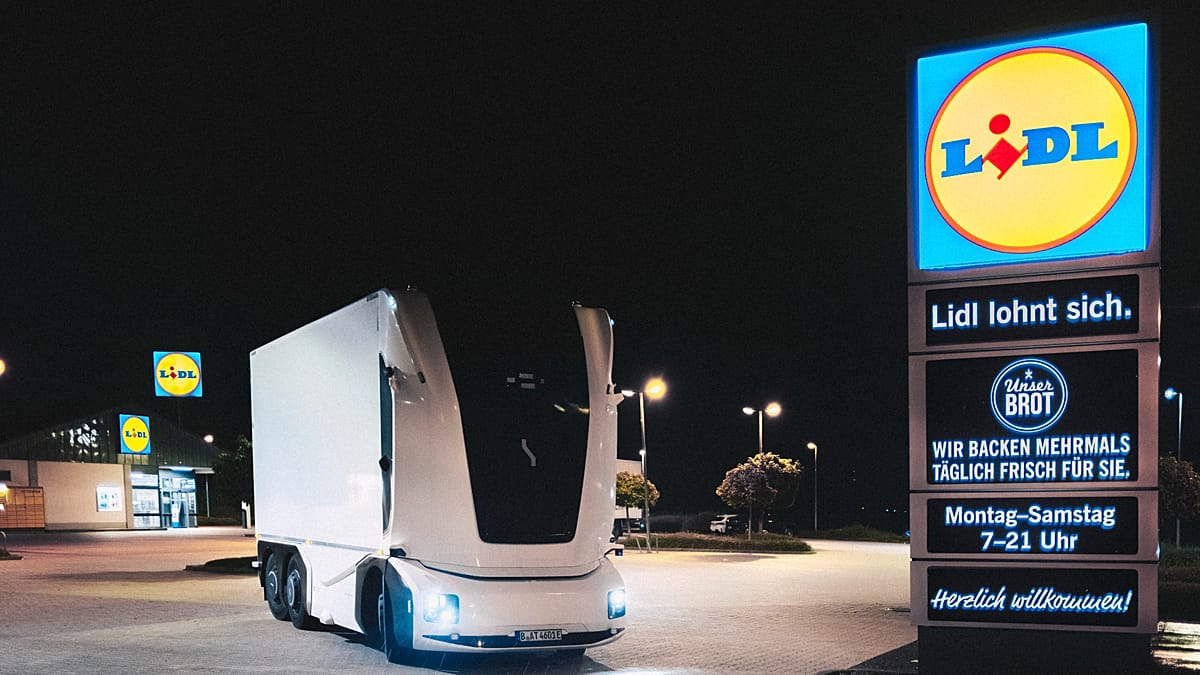
Since this week, a lorry without a cab and without a driver has been on the road in public traffic in Edermünde in the German state of Hesse, near Kassel. Lidl says it is the first food retailer in Germany to deploy a cabless electric HGV with autonomous driving capability in live operations. Its partner is Swedish technology company Einride.
What the lorry can do
The vehicle operates at SAE Level 4, the second-highest of six automation levels (0 to 5). Under the definition used by the German Federal Motor Transport Authority, the system permanently assumes full control within a clearly defined operating area. A human does not need to intervene or monitor what is happening.
If the vehicle detects it is reaching the limits of its operating domain or encounters a malfunction, it brings itself into a safe state on its own. Unlike Level 5, however, this only applies on predefined routes, not everywhere and under all conditions. For the deployment in Edermünde, the Federal Motor Transport Authority (KBA) has granted an official approval, according to Lidl.
Control is provided by sensors, cameras and a control system rather than by a traditional cab, which it does not have at all. The rigid vehicle’s loading area can accommodate 15 Euro pallets. Up to three times a day, the electric lorry shuttles between the administration and distribution centre in Edermünde and a nearby store, covering all dry-goods deliveries there. More than 3,000 pallets are to be transported during the four-month test phase.
Einride CEO Roozbeh Charli says in the press release (source in German) from Lidl: “The German approval process is among the toughest in the world. Clearing that hurdle there sets the course for scaling up decisively.”
Einride is already carrying out autonomous deliveries with real volumes for customers in the United States and Europe, Charli adds. Germany, as the “largest European market for road freight transport”, is of strategic importance.
What advantages Lidl is hoping for
For Lidl (part of the Schwarz Group), the core issue is a logistics challenge: moving huge volumes of goods reliably at a time when drivers are in short supply. According to the press release, the project is designed specifically to address highly complex supply chains and the shortage of skilled workers. Thomas Dangelmayer, head of operational logistics at Lidl in Germany, says: “Intelligence creates efficiency, and that is the backbone of reliably ensuring product availability over the long term. We make sure that products are always in the right place at the right time and in the right quality for our customers.”
With 39 distribution centres and more than 3,250 stores, Lidl has a tightly scheduled logistics network in Germany. If the first route proves successful, the next step will be a “milk run” model with multiple stops at another location.
Berlin is also giving its backing. Christian Hirte, Parliamentary State Secretary to the Federal Transport Minister, described the launch as a signal for Germany as a hub of innovation: “Autonomous and zero-emission driving is no longer some vision of the future; it is becoming a reality on our roads.” The project has been supported, among others, by the Mobility Data Space.
Not an isolated case in Europe
Autonomous lorry deliveries in Europe are not entirely new, however. Back in 2019, Einride operated its first cabless electric lorry in test service in Sweden, using the “T-Pod” to run between two warehouses belonging to logistics company DB Schenker.
According to the company, it now operates around 250 lorries for more than 30 customers in seven countries, including Amazon, Heineken and PepsiCo. In Antwerp-Bruges, Einride tested a fully autonomous lorry in port operations for the first time in September 2025, the specialist portal Electrive reported.
Competition is growing internationally. According to a report by news agency Reuters, Chinese provider Pony.ai already has several hundred Level 4 lorries in operation in China and is now looking to enter the European market, with initial tests under way in countries including Croatia.
Regulation could slow things down
How quickly autonomous lorries gain ground beyond pilot routes will depend heavily on regulation. Germany and 16 other EU member states want to coordinate the development of automated vehicles more closely in future so that they no longer have to stop at national borders, the specialist site Eurotransport.de reports. The aim is to establish common standards so that an autonomous lorry approved in Germany can also operate in countries such as France or the Netherlands.
The economic potential is substantial. According to a McKinsey analysis prepared for the IAA Transportation trade fair, autonomous road freight could generate revenue potential of 80 to 120 billion euros in Europe alone by 2035.
At the same time, the study says, European commercial vehicle manufacturers are under pressure from Chinese rivals, which enjoy cost advantages of 30 to 40 percent and shorter development cycles.