
In a bid to strengthen connectivity and close coverage gaps across Europe, German telecom company Deutsche Telekom is partnering with the US satellite company Starlink.
The announcement arrived during Mobile World Congress (MWC) in Barcelona, where non-terrestrial networks (NTN) are a major talking point among cellular networks hoping to expand their services in both scope and efficiency.
Telekom is currently the largest telecommunications provider in Europe, but many areas still remain underserved due to topographical and conservation restraints. The company sees partnering with Starlink as a way to connect Europeans better – and to achieve their goals of becoming an “everywhere network.”
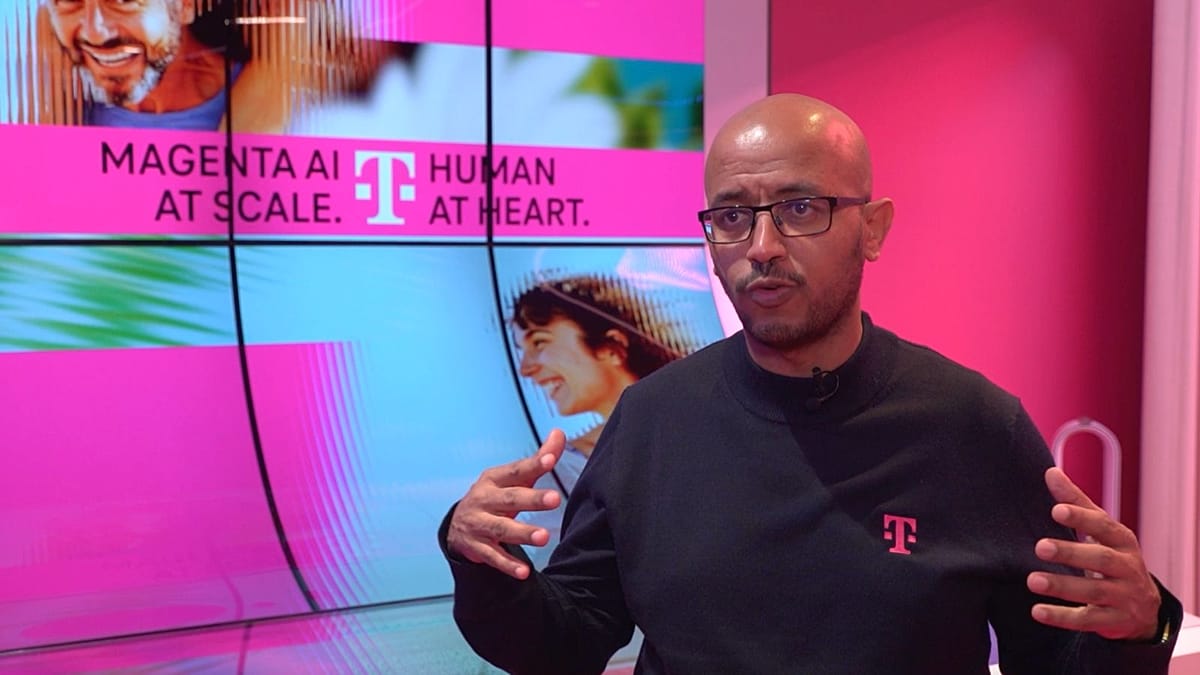
“We have the best network in all countries. We operate in undisputed network leadership with coverage of over 90 percent in most of our European countries,” Dr Abdu Mudesir, Chief Product & Technology Officer at Deutsche Telekom told Euronews Next.
“However, it’s always the last 10 percent, 5 percent, 1 percent that’s uncovered. The forests, the mountains, the islands. There, our customers are asking for ubiquitous communication everywhere, and that’s what we can offer with Starlink. And that fits very well into our vision of being networks of network providers.”
The service is planned to launch in 2028, with future smartphones made compatible for connecting directly to Starlink’s MSS (Mobile Satellite Service) spectrum, according to Telekom.
Starlink, a division of Elon Musk’s company SpaceX, has been exploring mobile connectivity for a while, with recent reports suggesting it’s even looking to develop a Starlink-branded smartphone.
Telekom began working with SpaceX to eliminate cell signal dead zones since 2022 – but it’s far from their only focus, Mudesir said.
Alongside NTNs, Telekom are self-proclaimed ‘artificial intelligence (AI) optimists’. By integrating agentic networks – interconnected autonomous AI agents – they’re hoping to supercharge their network and service performance.
“We started out with the vision of democratising access to AI,” said Mudesir. “We’ve now been able to integrate AI capability directly to our network. What this means is that you and I can speak in two different languages using live translation. Or, we can find the best restaurants to go to for dinner here in Barcelona.
“This capability makes it even possible for people who have a very old phone. Even a Nokia 3310 – anything without an app. I don’t have to explain to my mother how to download an app to use this service, it just works.”
EU sovereignty versus global growth
As a German-based company, Telekom has always strived for European Union (EU) sovereignty by pursuing EU partnerships and initiatives predominantly. But maintaining this within a fiercely competitive global market would not be conducive to the company’s long-term growth, Mudesir said, noting the importance of worldwide collaboration.
“We live in a global world, and we believe in partnership across the world,” he said.
However, global expansions also generate increased public concerns around regulation, privacy violations and surveillance. Mudesir believes the key to safeguarding against potential harms here is through a mixture of regulatory clarity and digital sovereignty.
“The key is, how do we make sure that we have a controllable environment where our data is secure? Where access to data is regulated on the European norm, and who can access it is in a sovereign environment.
Mudesir is also optimistic that Europe’s companies and start-ups will continue to lead long-term technological innovation, paving the way for bringing meaningful advancements to the tech and telecommunications industries.
“Europe can do this and we’re doing it. I mean, I recently saw that there were 27 unicorns last year, created in Europe. There is an opportunity. I am optimistic – if we get our act together.”
The 20th annual Mobile World Congress ends on 5 March 2026 in Barcelona, Spain.