
Published on •Updated
A striking new study on earthquake risk has been published for Southern California, one of the most densely populated regions of the United States.
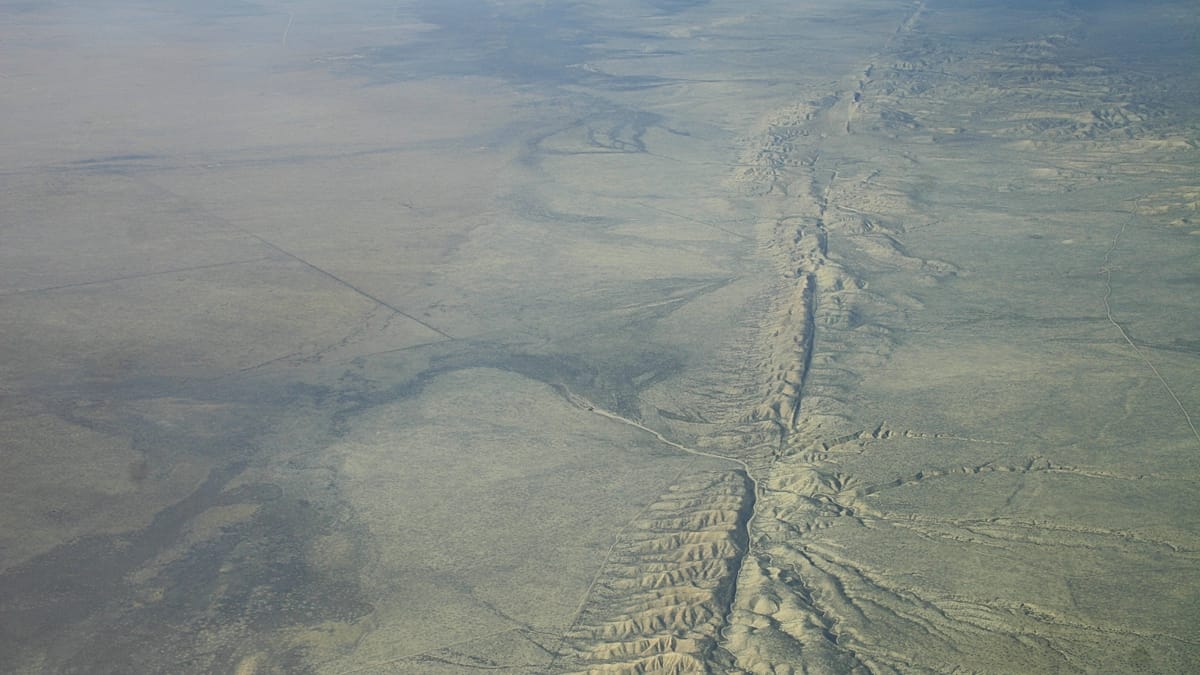
Researchers report that the tectonic stress accumulating on the San Andreas and San Jacinto fault systems has reached its highest levels in the past 1,000 years and, in some segments, may already exceed those levels.
While the study suggests the region may have the potential to generate a large and devastating earthquake in the future, it also stresses that the findings are crucial for reassessing earthquake hazards.
Study examines 1,000 years of earthquake history
The research was led by the University of Hawai’i at Mānoa, and the findings were published in the peer-reviewed Journal of Geophysical Research: Solid Earth.
The scientists developed a computer model that simulates how stress has built up and been released over time on the San Andreas and San Jacinto fault systems in Southern California. The model drew on roughly 1,000 years of earthquake history reconstructed from geological data, including radiocarbon dating of displaced sediments and tree-ring records.
By running these historical records forward to the present, the researchers estimated how much stress may have accumulated on the faults today.
The results predicted the stress on the San Jacinto-Bernardino section has hit 3.6 megapascals. Megapascals are a measurement of pressure on a specific area. In this case, it is the equivalent of the pressure generated by the weight of two blue whales applied on every square meter of that section of the fault.
If you extrapolate that to the size of that location, the fault is holding the pressure generated by the weight of over 6 billion blue whales.
Two major faults could rupture at the same time
One of the study’s main focus areas was Cajon Pass, where the two major fault systems intersect. The researchers say this area can sometimes act like an ‘earthquake gate’, at times blocking large quakes from jumping from one fault to the other and at other times allowing them to pass through.
Another of the study’s most striking findings was that, under certain conditions, Cajon Pass could allow the San Andreas and San Jacinto faults to rupture together in the same earthquake.
According to the scientists, such a scenario could be far more destructive than a major quake involving only a single fault. An event of this kind could affect areas home to millions of people, including Los Angeles as well as San Bernardino, Riverside and the Coachella Valley.
The research indicates that stress which would normally be expected to be released by large earthquakes has continued to accumulate for a long time and may now have reached unprecedented levels.
The timing of the quake cannot be predicted
The researchers emphasise that the study should not be interpreted as predicting the timing of an imminent earthquake, as it is impossible to determine the exact time of such events.
They note, however, that the findings could improve earthquake hazard analyses for the region and help guide infrastructure investment planning, updates to building codes and the strengthening of emergency preparedness.
The team say the modelling approach used in the study is not limited to California and could also be applied to complex fault intersections in other parts of the world. They therefore aim to turn the method into a general tool that can be used in future to assess earthquake risks posed by multiple fault systems.