
Russia is using a logistics operation in Berlin to circumvent European Union sanctions by routing banned goods to Moscow through a postal system that exploits lighter controls on international mail, according to an investigation by German newspaper Bild.
Test consignments equipped with GPS transmitters and containing sanctioned goods passed through a logistics hall near Berlin Brandenburg airport undisturbed before being forwarded via Poland and Belarus to Moscow, the investigation found.
The operation allegedly uses shipping labels from Uzbekistan’s state postal service, even though Germany’s Federal Network Agency does not authorise the postal service to operate in the country.
International mail items face less stringent checks than regular goods exports because postal traffic is handled quickly and in large volumes under simplified customs and export procedures.
The system is reportedly run by the former managing director of RusPost GmbH, the German branch of Russian state postal service Pochta Rossii, identified by Bild as Dimitri V.
Customs authorities searched the company’s Berlin offices in August 2024 on suspicion of violating economic sanctions against Russia, but the subsequent investigation produced no results.
Ukrainian envoy not surprised
Ukraine’s presidential envoy for sanctions policy, Vladyslav Vlasiuk, expressed little surprise at the revelations when asked about them by Euronews in Berlin on Wednesday.
“Nobody is doing enough, if you look at the number of cases,” Vlasiuk said when asked whether Germany was doing enough to prevent such loopholes.
Ukraine regularly collects information about such practices and shares it with international partners, he said. The principle of systems designed to circumvent Western sanctions is well known to Ukrainian authorities.
Vlasiuk is currently touring several European countries including the Netherlands and Belgium to campaign for tougher sanctions enforcement.
At a press conference at the Ukrainian embassy on Wednesday, he outlined three priorities: stricter enforcement of financial sanctions, preventing Western components from reaching Russia, and more decisive action against Russia’s shadow fleet.
Western components have been found in many of the more than 50,000 Shahed drone attacks launched by Russia, Vlasiuk said. Alternative payment methods such as cryptocurrencies enable many actors to circumvent existing bans, he added.
Strong sanctions send a strong signal to Russia, according to Vlasiuk. Although the Russian economy is struggling, the pressure has not yet been sufficient.
Shadow fleet remains active despite sanctions
Russia’s shadow fleet is at the centre of the sanctions circumvention debate. Russia regularly evades international oil and commodity sanctions using old and usually inadequately insured tankers, often registered under changing flags of convenience or with unclear flag status.
Flags of convenience are registrations in countries offering low fees, minimal regulatory requirements and weak control over safety, environmental and insurance standards.
Although the EU has sanctioned more than 600 ships, around 70 % remain active and continue transporting oil for Russia, according to Vlasiuk. He said the bloc must consider physical measures against these tankers.
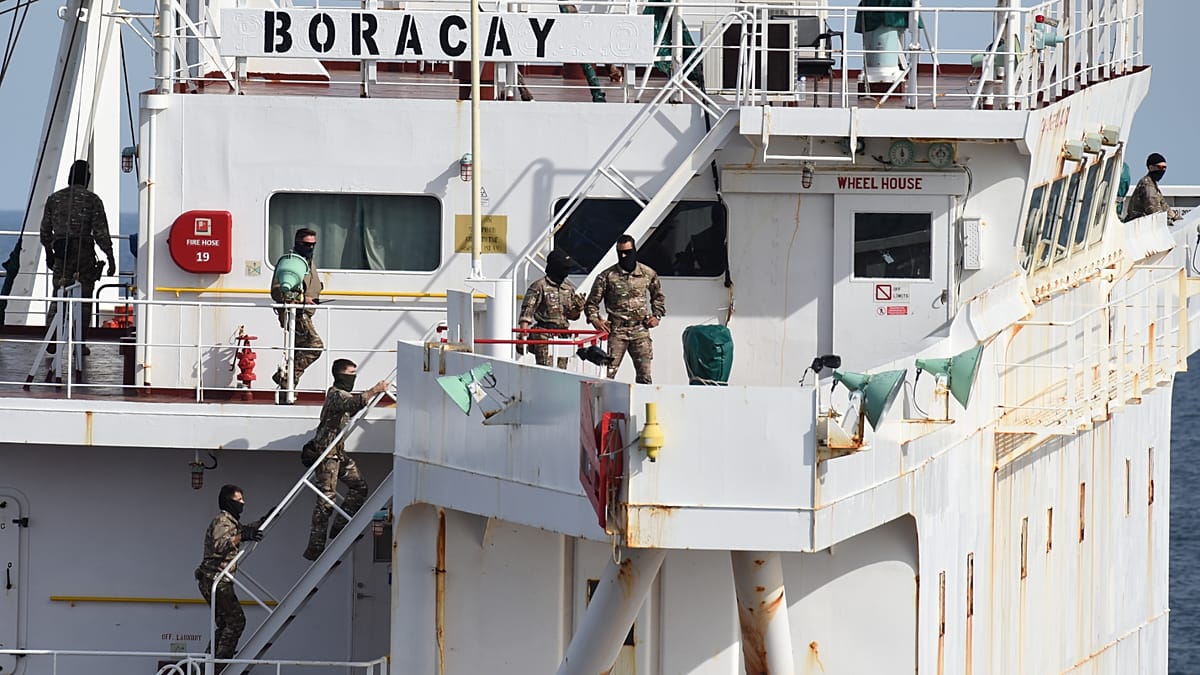
France intercepted and seized the oil tanker Grinch, belonging to Russia’s shadow fleet, in the western Mediterranean last week. Paris said the sanctioned vessel was suspected of sailing under a false flag and violating international sanctions.
On 26 January, Germany and 13 other EU states issued a joint statement warning against ships sailing in the Baltic and North Sea under multiple or false flags.
The countries announced they would treat these vessels as stateless in future to take tougher action against Russia’s shadow fleet.
The declaration states ships will only be allowed to sail in the Baltic and North Sea if they have valid documents, communicate adequately with authorities and comply with safety and maritime legislation.
The statement did not specify enforcement mechanisms or penalties for non-compliance.