
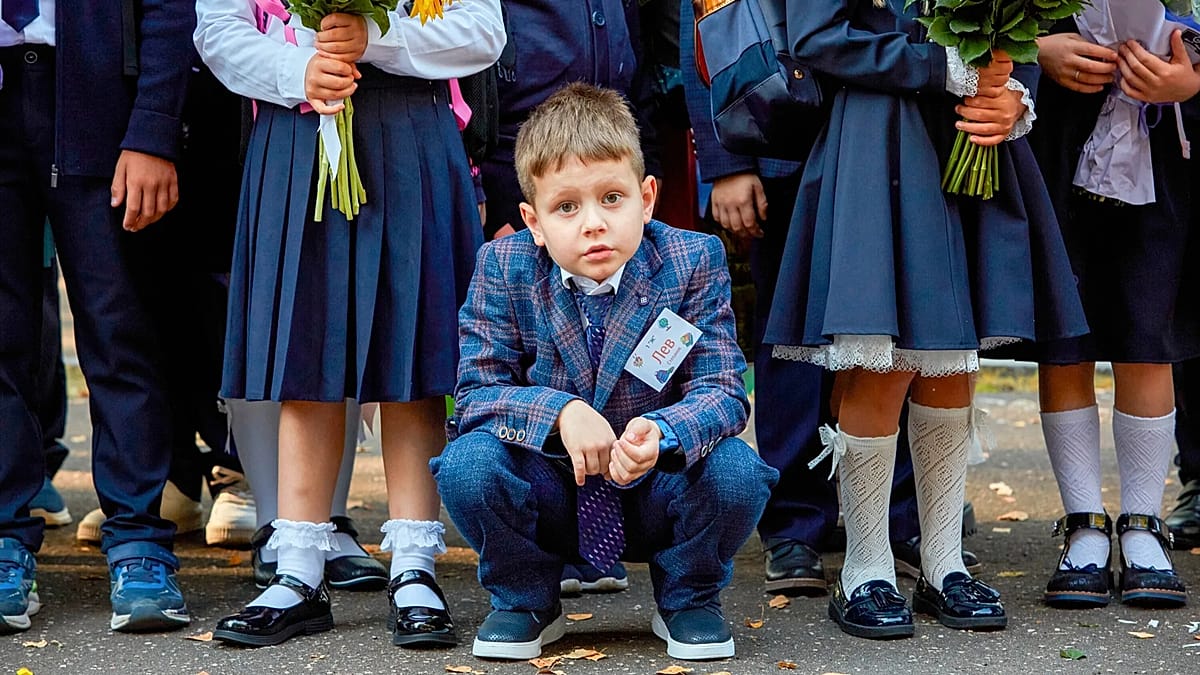
The number of schools in Russia has fallen by 45% since the start of the century, with rural communities losing the most, according to a report by the Higher School of Economics published this month.
Russia’s secondary school network has shrunk from 68,800 institutions in 2000 to just under 38,000 in 2026, the report says. The school-age population has fallen by around 13.5% over the same period, from 20.5 million to 17.7 million children.
Russia now has fewer schools than Germany, even though its population is roughly half the size. Germany has more than 40,000 schools in 2026.
Closures have been most severe in rural areas, where the number of state schools has fallen from more than 45,000 to around 21,000, a reduction of more than half.
Urban schools have also declined, from 22,700 in 2000 to 16,300 today. The number of pupils each school serves has grown substantially over the same period: from around 300 pupils per school 15 years ago to around 470 today.
Private schools have increased in number, from 635 in 2000 to 982 in 2026, but account for only 2.5% of total provision.
Is bigger always better?
The closures stem from an optimisation programme launched in 2001 that remains ongoing.
A shift to per-pupil funding made smaller schools financially unviable: the fewer children a school enrolled, the less state money it received. Schools were merged with neighbouring institutions or closed outright.
By 2010, 26% of Russia’s schools had shut. Around 10,000 more closed in the 2010s, and a further 2,300 since the early 2020s.
Teachers and parents protested the mergers. They argued that large consolidated institutions were harder to manage, that neighbourhood schools with distinct characters were being lost, and that overcrowded classes would reduce educational quality.
Sociologists have also linked school closures to village depopulation, according to a 2026 study published in the Russian magazine Nozh.
The study found that when a village school closes, families typically split — one parent relocates to a town with the children while the other stays to work — and the separation becomes permanent.
“By saving on the costs of a single classroom and teacher, you can wipe out a whole thriving local economy,” the study said.
The village of Atary in Kirov region’s Lebyazhsky district is one example: after the local school was declared unprofitable, young people left, and the settlement is now largely abandoned.
Communist Party MP Dmitry Novikov has called for rural schools to be funded as strategic social infrastructure rather than on a per-pupil basis.
He has proposed a moratorium on closing upper secondary classes in villages and, where closures go ahead, guaranteed year-round transport to schools in neighbouring areas.
‘Loyal state ideology’
Since September 2022, all Russian schools have held a mandatory weekly class called “Conversations about What Matters,” with lesson plans supplied directly by the Ministry of Education.
Topics include Russian traditional values, Russia’s global role and Moscow’s war in Ukraine — referred to in official lesson materials as a “special military operation,” the Kremlin’s only legally allowed term minimising its all-out invasion — along with themes such as “service to the Motherland” and “self-sacrifice”.
New unified history textbooks were introduced for senior pupils in 2023 and for middle-school years from 2024-2025.
The 2023 unified history textbook describes Ukraine as an “aggressive anti-Russian bridgehead,” presents Moscow’s 2014 invasion, occupation and annexation of Ukraine’s Crimea as the rectification of a “historical injustice,” while Western sanctions are portrayed as an attempt to destroy Russia’s economy.
Anna Wright, Amnesty International’s researcher for Eastern Europe and Central Asia, said that the books “hide the truth and distort the facts about serious human rights violations and crimes under international law committed by Russian troops against Ukrainians.”
Wright described the indoctrination of children as “a cynical attempt to eradicate Ukrainian culture, Ukrainian cultural heritage and identity.”
The textbooks instruct pupils not to trust information found online. They were updated this summer: chapters on the war were expanded, and a section on the Trump-Putin Alaska meeting was added.
The books were edited in part by Vladimir Medinsky, an aide to Putin, former culture minister and head of Russia’s delegation in ceasefire talks with Ukraine.
After he moved directly to the Kremlin as a presidential aide, he was appointed chairman of the Interdepartmental Commission on Historical Education, established in 2021 to counter what Russia terms historical “falsification”.
Mendinsky’s approach has been described as pseudo-historical rhetoric deployed to construct “loyal state ideology”. He is under sanctions from the EU, the US and Canada.