
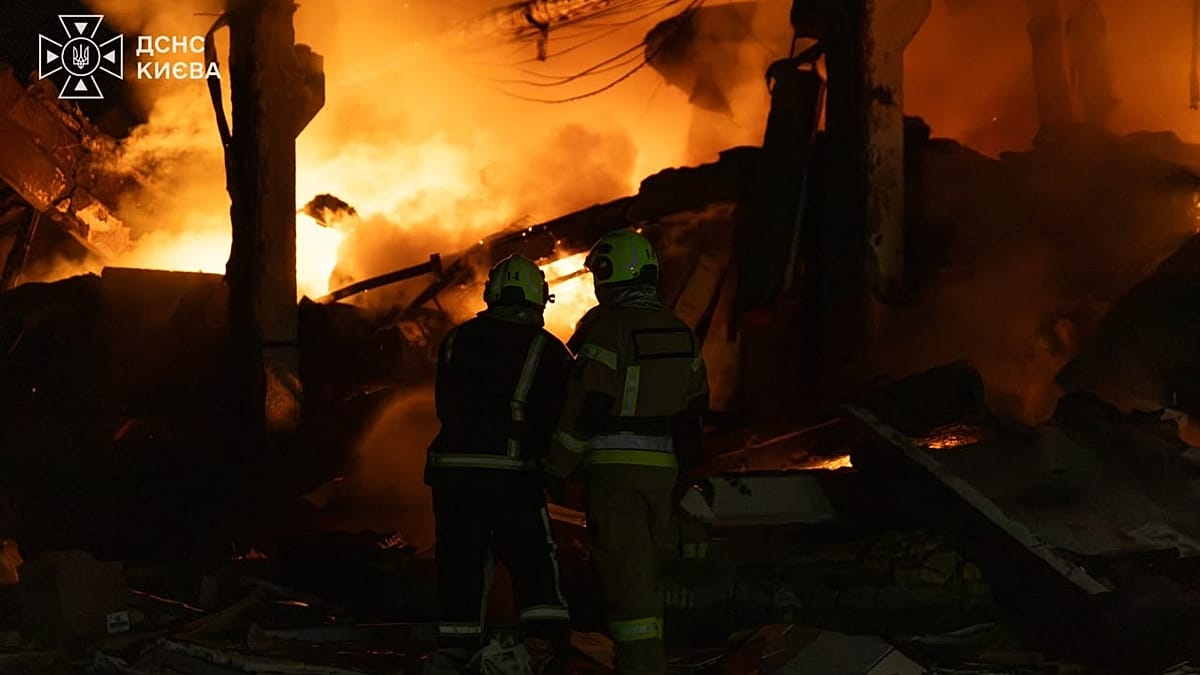
Ukrainian President Volodymyr Zelenskyy said on Tuesday that Russia fired North Korean missiles in an overnight attack that killed six and wounded 19 in the southeastern city of Zaporizhzhia.
“The city was struck with North Korean ballistic missiles, Zircons, and guided aerial bombs,” he said, referring to Russia’s hypersonic cruise missile system, Zircon.
Zelenskyy had warned on Monday evening that Russia was preparing to station more North Korean troops on its territory and had already received more ballistic missiles from Pyongyang.
He has repeatedly sounded the alarm over deepening military ties between Moscow and Pyongyang, often while appealing for more Western air-defence supplies.
“This is the first time they cannot wage war without supplements from North Korea,” he said in his nightly address, referring to Russian forces.
“They are now preparing to deploy an additional contingent of Koreans on their territory. They have received, just imagine, additional ballistic missiles from North Korea,” he added.
Only certain air defence systems, including US Patriots, are capable of intercepting ballistic missiles.
A shortage of PAC-3 interceptors has worsened since the war launched by the United States and Israel against Iran in February.
At the same time, Ukraine has been increasing its strikes against Russian cities far from the border.
At the weekend, Zelenskyy said a decision had been taken for 30,000-50,000 North Koreans to be deployed on Russian soil. He did not explain how he obtained those figures.
North Korea has become one of Russia’s closest military partners since Russian President Vladimir Putin and North Korean leader Kim Jong Un signed a mutual defence pact in June 2024.
Moscow used the North Korean troops in a counteroffensive later that year that pushed Ukrainian forces out of the border Kursk region.
The overnight Russian attacks spanned Kyiv, Zaporizhzhia and Dnipropetrovsk, regional authorities said.
Russia’s defence ministry said its forces “delivered a group strike with high-precision ground-based weapons, hitting military-industrial enterprises and transport-logistics centres in the cities of Kyiv and Zaporizhzhia.”
In Zaporizhzhia, Ivan Fedorov, head of the regional military administration, said Russian forces launched a “massive” attack using missiles and guided aerial bombs.
“Six people were killed and 19 others wounded,” Fedorov wrote on Telegram, updating an earlier toll of five dead.
In the eastern Dnipropetrovsk region, Russian drone and artillery strikes on five districts killed three people and wounded five others, regional military administration head Oleksandr Ganzha said on Telegram.
Journalists in Kyiv said they heard a series of explosions shortly after midnight after authorities issued a missile alert.
Mayor Vitali Klitschko said on social media that the capital was “under ballistic missile attack.”
Ukraine’s emergency service said a warehouse caught fire and one person was wounded.
Kursk offensive
About 600 North Korean troops were killed fighting for Russia against Ukrainian forces, South Korea’s spy agency told lawmakers last year.
North Korea has suffered some 4,700 casualties, including injuries and deaths, the South Korean National Intelligence Service (NIS) told a parliamentary committee.
About 2,000 injured soldiers were repatriated to North Korea by air or train between January and March, according to the NIS.
The dead soldiers were cremated in Russia before their remains were sent back home, the intelligence agency said.
The assessment came after Pyongyang confirmed for the first time that it had sent troops to help Russia recapture parts of the Kursk region, which Ukraine took control of in a surprise incursion.
Meanwhile, North Korea’s economy was showing signs of recovery as Pyongyang deepened trade and diplomatic ties with Russia and China, South Korea’s unification ministry said in a report in April.
Rigid socialist planning and high military spending undermined growth in North Korea for years, as have sweeping international sanctions aimed at scuppering its development of nuclear weapons.
China has long been the diplomatically isolated country’s main economic backer, though Pyongyang has also drawn closer to Moscow since it launched its full-scale invasion of Ukraine in 2022.
Those relationships are now driving an improved economic outlook, with the North appearing to have “moved beyond a period of contraction” and “entered a phase of gradual recovery,” according to the South Korean ministry.
Analysts said the North was also receiving economic and military technology assistance from Russia in return for sending troops and ammunition to help it fight Ukraine.