
Russia’s Supreme Court on Monday annulled the opposition Yabloko party’s registration for the country’s parliamentary elections, scheduled for September.
The ruling, which sidelines the only officially registered party that opposes Moscow’s war in Ukraine, came after the pro-Kremlin nationalist Rodina party filed a lawsuit last Friday, seeking to remove Yabloko from the elections.
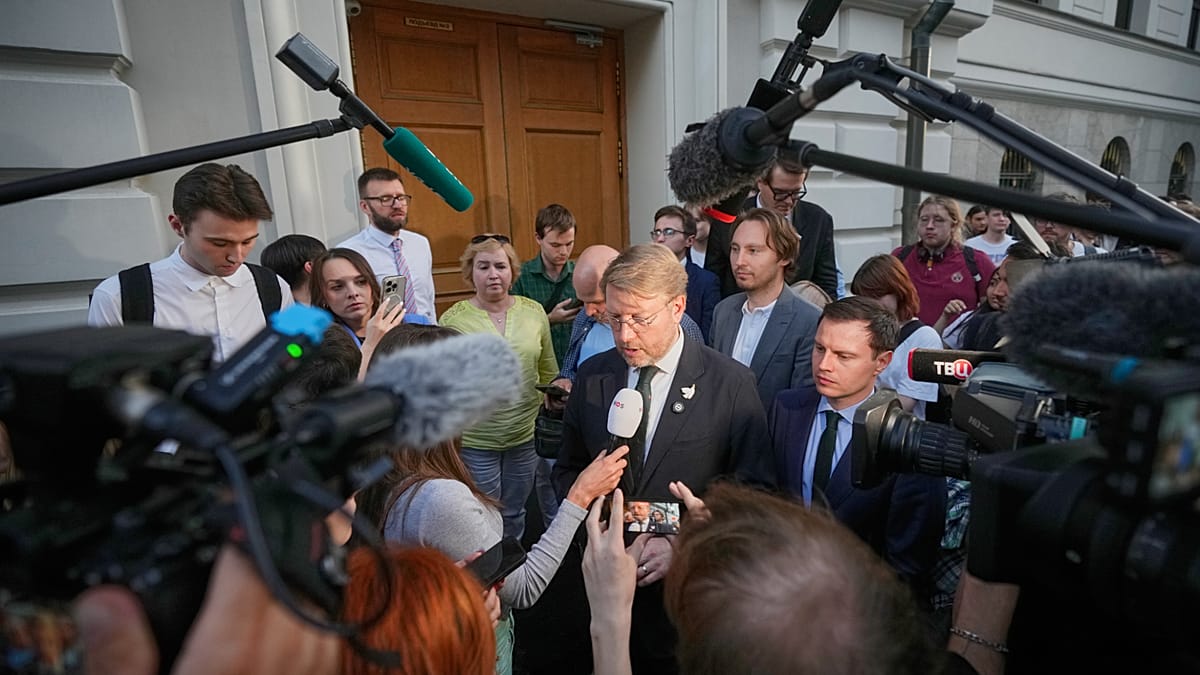
Reacting to the Supreme Court decision, Yabloko leader Nikolai Rybakov said that “there are no grounds at all for removing the party from the elections.”
“All the documents had been checked by the Central Election Commission, and the decision to allow us to run was taken unanimously,” Rybakov said, recalling that Russia’s Justice Ministry had repeatedly probed the party for various violations but found nothing illegal.
He described Rodina’s claims as unsubstantiated and groundless.
Rodina leader and State Duma deputy Alexei Zhuravlyov argued that “lawyers have found numerous violations” in Yabloko’s election campaign.
According to him, “first and foremost this is foreign funding that does not go through the account”, as well as “extensive activity on banned social networks, which is financed from the West”.
Zhuravlyov and Rodina accused Yabloko of “extremism,” saying they saw “signs” of it in the party’s call for peace.
Rodina also accused Yabloko of receiving funding from abroad and supporting the so-called “international LGBT movement,” which is illegal under Russian law.
Leaders of other Russian parties also levelled accusations against Yabloko.
Chair of the Central Committee of the far-left Communist Party of the Russian Federation (CPRF) Gennady Zyuganov blamed his opponents for not supporting “the policy of strengthening Russian statehood” and for “never once condemning the actions” of the Ukrainian authorities.
Ultranationalist Liberal Democratic Party of Russia (LDPR) leader Leonid Slutsky called for Yabloko to be designated an undesirable organisation because of its proposal to enter into peace talks with Kyiv.
Sergei Mironov, leader of left-wing nationalist A Just Russia party, said that the Justice Ministry and the Prosecutor General’s Office should “take a close look at Yabloko because the party ‘opposes the (war in Ukraine)’, ‘promises to conclude a peace that would disgrace the country’ and ‘supports foreign agents'”.
Russia’s Central Election Commission registered Yabloko’s list for the parliamentary elections on 29 July.
The only anti-war party in Russia or a spoiler?
Running under the slogan “For peace and freedom,” Yabloko is a social-liberal party platforming on anti-nationalism and demanding urgent political reforms in Russia.
Its election programme, made up of just 43 words, calls for “a ceasefire agreement, diplomacy, and the achievement of peace.”
For many, the registration of a party advocating an end to the war came as a surprise and has prompted much speculation about how and why this could have happened, including claims that the initial approval was itself a Kremlin-orchestrated manoeuvre.
“A source close to the Central Election Commission believes that the logic behind allowing it is likely this: the authorities need a channel through which citizens can ‘vent’ their discontent,” investigative outlet Important Stories wrote.
“Better into Yabloko than into spoiling ballot papers or voting for the Communist Party.”
“Yabloko was registered according to a plan by the presidential administration. After the elections, the party’s low official result can be presented as the share of Russians who oppose the war,” Radio Liberty quotes political analyst Ivan Preobrazhensky as saying.
Another widely circulated claim or belief is that the Russian authorities need Yabloko to divert votes from the increasingly popular New People party.
“Yabloko has been let into the elections to take down ‘New People’,” writes Alexander Kynev, a specialist in Russia’s regional political processes, on social media.
The nominally centrist New People party has also been accused of being a Kremlin-sanctioned outlet for protest votes.
Elections to the State Duma, along with voting for other levels of government, will take place in Russia on three days, from 18 to 20 September.