
Today, satellite operators have very few options when their space hardware runs out of fuel, the solar panels are damaged, or fault codes prevent it from functioning.
Some software problems can be corrected from the ground, and engineers can find workarounds for certain hardware hiccups, but generally, when a satellite needs maintenance, there’s no handy space repair service to call.
As a result, many old satellites either end up being parked in so-called graveyard orbits, or, in the worst cases, they drift and spin out of control, posing a risk to other space hardware and increasing the amount of space debris.
With the number of spacecraft rising rapidly, European engineers are now working on robotic mechanics to keep older satellites flying for longer, or push defunct satellites out of important orbital paths.
“It’s like a breakdown truck on a road,” says Stéphanie Behar-Lafenêtre, project manager at Thales Alenia Space for the European Union-funded European Robotic Orbital Support Services mission (EROSS).
Their goal is to launch a small European-made satellite with a robotic arm in a proof-of-concept mission in 2028.
During the mission, it will rendezvous with its target satellite, perform a fly-around inspection, and then demonstrate its ability to capture and refuel the spacecraft. Thales Alenia Space is also working on USB-style universal connectors that would allow the robot to assemble components in space more easily.
By the early 2030s, the vision is that EROSS-style space breakdown trucks would be deployed for paying clients.
“The idea is that you just ask for a service to tow you towards another place or to repair something, or to refuel. The idea being to provide services to space components that are usually not meant for this,” she told Euronews Next.
The last point is crucially important. Most satellites currently orbiting Earth were never designed to be serviced. They were built with the expectation that once launched, they would operate independently until they ran out of fuel or suffered a critical failure.
But these days, with nearly 15,000 operational satellites in orbit and several thousand defunct machines still in space, it’s clear that on-orbit servicing is ripe for development, including engineering systems capable of catching and repairing ‘uncooperative’ spacecraft.
Jean-Luc Maria, CEO and co-founder of ExoTrail, frames the development as a natural shift between the days when satellites were tools for exploration and discovery, to today, when satellites are essential infrastructure for life on Earth.
“When you reach a critical mass of this infrastructure, you start to have new needs that are in favour of the management of this infrastructure,” the French engineer told Euronews Next. It’s simple – just as highways and telecom towers need fix-it crews, so do satellites.
Grabbing the Unprepared
The technical challenges of servicing most satellites on-orbit are immense. For starters, “we need to try to identify and grab something that has absolutely nothing to be grabbed,” said Behar-Lafenêtre. For the EROSS mission, the robot spacecraft will aim for the metallic ring that originally connected the satellite to its rocket for launch.
While not universal nor standardised, this ring is present on about three-quarters of spacecraft, and is always engineered to be sturdy.
“Once you have grabbed it, then you can tow it,” Behar-Lafenêtre said.
“So you can take over its attitude and orbit control, but you can also move it from one place on the orbit to another. You can take over whatever function that the spacecraft is not able to do by itself,” she added.
Some constellations have planned for future servicing, such as the Eutelsat One Web satellites, which were launched with a magnetic plate on the side.
“It’s a very good example,” said Maria. “We know that potentially we would be able to design a counter plate to attach to the OneWeb satellite that would need, at some point, to be serviced.”
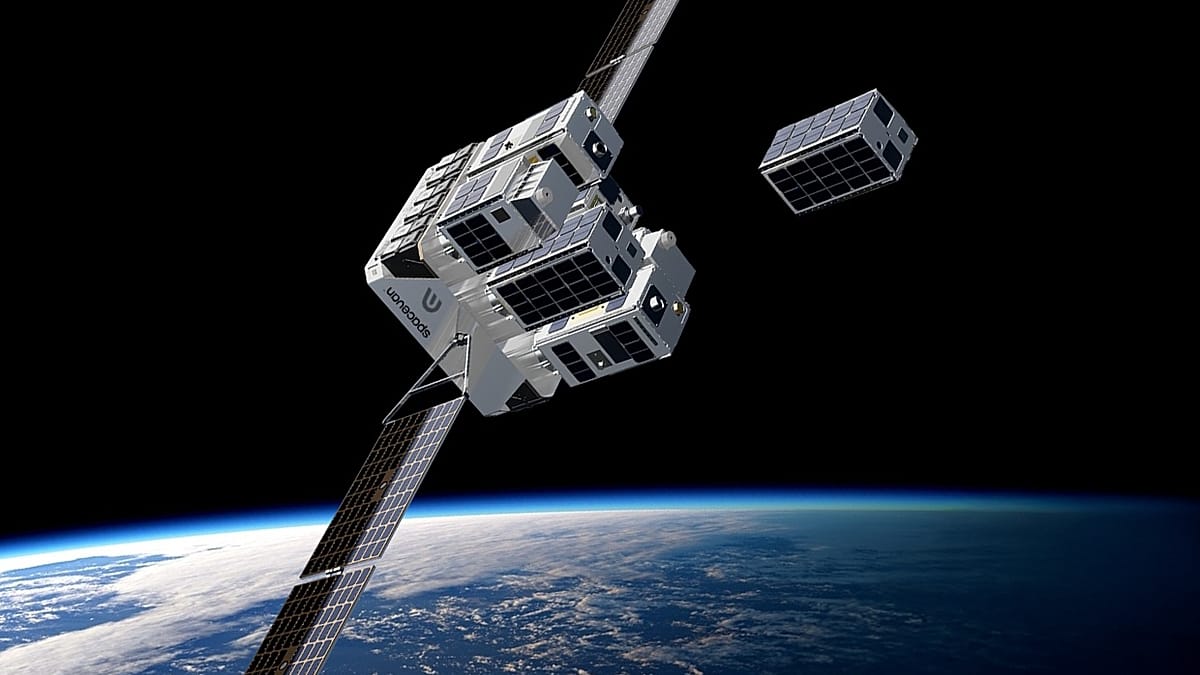
ExoTrail is already on the path of offering third-party services to satellite companies with a device it calls the ‘spacevan’.
This device, which first flew with SpaceX in 2023, carries small satellites away from the rocket and delivers each one to a very specific orbit, just like a delivery driver dropping off parcels at homes and businesses.
This is what Maria calls their “early services”, a kind of ride-sharing in space for last-mile delivery. Now they’re building toward something more ambitious: namely, full rendezvous and docking capabilities that will enable inspection, life extension, refuelling, and ultimately, orbital repairs.
Another key market segment that Exotrail is aiming for is deorbiting, which entails deliberately pushing a client’s satellite down towards an empty part of the ocean. Last month, it announced a partnership with Japanese space company Astroscale to demonstrate such precise satellite disposal by 2030.
Legal Hurdles and Uncertain Markets
While the technical challenges are immense, the legal landscape is also unclear. If two satellites collide during servicing, who is responsible? If a French servicing vehicle docks with a Japanese satellite, which country’s laws apply? These are issues that France, Japan, and other nations are actively working to address through frameworks like the EU Space Law and bilateral agreements.
Then, there’s the question of who will pay for on-orbit servicing and how big the market really is. “It’s difficult to estimate the market because it’s like the chicken and egg issue,” admits Behar-Lafenêtre. “You always have to demonstrate that you’re able to do it so that someone is interested in purchasing the service.”
The clearest early market appears to be far, far away from Earth, over 35,000 kilometres above our heads, in geostationary orbit. This is where telecommunications operators have ageing fleets they’d prefer to maintain rather than replace.
With new low Earth orbit mega-constellations offering alternative telecommunications solutions, geostationary orbit has become less attractive for new spacecraft launches, making life extension services of particular economic interest.
On-orbit servicing has significant defence implications, which could offer a strong market demand. The ability to inspect, approach, and manipulate satellites in orbit is a killer app in the military world.
“By essence, it’s something dual,” acknowledged Maria. Russia, China, and India have all demonstrated advanced capabilities in this domain. China moved a geostationary satellite thousands of kilometres in 2022, while India demonstrated docking in space a few months ago.
‘A long journey’
It’s not all plain sailing, though. NASA experienced the chicken and egg issue with its OSAM-1 (On-orbit Servicing, Assembly, and Manufacturing) mission, which it cancelled in 2024 after costs ballooned and the commercial market for refuelling unprepared satellites failed to materialise.
Meanwhile, Northrop Grumman’s Mission Extension Vehicles have been operating in geostationary orbit since 2020, extending the lives of Intelsat satellites. The company’s next-generation Mission Robotic Vehicle, scheduled for launch this year, will use advanced robotics to install ‘mission extension pods’ and perform inspections, repairs, and even debris removal.
Beyond Thales Alenia Space and Exotrail, several European companies are developing servicing capabilities.
ClearSpace, a Swiss startup, has a contract with the European Space Agency (ESA) for its first active space debris removal mission in 2027. Their system uses two satellites working in tandem for the world’s first commercial active debris removal mission in low Earth orbit. Later this decade, they also aim to demonstrate their technology to dock with and extend the life of a satellite in geostationary orbit.
Another key player is Italy’s D-Orbit, which began with its ION Satellite Carrier, similar in concept to ExoTrail’s ‘spacevan’, and is now setting its sights on creating a ‘circular space economy’, using space debris as a resource. In 2024, it signed a deal with ESA for a mission called RISE, which will demonstrate safe rendezvous and docking with a geostationary satellite in order to extend its useful lifespan in 2028.
The future of on-orbit servicing should be clearer by 2030. And within a decade, a technology that seems like science fiction could become a regular part of European space traffic management.
Nevertheless, Maria insists on a reality check. “We need a step-by-step approach,” he said.
Catching an uncooperative satellite that’s rapidly spinning out-of-control in space is still only possible in Hollywood films. “All in all, it’s going to be a long journey, probably, for all the companies,” he smiles.
Nevertheless, a simple European space breakdown truck is on the way, and with it the ability to refuel and rescue spacecraft worth hundreds of millions of euros, extending the life of critical infrastructure that connects our world.