
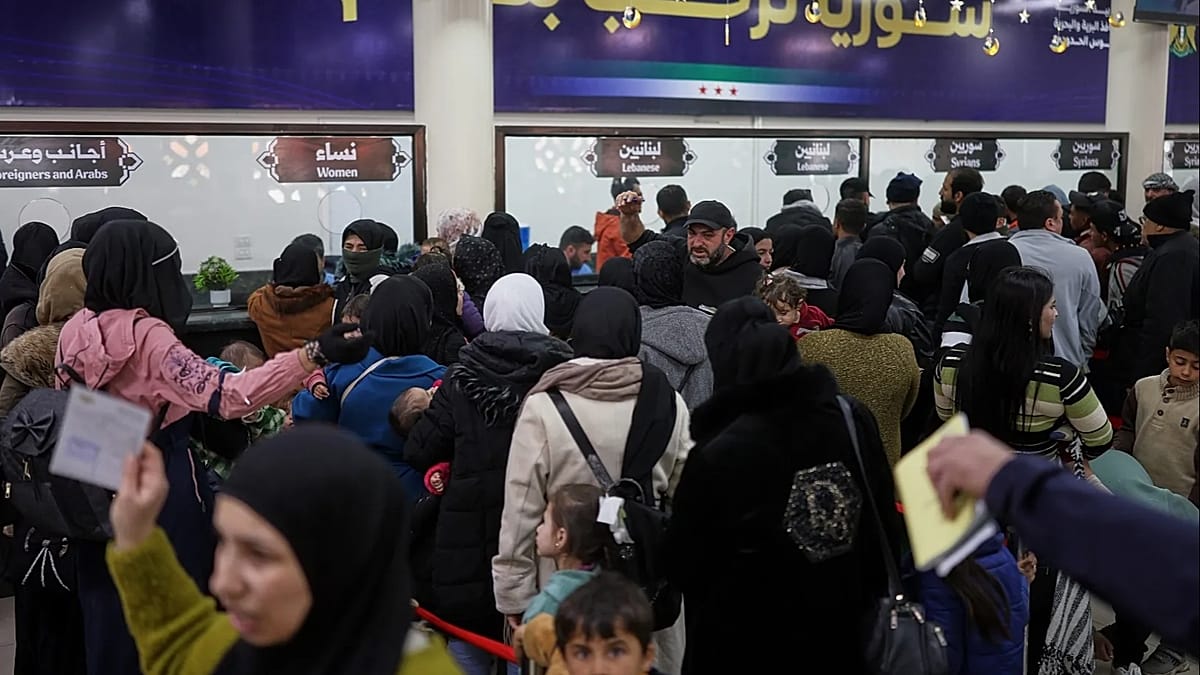
The border crossings between Syria and Lebanon have witnessed an unprecedented reverse exodus, with tens of thousands of Syrians returning to their country to escape the ongoing Israeli military escalation on Lebanese territory.
This new wave comes amid deteriorating security conditions and growing fears of a widening conflict, prompting families to voluntarily leave their places of residence in Lebanon in search of relative stability inside Syria.
The General Authority for Syrian Ports and Customs revealed in its official statements that the Jdeidet Yabous in the Damascus countryside and Jussiya near Homs received about 11,000 travellers from Lebanon on Monday, the vast majority of whom were Syrians.
The authority confirmed that staff working at the two crossings provided all the necessary facilities and services to organise entries and said that things are running smoothly to ensure the speedy completion of procedures and maintain the safety of the returnees.
The data indicated that the state of readiness and full mobilisation continues to keep pace with the increasing number of arrivals in light of the escalation of regional tension.
Medical preparations and facilities for Syrians’ return
The Jussiyeh border crossing, located near the city of al-Qusayr in Homs province and linking the Syrian village of Jussiyeh with the Lebanese village of al-Qaa, is one of the five active border crossings, and has become a major attraction for returnees.
Intensive logistical preparations were observed on the Syrian side of the crossing, where specialised medical teams and ambulances were prepared to transport patients and provide rapid medical care to citizens as soon as they cross, in anticipation of any emergencies resulting from long waiting times or difficult travel conditions.
The crossing witnessed the entry of large numbers of Syrians, including those who had recently left the country illegally during the period following the fall of the former Syrian regime and others who had fled to Lebanon to escape the Syrian civil war and settled there for many years before the current security developments forced them to return.
All of them were officially admitted after their personal data was taken to facilitate their entry and rectify their status through legal channels.
However, the process was not without some procedural complications. Syrian citizens who spoke to Euronews on condition of anonymity reported large numbers on the Lebanese side still waiting for permission to cross.
The returnees explained that the Lebanese authorities have imposed measures to regularise the flow of those leaving, especially those who had previously entered the country illegally, by requiring the payment of fines for residency violations and illegal crossings as a precondition for granting them an official exit permit.
Citizens indicated that this procedure, in addition to the enormous pressure on the crossing point, caused significant delays that in some cases led to issues with the Lebanese security services before the crossing was allowed, while Euronews observed long queues of cars loaded with luggage.
In search of safety
Euronews met with many of the returnees, all of whom said that the decision to return was voluntary, driven by fear of Israeli military operations. One woman said that the shelling had forced her to return despite the difficulties she faced while exiting from Lebanon, including financial and administrative procedures.
A man who fled Beirut told Euronews about his escape from Israeli strikes, describing the scene as causing people to run to escape death.
He added that the roads had been destroyed as a result of previous attacks, but that people in Syria “feel at home” due to the feeling of security there compared to the areas of Lebanon affected by bombing.
Congestion at Masnaa crossing and regional tensions
The pressure was not limited to the Jussiyeh and al-Yabous border crossings, but extended to the Masnaa border crossing in Lebanon’s Bekaa region, which is the main land crossing between the two countries, according to the UK-based Syrian Observatory for Human Rights (SOHR).
The monitor said it was heavily congested, with queues of cars stretching for long distances on both sides of the border.
According to local sources, the high density has led to a relative slowdown in crossing amid tightened inspection procedures, while the number of families wishing to cross the border is increasing out of fear of any possible escalation that may affect the border areas or the Lebanese depths adjacent to Syria.
The Jussiyeh crossing was previously the target of Israeli strikes during the regime of Bashar al-Assad, which Israel justified as preventing the smuggling of weapons to Hezbollah, before a relative calm was restored after a ceasefire agreement was reached between Hezbollah and Israel in November 2024.
However, the current security escalation due to intensive Israeli bombardment of large areas of Lebanon has radically redrawn the map of movement on the border, turning the direction of population flow on its head.
The path has shifted from Syrian migration towards Lebanon to an urgent mass return.