

Everyone knows the pictures of the Brandenburg Gate on 9 November 1990: people standing on the Wall, cheering, celebrating history at the moment of its creation. The scenes are emotional, stirring, iconic – even for those who weren’t there or weren’t born at the time.
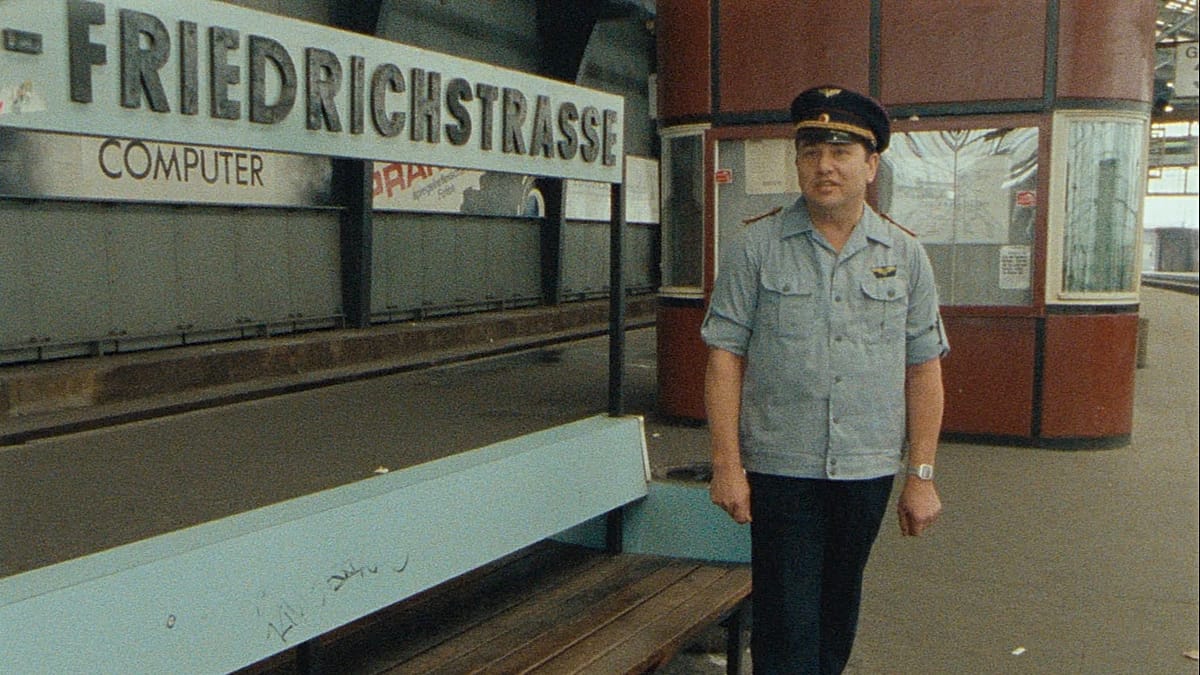
But just a few kilometres away is a place that also played a central role in German reunification: the former Berlin border station Friedrichstrasse. Hardly any other place experienced the rapid change of the fall of the Wall so directly.
“We knew the fears on both sides, the sweats […] when you had to cross that border,” say documentary filmmakers Konstanze Binder and Lilly Grote. Friedrichstrasse station became the starting point for their film.
Four camerawomen Konstanze Binder, Lilly Grote, Ulrike Herdin and Julia Kunert documented what happened there within six months from East and West. The resulting film “Berlin, Friedrichstraße, 1990” is both an exciting observation and a testimony to the times.
The film has been screened this week as part of the Berlinale retrospective “Lost in the 90s”. Its two directors Lilly Grote and Konstanze Binder spoke to Euronews about the making of the film – and about their own experiences during this historical phase.
Perspectives from East and West
For almost 90 minutes, the film follows the events at Friedrichstrasse station, which would never be the same again after the famous press conference held by GDR government spokesman Günter Schabowski.
The filmmakers talk to border control officers, kiosk saleswomen and travellers. They record how a new reality took shape just a few months after the border was opened.
The collective deliberately worked from two perspectives: Lilly Grote and Konstanze Binder with a West German background, Ulrike Herdin and Julia Kunert with East German experience. These contrasting viewpoints shape the film.
“We all had different perspectives on the events, different experiences of the border,” Konstanze Binder tells Euronews. “For the people from the GDR, it was a much more existential change. From our experience, the railway station was the place that held it all together – these different perspectives.”
The difference was also noticeable when working with her colleagues, explains Binder: “Both sides speak German, but the German language here is filled with different experiences.”
Friedrichstrasse station: a place of fear
For many, however, Friedrichstrasse station was a place of fear for decades. This is another reason why the directors deliberately chose this location rather than symbolically charged places such as Checkpoint Charlie.
“We knew the fears on both sides, the sweats, that if you had to go through this border, you immediately felt uncomfortable, you felt watched. This feeling from both sides – from East to West and vice versa – was the starting point. It was clear: we would shoot at Friedrichstraße station.”
The very beginning of the film underlines this atmosphere: a train slowly arrives at the station, the music is tense, almost threatening.
Historically, the station was a kind of “bottleneck” for divided Germany. In the East-West direction, this was the last stop before West Berlin. After the Wall was built in August 1961, the through station became a border crossing. The check-in pavilion has been preserved to this day – because of the many farewells up to 1989, it bears the name “Tränenpalast” (Palace of Tears).
A scene at the beginning of the film exemplifies the threatening nature of this place before the fall of the Wall: a musician is pulled out and interrogated by border officials on his way to the West – his cello has “too many strings”. “I’m scared,” he says in the film. His passport was temporarily withheld.
The border houses: first a bottleneck, then dismantled
In addition to the people, however, the film focuses on the border control posts. They symbolise the decades of division – and its end. The camera shows how they gradually lose their significance and are eventually dismantled.
But with them, the role of those who worked there also disappears.
At the beginning, a border guard in uniform is interviewed. He speaks matter-of-factly about the demands of his job, about the care and responsibility involved in passport control. During the course of the film, however, his workplace is dismantled piece by piece. In the end, all that remains is dust – which travellers pass over as if the checkpoint had never existed.
“There’s a lot of dust, it’s being swept away. And at the same moment, the first S-Bahn train arrives. People just walk over – you can see that history has already forgotten that there used to be a border house there,” explains director Lilly Grote. “It’s a symbol for the whole railway station.”
Later, the film shows two men in casual clothes helping to dismantle one of these huts. They smoke and sit slumped together. They used to stand here in uniform, upright and with a clear role. Little has remained of this official demeanour. In a way, they have demolished their workplace themselves.
From hope to disillusionment
The film was also criticised at the time, says Lilly Grote, because it did not exclusively show the euphoria of the reunification. “It wasn’t this jubilant: great, great, great, we’ve overcome everything now. The film actually expresses the mood we have today.”
Many people in the film express hope for a better future, with one passer-by describing the time of the Wall as a “prison”. However, some East Germans also report worries: fear of unemployment, experiences of arrogance or devaluation.
Looking back, Grote also sees a connection between this and today’s political mood. “The hopes of many in the GDR were very disappointed. You can see that, you can feel it.”
With regard to reunification, she says that people did not automatically grow together. “We have to make an effort. It’s not as if you can say that everything has been successful.”
We still need dialogue and understanding. We need to explain ourselves, talk to each other, discuss and come together. Different experiences with the same language often have different backgrounds – and this is still noticeable today.
When asked who she would interview at Friedrichstrasse station today, Grote says that she is still interested in the place as a transit station – for example, trains such as the former Paris-Moscow Express, which continue eastwards to where a kind of border runs between Russia and Europe today.
“That interests me as an image in both directions. The railway station as a place of departure. We all dream of railway stations, of trains travelling far away – arriving in Paris in the morning, having a coffee at the Gare du Nord. There’s something timeless about that.”