
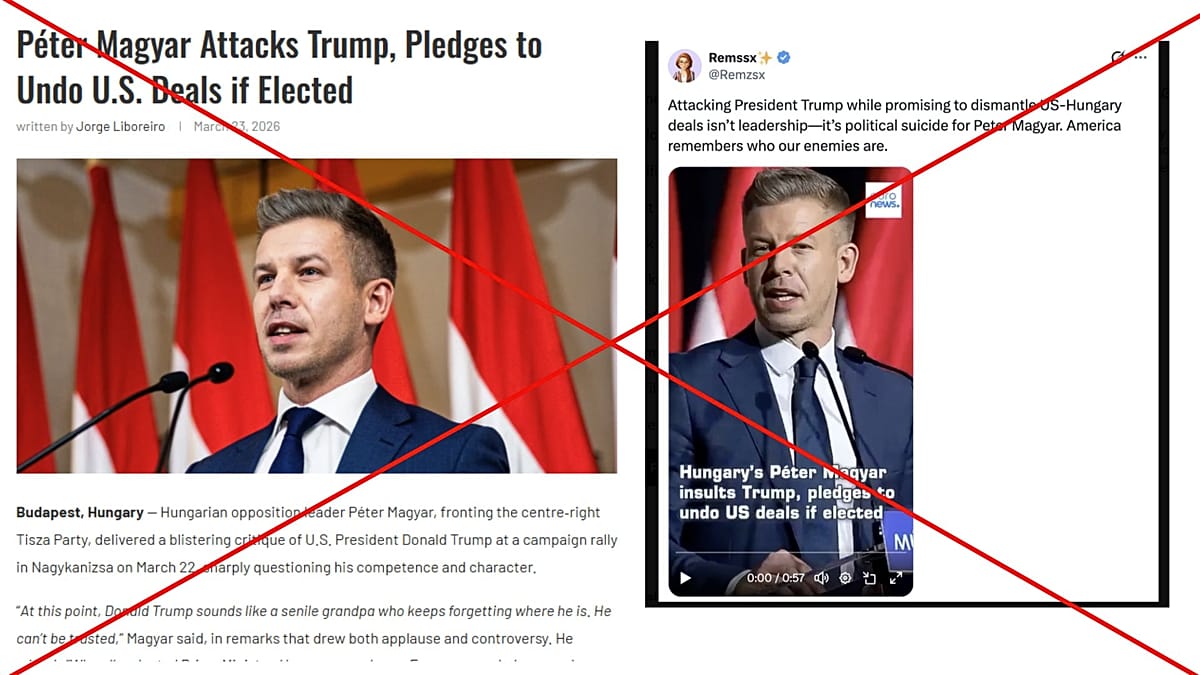

A fake Euronews-style article and website claiming that Hungary’s opposition leader Péter Magyar insulted Donald Trump is circulating online as part of a wider campaign researchers have linked to Storm-1516, a Russian disinformation operation.
The article, which utilises a real byline and appeared on a fake Euronews website that has since been taken down, claims that Magyar delivered a blistering critique of Trump at a campaign rally.
Among other false claims, the article says Magyar called Trump a “senile grandpa” and promised to undo “key agreements” made with the US, should Magyar win parliamentary elections in Hungary scheduled on 12 April.
The article’s contents are fabricated and the website it appeared on have no connection to Euronews.
A video report that repeats the claim using Euronews’ branding is also circulating on social media. The Cube, Euronews’ fact-checking team, found examples of this clip circulating since Monday evening, some with thousands of views.
The videos were posted by accounts with similar captions in quick succession, implying they are part of a coordinated campaign. The accounts that posted the clip were largely anonymised, with X’s location tool showing they are based in the US and Africa.
Researchers at Antibot for Navalny, a collective that tracks Russian bot networks online, told The Cube that the post was part of Storm-1516, a prolific Russian disinformation campaign that spreads claims online that further the interests of the Russian government.
The group are typically active during election campaigns, having spread false claims about Democratic Party candidates in the 2024 US presidential election and during Germany’s February 2025 elections.
In December, Germany’s Foreign Minister summoned the country’s Russian ambassador over allegations of repeated Russian hybrid attempts in Germany including allegations that Storm 1516 actively spread disinformation during the country’s general elections.
At the time, the campaign focused on Chancellor candidate for the Greens, Robert Habeck, and current German Chancellor Friedrich Merz.
Hungary’s upcoming parliamentary elections will see Magyar’s Tisza Party pitted against current Hungarian Prime Minister Viktor Orbán.
Magyar has accused Hungary’s secret service of targeting his party’s campaign systems just weeks before the election date in a hostile election campaign in which polls suggest his party is ahead.
Orbán, meanwhile, has become embroiled in scandal in Brussels after a Washington Post investigation revealed Foreign Minister Péter Szijjártó regularly leaked sensitive information from high-level European Union meetings to Moscow.
Orbán has maintained close ties to the Kremlin despite the resistance of other European leaders and has utilised Hungary’s veto power to block key decisions on European aid to Ukraine.