


Published on •Updated
The World Nomad Games may be over for another year but the impact of the event is likely to echo throughout Central Asia for some time.
After the grand opening at Kyrgyzstan’s Bishkek Arena, the games and more than 3,000 athletes from 110 nations moved to a lake-side venue in the Isyk Kul region, a popular tourist destination.
Traditional equestrian and archery skills filled every corner of the Kyrchyn Gorge, as competitors pitted their wits and strengths against each other, giving visitors a lookback in time travelling experience at an ancient style settlement.
Village people
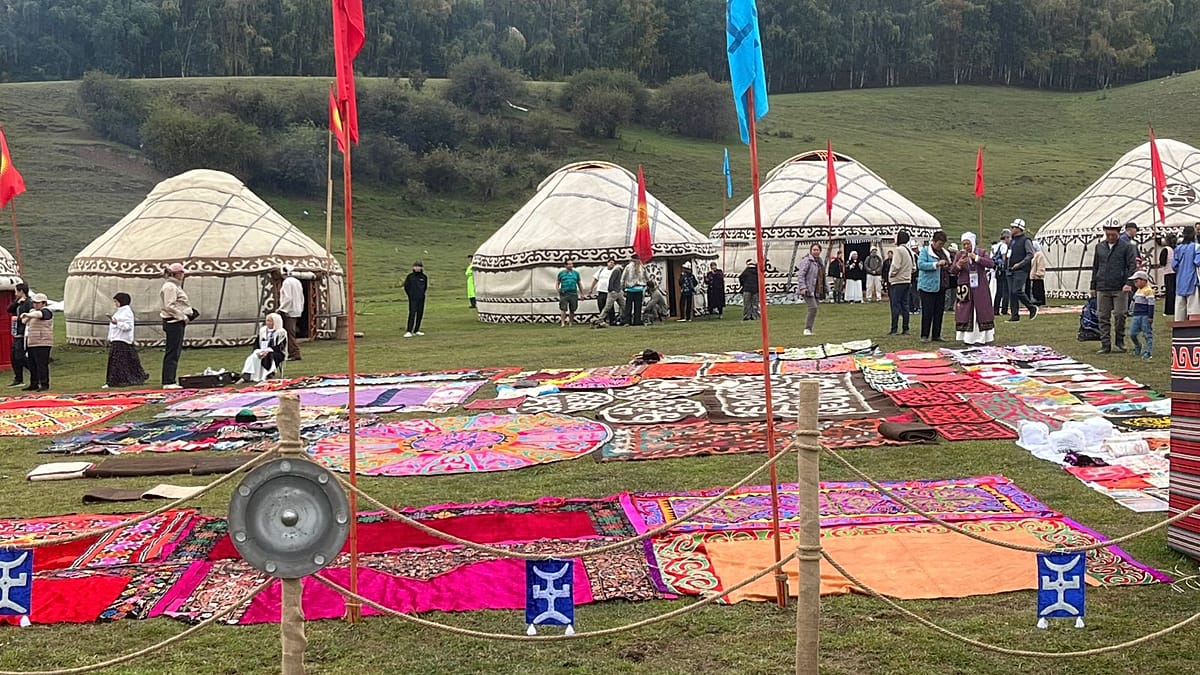
Each region of the Kyrgyz Republic built their own village by erecting age-old nomadic dwellings and yurts, all traditionally decorated.
Yurts – tent-like structures with wooden framework covered with felt, animal skins and heavy canvas – have been used by Asian nomadic tribes for millennia. A yurt houses a single nuclear family who can assemble and disassemble it in about half an hour, making it suitable for nomadic lifestyle.
Among the decorated yurts, people from all parts of Kyrgyzstan, dressed in traditional colourful costumes, displayed their works of folk art, alongside handicraft like embroidery and carpet-weaving.
During the first two days, more than 150,000 visitors were treated to traditional songs and folk tunes and offered the chance to taste national dishes often prepared right on the spot.
The attraction, named “The Universe of Nomads”, was opened with a theatrical performance on a hillside that included a dramatic village raid where horsemen and women amazed the crowds by showing off extremely impressive defensive riding skills.
At the opening, Kyrgyz Prime Minister Adylbek Kasymaliyev, said that the village would not be a one-off. The plan is for it to remain open as a tourist attraction and help educate visitors about the country’s past.
“We do not preserve the heritage of our ancestors only behind the museum glass – we are bringing it back into the people’s lives. We build yurts today – that is a living heritage,” said Kasymaliyev.
“We are raising shyrdaks, smelting metal, making horse tack – that is a living heritage. The craftsmanship of the father passes onto the son, the skills of the mother to the daughter,” he added.
Bone crush bonaza
Opposite the village, a reconstruction of an ancient fort houses a bazaar where one can enjoy the atmosphere of an ancient town bustling with activity and acrobats performing high jinks.
Right next to the fort, Nomad games athletes were engaged in archery and strength games, such as tug of war and arm-wrestling and the more unusual sport of bone crushing.
In this Mongolian and Central Asian popular game participants show their strength by breaking the back bones of animals (not live ones). It is frequent sight at festivals and folk fairs. This year, the Mongolian world champion managed to defend his title with 58 bones crushed in a minute.
Whille the World Nomad Games aim to promote nomadic heritage, culture and influence on different civilisations, they are usually accompanied by scientific and cultural events. This year, the highlight among dozens of such events was the International Scientific Conference “Nomadic Civilisations: Heritage, Paradigms and Prospects”.
“Nomadic civilisation represents a vast body of humanity’s historical experience, knowledge and cultural practices,” said Gylzat Isamatova, Kyrgystan’s Minister of High Education. “Today, its study is particularly relevant in the context of climate change, environmental challenges, the sustainable use of natural resources and the preservation of cultural heritage.”